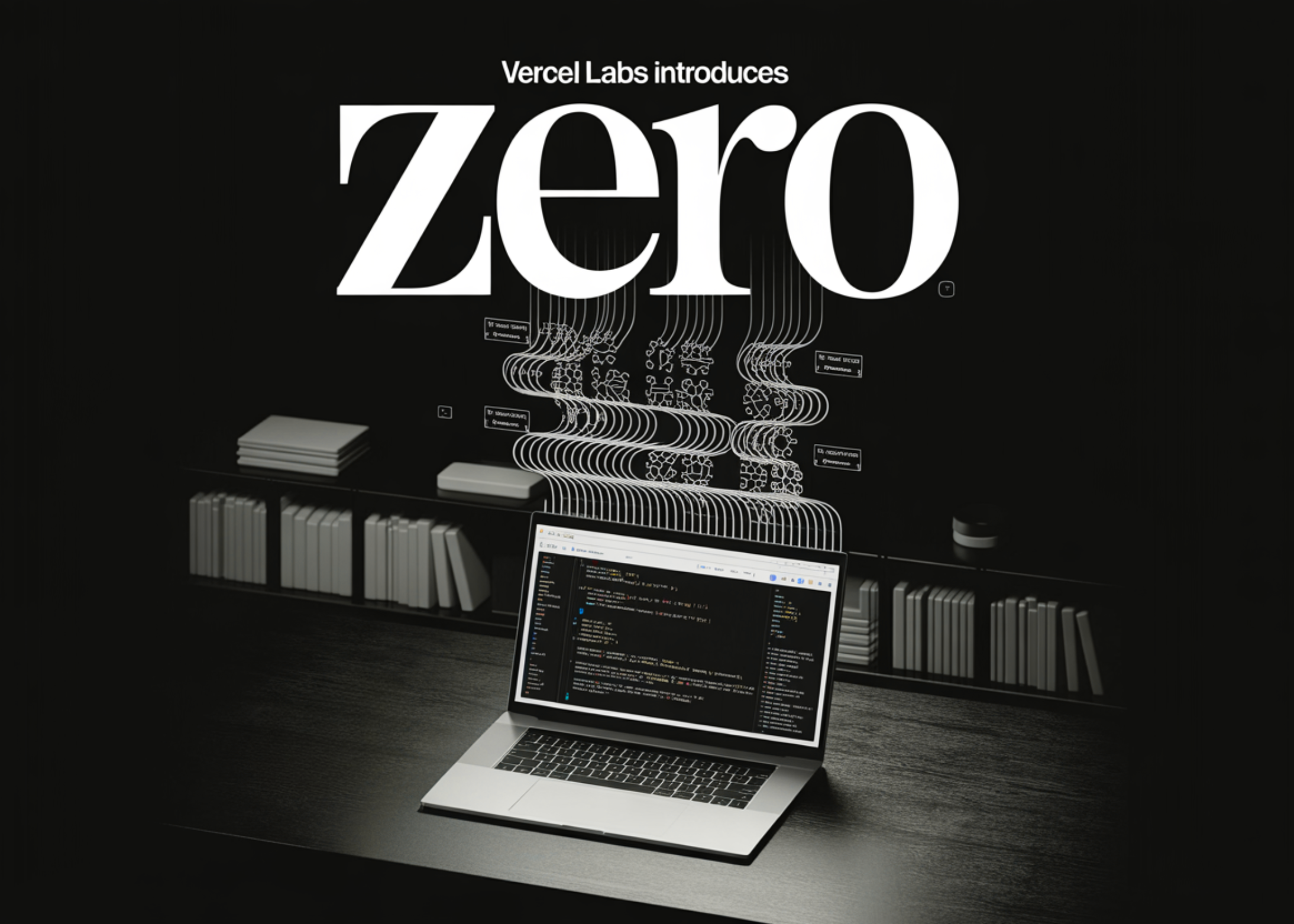
Most programming languages were designed for humans who read error messages, interpret warnings, and manually trace through stack output to fix bugs. AI agents do none of those things well. They work better with structured data: predictable tokens, stable codes, and machine-parseable repair hints. That gap is what Vercel Labs is trying to close by releasing Zero, an experimental systems language that is faster, smaller, and easier for agents to use and repair.
What is Zero Language
Zero is a systems programming language that sits in the same design space as C or Rust. It compiles to native executables, gives you explicit memory control, and targets low-level environments.
What separates Zero from existing systems languages is that its compiler output and toolchain were designed from day one to be consumed by AI agents, not just human engineers.
The Agent-First Toolchain
The core problem Zero addresses is how agents interact with compiler feedback. In a typical development loop involving a coding agent, the agent writes code, the compiler emits an error as unstructured text, and the agent has to parse that text to determine what went wrong and how to fix it. This is fragile — error message formats change, messages are written for human readers, and there’s no built-in concept of a ‘repair action.’
Zero’s CLI emits structured JSON diagnostics by default. When you run zero check --json, the output looks like:
{
  "ok": false,
  "diagnostics": [{
    "code": "NAM003",
    "message": "unknown identifier",
    "line": 3,
    "repair": { "id": "declare-missing-symbol" }
  }]
}
Each diagnostic carries a stable code (e.g., NAM003), a human-readable message, a line reference, and a repair object with a typed repair ID. Humans read the message. Agents read the code and repair. The same CLI command surfaces both — there is no separate mode or secondary tool to run.
The toolchain is unified into one binary: zero check, zero run, zero build, zero graph, zero size, zero routes, zero skills, zero explain, zero fix, and zero doctor are all subcommands of the same CLI. This matters for agentic workflows because agents don’t need to reason about which tool to invoke for which task.
Two subcommands are particularly relevant to the repair loop. zero explain <diagnostic-code> returns a detailed explanation of a given diagnostic code, so an agent can look up NAM003 without parsing prose documentation. zero fix --plan --json <file-or-package> emits a structured fix plan — a machine-readable description of what changes to make to resolve a diagnostic — rather than requiring the agent to infer the fix from the error message alone.
zero skills serves a different purpose: it provides version-matched agent guidance directly through the CLI. Running zero skills get zero --full returns focused workflows covering Zero syntax, diagnostics, builds, packages, standard library use, testing, and agent edit loops — all matched to the installed compiler version. This is notable because it means agents working with Zero don’t need to scrape external documentation that may be out of sync with the compiler they’re actually running.
Explicit Effects and Capability-Based I/O
One of Zero’s core design decisions is that effects are explicit in function signatures. If a function writes to standard output, accesses the filesystem, or makes a network call, it must declare that through a capability object.
The canonical entry point in Zero looks like this:
pub fun main(world: World) -> Void raises {
  check world.out.write("hello from zeron")
}
The world: World parameter is the capability object that grants access to the outside world. A function that doesn’t receive World (or a capability derived from it) cannot perform I/O — the compiler enforces this at compile time, not at runtime. There is no hidden global process object.
The check keyword handles fallible operations. If world.out.write(...) can fail, check surfaces that failure along the call stack. The raises annotation on main signals that the function can propagate errors — making error paths visible in signatures rather than buried in runtime exceptions.
Getting Started
Installation requires one command:
curl -fsSL https://zerolang.ai/install.sh | bash
export PATH="$HOME/.zero/bin:$PATH"
zero --version
The installer downloads the latest binary from the GitHub release and places it in $HOME/.zero/bin/zero. Packages are defined with a zero.json manifest and source files under src/, initialized with zero new cli <name>.
A VS Code extension for .0 file syntax highlighting ships in the repository under extensions/vscode/.
Marktechpost’s Visual Explainer
Key Takeaways
- Zero is an experimental systems language from Vercel Labs that compiles to sub-10 KiB native binaries and is designed for AI agent workflows.
- Its compiler emits JSON diagnostics with stable codes and typed
repairmetadata, so agents can parse and act on errors without interpreting human-readable text. zero explainandzero fix --plan --jsongive agents structured access to diagnostic explanations and machine-readable fix plans — no prose parsing required.- Effects are explicit in function signatures via capability-based I/O — functions must declare what they access, and the compiler enforces this at compile time.
- The language has no mandatory GC, no hidden allocator, no implicit async, and no magic globals — making memory and control flow predictable.
- Zero is currently experimental (v0.1.1, Apache-2.0)
Check out the GitHub Repo and Project Page. Also, feel free to follow us on Twitter and don’t forget to join our 150k+ ML SubReddit and Subscribe to our Newsletter. Wait! are you on telegram? now you can join us on telegram as well.
Need to partner with us for promoting your GitHub Repo OR Hugging Face Page OR Product Release OR Webinar etc.? Connect with us
The post Vercel Labs Introduces Zero, a Systems Programming Language Designed So AI Agents Can Read, Repair, and Ship Native Programs appeared first on MarkTechPost.