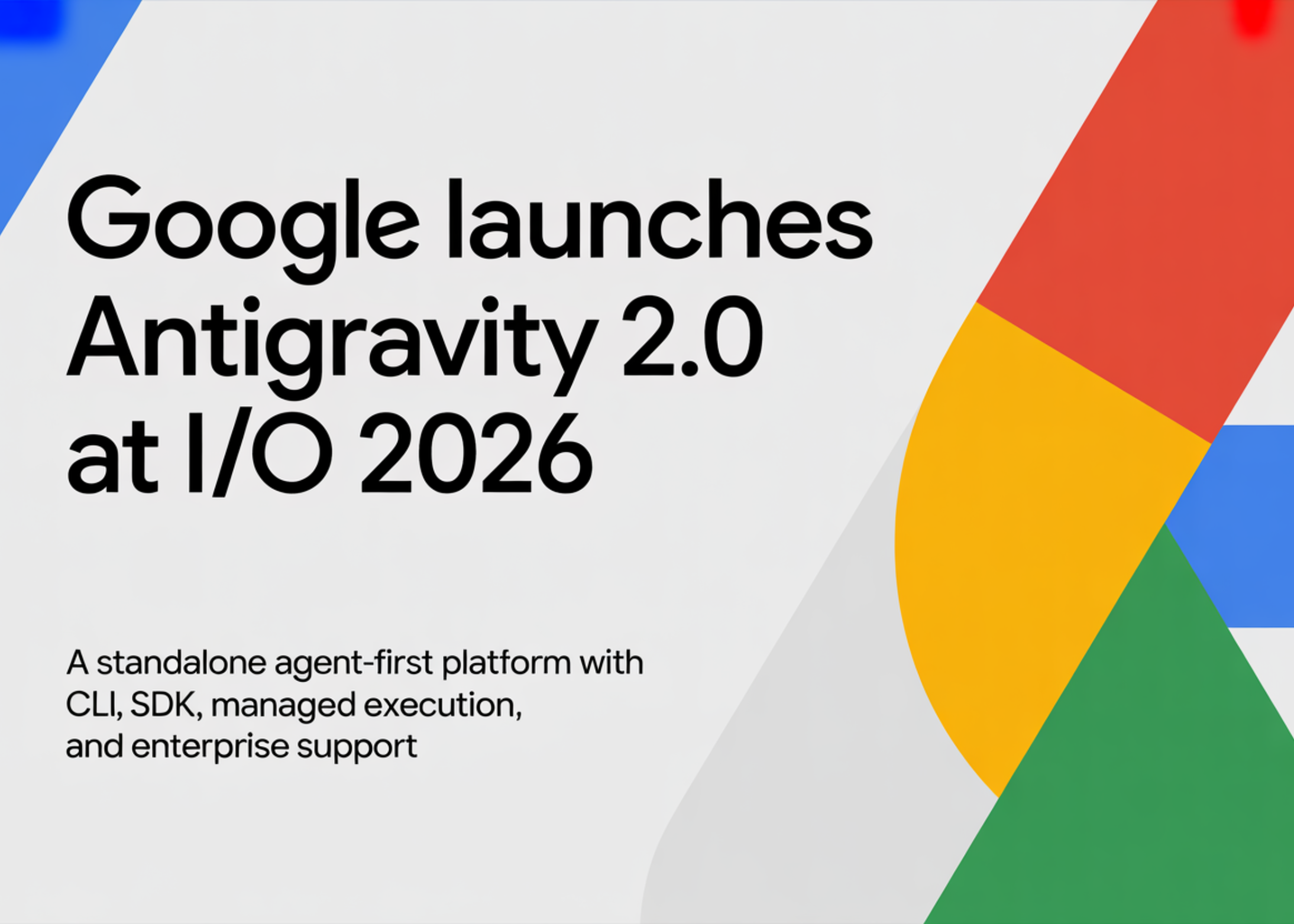
Google used its I/O 2026 developer keynote to ship a meaningful architectural shift in how it packages AI-assisted development. The company announced Google Antigravity 2.0 — a standalone desktop application built entirely around agent orchestration alongside an Antigravity CLI, an Antigravity SDK, Managed Agents in the Gemini API, and enterprise support through the Gemini Enterprise Agent Platform. So, basically Google is moving its developer tooling away from IDE-centric assistance and toward multi-agent workflow management as the primary abstraction.
What is Antigravity 2.0
Google Antigravity is the agent-first development platform for taking an idea and turning it into a production-ready app. Version 2.0 is a new standalone desktop application, separate from the existing Antigravity IDE, designed fully around an agent-optimized experience. It acts as a base for agent interaction, allowing developers to orchestrate multiple agents and execute tasks in parallel. The application also features dynamic subagents for parallelized workflows, scheduled tasks for background automation, and ecosystem integrations across Google AI Studio, Android, and Firebase.
The scheduled tasks capability is practically significant: rather than manually prompting an agent each time, developers can define tasks that invoke agents automatically in the background — converting the agent from a single-turn tool into something closer to a persistent automation pipeline. Google also added native voice command support to Antigravity, consistent with similar additions to consumer products like Gmail and Docs.
The New Ecosystem: CLI, SDK, Enterprise, and Managed Agents
Beyond the desktop app, Google is releasing four additional surfaces that together form a unified developer harness.
The Antigravity CLI is focused at developers who prefer terminal-based workflows. It delivers a lightweight, high-velocity surface for creating new agents without a graphical user interface. Critically, it shares the same agent harness as Antigravity 2.0, meaning all future improvements to core agents are automatically applied across both surfaces. The Antigravity CLI fully replaces the Gemini CLI. For developers migrating, Antigravity CLI preserves the most critical Gemini CLI features: Agent Skills, Hooks, Subagents, and Extensions — the last of which are now rebranded as Antigravity plugins.
The Antigravity SDK provides programmatic access to the same agent harness that powers Google’s own products. Optimized for Gemini models, it lets developers define custom agent behaviors and host them on their infrastructure of choice — relevant for engineering teams that want to embed Antigravity-style agents inside their own products or internal tooling.
Antigravity in the Gemini Enterprise Agent Platform addresses organizational use cases by simplifying enterprise workloads and allowing Google Cloud customers to connect Antigravity directly to Google Cloud projects. This is the enterprise-facing deployment path for teams that need to operate agents within their existing cloud infrastructure.
The Managed Agents feature in the Gemini API provides infrastructure-level isolation for agent execution. With a single API call, developers can spin up an agent that reasons, uses tools, and executes code in an isolated Linux environment. Managed Agents are powered by the Antigravity agent harness, built on Gemini 3.5 Flash, and available via the Interactions API and in Google AI Studio. Three capabilities define this feature: first, the agent harness itself — the same technology and infrastructure that powers Google’s own agents, co-optimized with Gemini 3.5 Flash. Second, persistent isolated environments — each interaction creates an environment that can be resumed in follow-up calls with all files and state intact, enabling seamless multi-turn sessions without reinitializing context. Third, custom agent definitions — developers can extend the Antigravity agent with custom instructions and skills using markdown files, with new custom agent templates available in the Google AI Studio Playground to get started quickly.
Gemini 3.5 Flash as the Default Model
Underpinning the entire ecosystem is Gemini 3.5 Flash, which Google is setting as the default model across Antigravity. According to Google team, 3.5 Flash outperforms Gemini 3.1 Pro across almost all benchmarks while running four times faster than other frontier models. The speed advantage being practically significant when multiple agents are running in parallel, since model latency compounds across concurrent agent calls.
AI Studio: Mobile, Workspace, Android, and Google Play
Google is substantially expanding where developers can start and continue their work. A new Google AI Studio mobile app is available to pre-register this week, letting developers capture ideas on the go and have a working prototype ready when they return to their desktop. Through a new Export to Antigravity integration, entire projects can be moved from AI Studio to local Antigravity development with a single click, including all project context.
A new Workspace integration means agents can now natively call relevant Google Workspace APIs and embed them directly into applications — useful for any workflow that needs to interact with Google Docs, Sheets, Calendar, or other Workspace services programmatically.
Native Android support has been added, allowing developers to build Android apps with just a prompt. Google is also introducing support for the Google Play Console directly in Google AI Studio, enabling developers to publish apps to the test track without leaving the Studio environment.
Google is introducing a new $100/month AI Ultra plan offering 5x higher usage limits in Antigravity compared to the existing Google AI Pro plan.
Key Takeaways
- Google Antigravity 2.0 is a standalone agent-first desktop app — no IDE, just parallel agents, scheduled tasks, and subagent workflows running in the background.
- Managed Agents in the Gemini API spins up a full isolated Linux environment with a single API call, with persistent state across multi-turn sessions.
- Antigravity SDK + Enterprise Agent Platform gives teams a path to deploy custom Gemini-optimized agents on their own infrastructure or directly inside Google Cloud projects.
Check out the Technical details and Try it here. Also, feel free to follow us on Twitter and don’t forget to join our 150k+ ML SubReddit and Subscribe to our Newsletter. Wait! are you on telegram? now you can join us on telegram as well.
Need to partner with us for promoting your GitHub Repo OR Hugging Face Page OR Product Release OR Webinar etc.? Connect with us
The post Google Launches Antigravity 2.0 at I/O 2026: A Standalone Agent-First Platform with CLI, SDK, Managed Execution, and Enterprise Support appeared first on MarkTechPost.


