
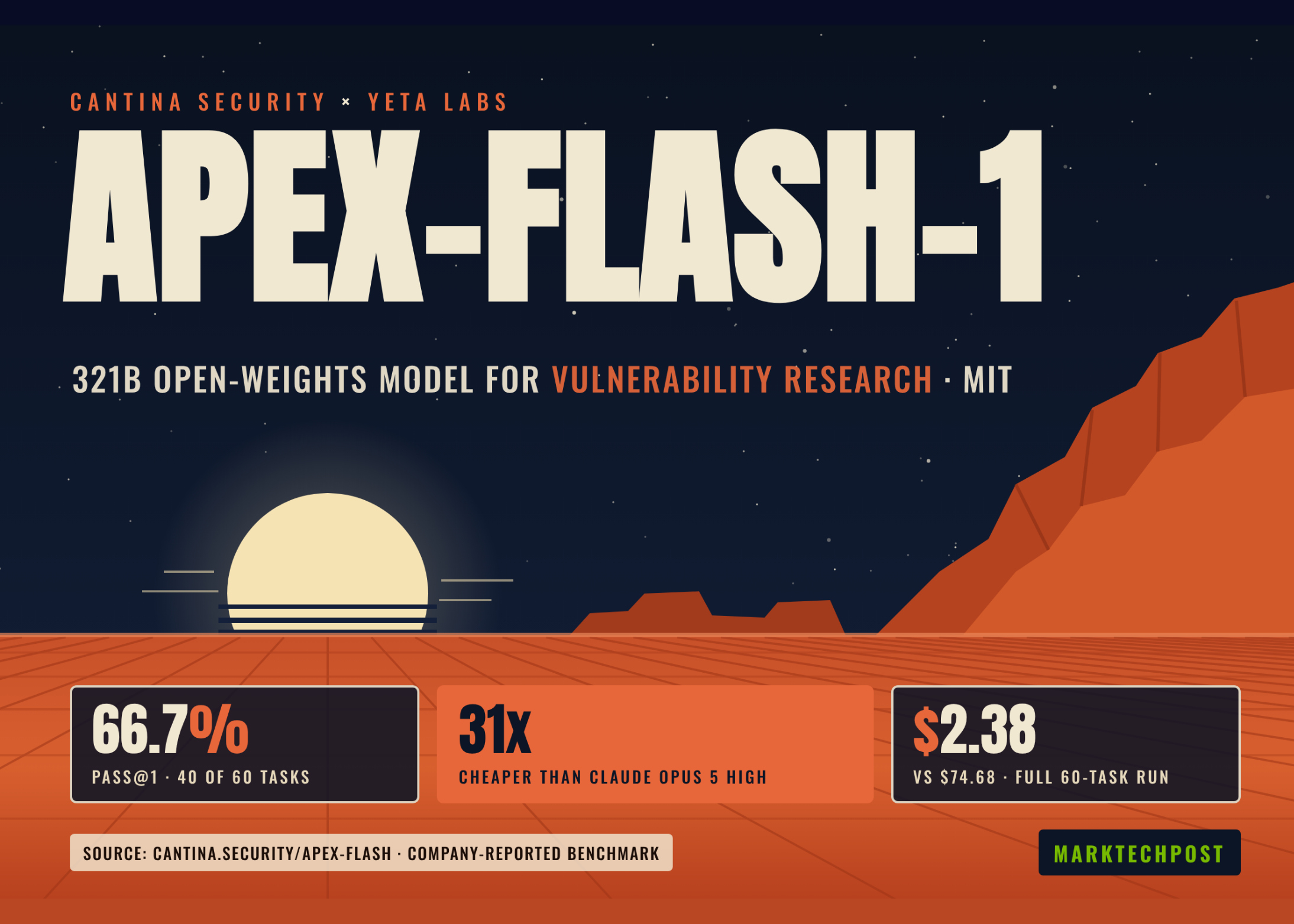
Cantina Security, with Yeta Labs, has released apex-flash-1, an open-weights model trained specifically for vulnerability research. It is a reinforcement learning fine-tune of Z.ai’s GLM-5.3-Flash, released on Hugging Face under the MIT license.
Is it deployable? Yes, the MIT weights serve on vLLM, SGLang or Transformers, but BF16 needs roughly 640 GB of GPU memory.
What Cantina Built
apex-flash-1 has 321.3B total parameters, per its Hugging Face safetensors metadata. The GLM-5.3-Flash base is a Mixture-of-Experts model with 18B active parameters.
Cantina trained it with GRPO using a rank-256 LoRA plus selective full-parameter training. The data covers 150 tasks built from 50 real vulnerability cases.
Each case appears in 3 variants: guided whitebox, focused whitebox and focused blackbox.
Authorization, identity and scope flaws make up 72% of cases. Accounting and numerical precision bugs add 18%. Time validation, business rules and SSRF cover the rest.
As per the model card on HF, RL rollouts ran inside the Codex agent harness on production-like software and protocol environments.
Benchmark Results
Cantina evaluated 60 tasks from 20 held-out vulnerability cases. Each model ran the set once, with costs estimated from provider pricing.
- apex-flash-1: 40/60 solved (66.7% pass@1), about $2.38
- GLM-5.3-Flash (base): 36/60 solved (60.0%), about $4.56
- Claude Opus 5 High: 43/60 solved (71.7%), about $74.68
Opus solved 3 more tasks but cost about 31x more per run. That is roughly $0.06 per solved task for apex-flash-1 versus $1.74 for Opus. These are company-reported numbers on an internal benchmark.
A Worker Model, Not an Orchestrator
Cantina positions apex-flash-1 as a worker orchestrated by a larger model. The card lists code reading, tool use, exploit development and verification as target skills.
An experimental apex-flash-1-abliterated variant ships with modified refusal behavior. It was not separately evaluated.
Cantina’s rationale is that defenders need capable models they can run and control locally.
Interactive Explainer
How It Compares
| Feature | apex-flash-1 | Aikido Altar-1 | Cisco Foundation-Sec-8B-Reasoning | GLM-5.3-Flash |
|---|---|---|---|---|
| Developer | Cantina Security + Yeta Labs | Aikido Security | Cisco Foundation AI | Z.ai |
| Base model | GLM-5.3-Flash | GLM-5.3 (pruned) | Llama 3.1 8B | Own pretraining |
| Size | 321.3B total, BF16 | 328 GB, INT4 (W4A16) | 8B | 320B total, 18B active |
| License | MIT | Inherits GLM-5.3 license | Custom (see NOTICE.md) | MIT |
| Security method | GRPO RL on 50 real vulnerability cases | Expert pruning (REAP) + quantization | Instruction tuning + RLHF on security QA | General-purpose base |
| Primary use | Agentic vuln research worker | Air-gapped autonomous pentesting | SOC triage and threat defense | General coding and agents |
| Hardware | Multi-GPU node (~642 GB BF16 weights) | 4x H200 with vLLM | Single GPU | Multi-GPU node |
| Published security result | 66.7% pass@1, 60 tasks | 60.4% recall, 32-CVE internal set | Cisco-reported security benchmarks | 60.0% on Cantina’s set |
Sources: Cantina, Aikido, Cisco, Hugging Face model cards. © Marktechpost
Key Takeaways
- apex-flash-1 is a 321.3B open-weights security model under MIT.
- GRPO training on 50 real vulnerability cases produced 150 tasks.
- It scored 66.7% pass@1 versus 71.7% for Claude Opus 5 High.
- Its 60-task run cost about $2.38 versus $74.68 for Opus.
- BF16 needs a multi-GPU node; community 4-bit ports exist.
Check out the Technical details. All credit goes to the researcher of this project. Also, feel free to follow us on Twitter and don’t forget to join our 150k+ML SubReddit and Subscribe to our Newsletter. Wait! are you on telegram? now you can join us on telegram as well.
Need to partner with us for promoting your GitHub Repo OR Hugging Face Page OR Product Release OR Webinar etc.? Connect with us
The post Can an Open Model Do Security Research? Cantina’s apex-flash-1 Solves 40 of 60 Held-Out Bug Tasks appeared first on MarkTechPost.