

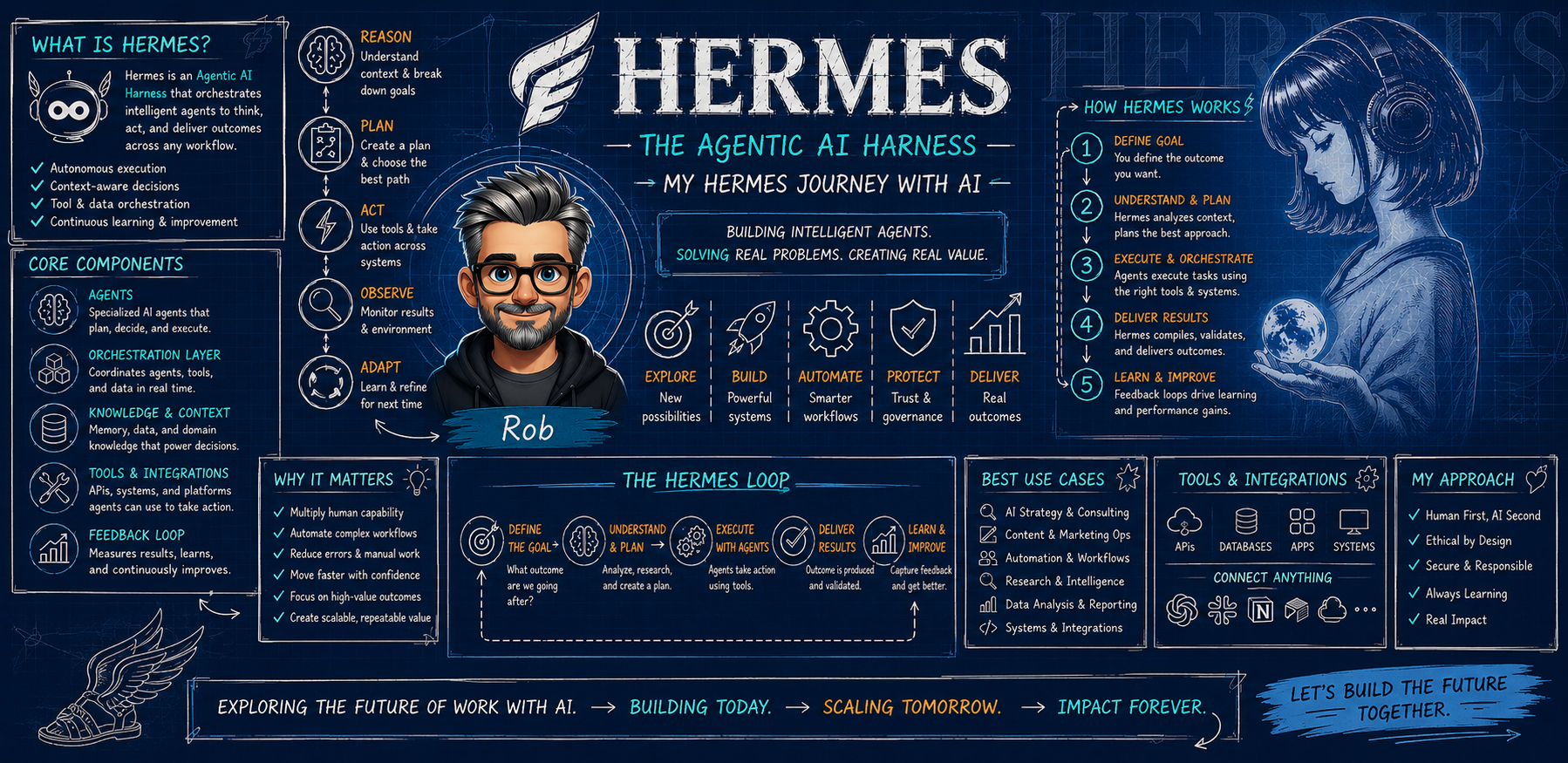
Bot Mode Changed the Question: Not What Can AI Do, But Who Should Be in the Room?
Fifth in the Hermes Journey series.
Summary: The next step in my Hermes Journey was not a smarter single assistant. It was learning how different bots, roles, routines, and rooms could make AI feel less like a tool and more like a practical operating team.
Practical takeaway: Multiple bots are useful when they represent different responsibilities, not when they become a noisy panel of generic opinions.
When people ask what changed with the latest version of Hermes, the feature that gets the most attention is Bot Mode. I understand why. It sounds like the kind of thing that belongs in an AI demo: multiple bots, group rooms, named assistants, different profiles, and even bot-to-bot interaction.
But the practical question is not, “Can I put several AI agents in a room?” The better question is, “Who belongs in the room, and what job does each one have?” That is where the feature starts to matter for me.
For most of my AI journey, Storm was the center of the system. Storm remembered context, helped me close loops, worked across tools, watched for recurring tasks, and became the operating layer between my intentions and the growing number of places where work actually happens. That alone was a big shift. A single dependable assistant is already different from a chatbot you open when you remember to ask it something.
But as the system grew, I started running into a familiar business problem: one person, or one assistant, should not be every role. The same voice that helps me decide a client follow-up should not necessarily be the same voice that reviews a newsletter, researches a theological archive, drafts a product page, and audits a broken dashboard. Those jobs have different standards. They need different memories, different boundaries, and sometimes different personalities.
That is why Bot Mode feels important. Not because it gives me more AI. I already had plenty of AI. It gives me a cleaner way to organize responsibility.
In a normal business, you would not ask one employee to be the strategist, copy editor, compliance reviewer, systems engineer, and customer success lead in the same breath. You might have a small team, or at least a few hats that are clearly named. Bot Mode brings that same idea into an AI operations system. Storm can remain the orchestrator. Molly can help with public voice and content. Victor can focus on prospecting and business development workflows. Watchmen can live in a research-heavy lane with its own source library and citation discipline.
The value is not that these bots can all talk. The value is that they can bring different defaults into the conversation.
That matters because defaults are where AI systems quietly succeed or fail. If an assistant defaults to speed, it may skip verification. If it defaults to creativity, it may overstate. If it defaults to caution, it may never ship. If it defaults to technical language, it may lose the very audience I am trying to serve. Giving different bots different roles is a way of making those defaults visible instead of pretending one general-purpose personality can do everything well.
The group room idea is interesting for the same reason. A group room should not be a novelty where every bot talks just because it can. It should be a working meeting. If I am planning a public article, I might want Molly to shape the voice, Storm to check chronology and safety, and a reality-checking reviewer to flag claims that sound more certain than they are. If I am planning an offer for small businesses, I might want strategy, operations, and plain-language customer empathy in the same room.
That is closer to how I work with people. The best meetings are not loud. They are structured. The right people are in the room. The wrong people are not. Everyone knows why they are there.
This is also where human leadership still matters. More bots does not remove the need for judgment. In some ways it increases it. If I create a room with five assistants and no clear purpose, I have not built a team. I have built a committee. The system needs a human to decide the outcome, approve the next step, and keep the room from drifting into interesting but unhelpful conversation.
That is the pattern I keep coming back to in this whole Hermes Journey: the technology becomes useful when the workflow gives it shape.
A single chatbot waits for a prompt. A practical assistant system has memory, roles, routines, escalation paths, and approval boundaries. Bot Mode is another step in that direction. It is not just a new interface. It is a way of saying that AI work is becoming less about isolated prompts and more about designing the operating model around them.
For a small business owner or consultant, that is the lesson I would take from this. Do not start by asking how many AI tools you can add. Start by naming the roles you wish you had more consistently covered. Who keeps track of follow-ups? Who turns meeting notes into next actions? Who checks whether the draft sounds like you? Who catches the risky thing before it goes out? Who watches for the recurring task you always forget until it is urgent?
Those are not tool questions. They are operating questions.
The promise of multiple bots is not that your computer suddenly becomes a company. The promise is that you can stop treating every AI interaction as a blank page. You can give the work a place to live, give the assistants a job to do, and give yourself a clearer way to stay in charge.
The discipline is in letting a bot pass when it does not have a useful role. That may sound like a small design detail, but it is a big operational idea. In human meetings, we value people who know when to contribute and when to let the work move. AI rooms need that same etiquette, or multiple bots become just another source of interruption.
I also think this is where non-technical leaders can start to see AI differently. The goal is not to become an AI operator all day. The goal is to create a few dependable rooms for recurring decisions: content review, client follow-up, weekly planning, research triage, and product development. Each room should have a purpose, a small roster, and a clear human decision at the end.
Follow the Hermes Journey
I am writing these field notes for consultants, owners, and team leaders who want practical AI adoption without pretending the messy parts do not exist. If you are building toward a real assistant, workflow, or approval system of your own, follow the series at the Hermes Journey page or reach out and let’s talk about what would actually fit the way you work.