The science of optimal decisions — and how leading organizations are applying it.
Every enterprise faces decisions that are too complex for intuition or manual decision-making alone. Which delivery routes minimize cost while meeting next-day promises? How should hundreds of robots sequence movements across a factory floor without collision? How do you staff a 24/7 healthcare operation fairly, compliantly, and efficiently?
These are problems where the stakes are high, the options are near-infinite, and the wrong choice is expensive. They also share a common trait: the number of possible solutions is so vast that no human — and no simple rule — can reliably find the best one.
Enterprises need AI that decides with mathematical certainty.
Leading organizations are increasingly turning to mathematical optimization, a specialized subfield of AI complementary to machine learning, to navigate that complexity and find answers that measurably outperform the status quo. Applying it well requires deep scientific expertise — and infrastructure that scales.
A team of specialized scientists with the AWS Generative AI Innovation Center does exactly this work — solving customers’ most challenging, high-impact problems through scientific innovation. Working backwards from customer needs, the team combines expertise in AI, mathematical modeling, optimization, quantum computing, and high-performance computing to deliver measurable business outcomes, all powered by AWS cloud services.
In this post, we introduce mathematical optimization, explain how it fits within the broader AI landscape, and showcase real-world success stories where the Innovation Center has partnered with customers to deliver concrete results.
Where optimization fits in the AI landscape
Mathematical optimization is the science of finding the best possible decision from a vast set of alternatives, subject to real-world constraints. At its core, it’s prescriptive analytics — it doesn’t just tell you what happened (descriptive) or what might happen (predictive). It tells you what you should do to achieve your goals, given your constraints and objectives.
If machine learning is inductive AI — learning patterns from many examples to make probabilistic predictions — mathematical optimization is deductive AI. It applies mathematical principles to specific business problems and delivers definitive, provably optimal decisions.
| Mathematical Optimization | Machine Learning | |
| Approach | Deductive AI: Applies general principles to specific problems | Inductive AI: Learns patterns from many specific examples |
| Output | Definitive optimal decisions | Probabilistic predictions |
| Strength | Exact reasoning over hard constraints and long horizons | Pattern recognition in unstructured data |
Most enterprise AI is probabilistic — it learns patterns and gives you a likely answer. For pattern recognition tasks, that works. But operational decisions with hard constraints — regulatory compliance, physical capacity limits, time windows — need definitive answers, not confident approximations.
Optimization finds the mathematically best solution within those constraints. “This route is probably efficient” becomes “this is the optimal route given every constraint in your system.”
The Fidelity Center for Applied Technology (FCAT®) saw this gap firsthand. The team’s ML models already delivered strong predictive performance for investment decisions and risk management, but they wanted to ensure that these models were interpretable in addition to their underlying accuracy. FCAT collaborated with the Innovation Center to build optimization techniques that incorporate explainability directly into model construction, rather than trying to explain a black box after the fact. The result: compliant AI with no sacrifice in predictive performance, plus reusable frameworks for ongoing development.
Rather than competing, mathematical optimization and ML form powerful predict-then-optimize pipelines: machine learning models forecast demand or predict failures, and optimization uses those predictions to make the best possible decisions. Just as automated reasoning in Amazon Bedrock Guardrails constrains generative AI to factual outputs, optimization constrains decision-making to provably valid ones.
Consider Amazon’s EU logistics network: 90 warehouses, 34 sort centers, 242 distribution stations, and over 11,000 paths. ML models predict demand patterns across this network. But deciding when trucks should depart — while satisfying shift, capacity, and spacing constraints — requires optimization. The Innovation Center developed two complementary optimization approaches that delivered +20 to +50 basis point improvements in next-day coverage, translating to tens of millions of dollars in business value.
Both mathematical optimization and ML run on data, benefit from advances in cloud computing and hardware, and are rooted in deep mathematics. Together, they represent how science, data, and cloud infrastructure solve complex business problems at scale.
How it works
The Innovation Center approaches every optimization challenge with a consistent four-step framework:
- Discover — Work with the customer to identify high-impact optimization opportunities, survey existing approaches and state-of-the-art methods, and define clear objectives and measurable success criteria.
- Model — Build a mathematical representation of the business problem, capturing objectives (what to optimize), decision variables (what can be controlled), and constraints (what limits exist). A well-constructed model transforms a vague business challenge into a precise, solvable formulation.
- Solve — Design or configure the right algorithmic approach for the problem’s size and structure — from exact methods like constraint programming and mixed-integer programming, to metaheuristics like genetic algorithms, to custom heuristics tailored to the specific problem.
- Architect — Leverage AWS services to design cloud infrastructure that scales, integrates with existing systems, and delivers results within operational time windows.
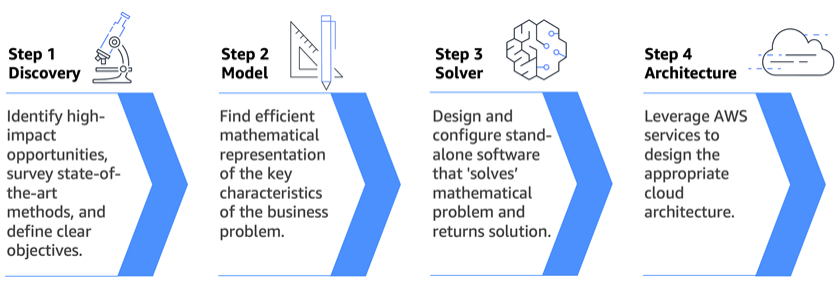
Figure 1: The optimization workflow
To see what this looks like in practice: BMW Group, a large automotive company headquartered in Germany, uses hundreds of robots per plant to apply sealant to car chassis seams for waterproofing and corrosion protection. Figuring out the optimal sequence for each robot’s path — which seam to hit next, in what direction, with which tool — has more possible combinations than any human or simple rule can evaluate.
The Innovation Center followed this framework to discover the sequencing bottleneck, model the problem as a combinatorial optimization over robot paths and tool changes, solve it with custom algorithms tuned to the problem’s structure, and architect a reusable solution BMW can now apply to any sequencing challenge across their manufacturing operations. The result: up to 10% improvement in robot cycle time per car body.
From problems solved to reusable solutions
The best solutions produce reusable methodology, not just one-time results. Two customer challenges illustrate how solving a specific problem well can yield something broader.
Delivery Hero — Middle-mile logistics. Delivery Hero, a leader in food delivery and quick commerce, moves 50–150 pallets of groceries daily from distribution centers to neighborhood fulfillment centers across dense urban environments, with shifting destinations and strict time windows. This was planned manually. The Innovation Center built an automated vehicle routing solution on AWS that demonstrated the potential for up to 24% savings in middle-mile planning costs across multiple sectors, while improving replenishment reliability and reducing delivery delays.
Australian Red Cross Lifeblood — Workforce scheduling. The Australian Red Cross Lifeblood (Lifeblood) is an Australian non-profit collecting more than 1.6 million blood donations in 2023 (up 600,000 from 2022). Collecting blood donations would not be possible without the thousands of Lifeblood nurses across about 100 donor centers. However, ensuring that the donor centers are staffed with the appropriate number of nurses with the right level of expertise while considering other real-world factors is a hard combinatorial optimization problem. The Innovation Center formulated the full industrial-scale optimization problem as a constraint programming model and then used the state-of-the-art CP-SAT solver and using synthetic data, demonstrated a theoretical cost reduction of 7% – and a cost reduction of 46% when doubling the supply.
The methodologies proven in these projects are now available as accelerated solutions to new customers:
- Route Optimization and Dispatch Solution (ROaDS): Born from the Delivery Hero work — a configurable framework for vehicle routing, logistics optimization, and field services planning. It encodes proven solution patterns into components that accelerate time-to-value.
- Workforce Intelligence and Scheduling Engine (WISE): Built on the Lifeblood methodology — a configurable foundation for workforce scheduling and rostering across industries. It provides a robust starting point that can be tailored to each organization’s unique constraints.
Both give customers full ownership and the flexibility to customize — reducing the path to production while addressing each organization’s specific objectives.
Partner with the AWS Generative AI Innovation Center
Mathematical optimization turns complex operational decisions into competitive advantages — 10% production efficiency gains, 24% logistics cost reductions, tens of millions in incremental revenue from improved delivery coverage. From routing to scheduling to network design, the team brings the scientific depth and AWS expertise to deliver. If you’re exploring your first optimization use case or scaling an enterprise-wide capability, contact your AWS account team to start a conversation about your workflows, your data, and your business outcomes.