

We’re in the midst of a fundamental shift in how software gets built and used. AI agents are moving beyond assistants that wait for instructions. They call APIs, access MCP servers, coordinate with other agents, and complete complex multi-step tasks on behalf of users. As agents take on increasingly diverse tasks, the ecosystem around them is expanding just as fast to meet that demand.
Looking further ahead, services, tools, and content must be designed for humans and agents. Agents will discover, evaluate, and pay for resources when they need, all within a single execution loop. The services that support them must be priced and consumed in that way: fractions of a cent per call, billed in real time. Early protocols like x402, ACP, MPP, and AP2 are pioneering what this looks like, and teams are experimenting with payment-enabled agents. The building blocks are emerging, but the agentic economy is still in its earliest days, and the infrastructure to support it at scale doesn’t exist yet. For developers who want to get ahead of this, the path has been hard. You’d wire up bespoke billing relationships with every service provider, manage credentials securely, enforce spending governance, navigate compliance requirements, and write orchestration logic across a fragmented landscape. That’s months of engineering effort, and the stakes are high: a misconfigured payment flow doesn’t just produce a bad answer, it moves real money.
Today, we’re announcing Amazon Bedrock AgentCore Payments (preview), a new set of features in Amazon Bedrock AgentCore, enabling AI agents to instantly access and pay for what they use, such as web content, APIs, MCP servers, and other agents. We’ve built these capabilities in partnership with Coinbase and Stripe, who are providing the wallet infrastructure and payment rails that power the first set of capabilities.
AgentCore is the platform to build, connect, and optimize agents at scale, with security enforced at the infrastructure layer that agents can’t bypass. Developers from companies like Cox Automotive, Thomson Reuters, and PGA TOUR already use AgentCore to build agents that reason, plan, and act across complex workflows. With today’s announcement, those agents can also transact, using the same identity system, agent gateway, and observability they already rely on. Amazon Bedrock AgentCore Payment isn’t a bolted-on module, it’s native to the platform that the agent is built on, governed by the same controls as every other action the agent takes.
The first managed end-to-end payment capabilities for agents
This marks the first managed payment capabilities purpose-built for autonomous agents, spanning the full lifecycle from wallet authentication through transaction execution to spending governance and observability, so developers can focus on what their agents do, not on how they pay.
With these capabilities, developers can build agents that can reach any resource that they need, paid or at no cost, without wiring up each billing relationship by hand. A financial research agent can dynamically access real-time market data feeds and paywalled publications, paying for the articles and data points it uses on behalf of the end user. A coding agent can call specialized APIs and paid MCP servers as it needs them, whether that’s a private package registry, a sandboxed execution environment, or a niche third-party agent that handles one thing well. As the market matures, agents can handle commercial transactions: book flights, reserve hotels, and complete purchases on behalf of users across merchant platforms.
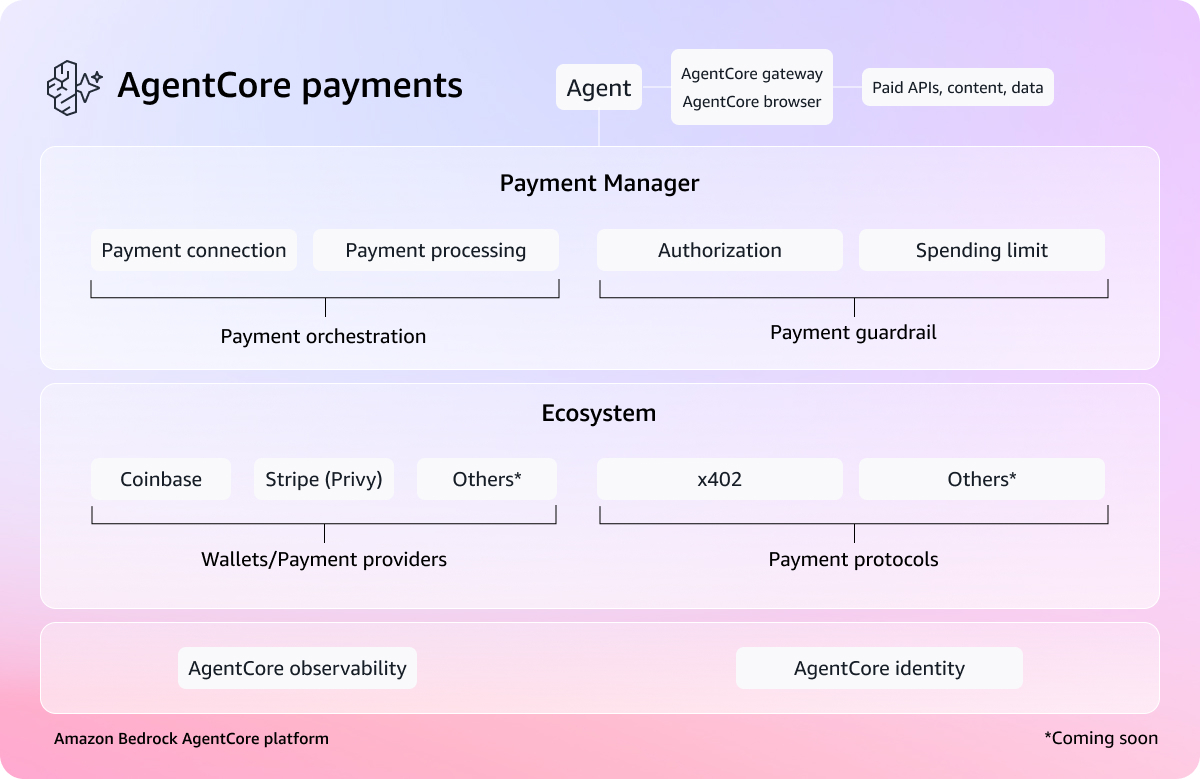
To get started, developers connect their agent to a wallet or payment service provider, register a funded payment source, and set spending limits per session. AgentCore manages all credential authentication and token lifecycle. When the agent encounters a paid resource during execution, AgentCore handles protocol negotiation, retries, and payment, routing the transaction through the appropriate provider without interrupting the agent’s reasoning loop. Every transaction is observable through the same logs, metrics, and traces that developers already use to monitor agent behavior.
AgentCore is designed to work with any framework and any protocol. We’ve carried that same flexibility into Amazon Bedrock AgentCore Payments. Developers don’t have to track the evolving payment protocol landscape or lock into a single standard. At preview, we support the x402 protocol, with additional protocols on the roadmap. As new protocols emerge, we add support at the platform level so developers don’t have to rebuild their agents.
“At Warner Bros. Discovery, we’re actively exploring more flexible and scalable approaches to payments as we evolve beyond direct API integrations with third-party processors. AgentCore payments represents a promising direction, enabling our teams to experiment with possible agent-driven experiences where premium content, like live sports and tentpole releases, could be surfaced and transacted on seamlessly in the moment of interest. We’re particularly interested in evaluating its potential to reduce engineering overhead, streamline payment orchestration, and introduce governed, traceable transactions as we look at potential next-generation commerce experiences.” – Mit Majithia, Executive Vice President, Warner Brothers Discovery Inc.
Micropayment in preview: Unlocking paid data, APIs, and content for agent workflows
The first use case that we’re enabling in preview is where agents make instant micropayments to access APIs, MCP servers, web content, and other agents. Services are rapidly shifting to pay-per-use models, AI agent web crawling surged rapidly in the past year, and these transactions are typically under $1 or fractions of a cent.
Developers enable Amazon Bedrock AgentCore Payments on their existing agent using the AgentCore SDK or console. You choose between a Coinbase wallet or a Stripe Privy wallet as your payment connection. With both options, end users can fund wallets through stablecoin or fiat using a debit card. Guardrails are enforced at multiple layers. Before an agent can transact, the end user must explicitly authorize the agent to access and use their wallet. At runtime, spending limits are enforced per session, keeping the agent within the budget set for each execution. The agent never has open-ended access to funds. It operates only with explicit permission and within defined limits.
Under the hood, the payment flow is built around the x402 protocol, an open HTTP-native payment standard that enables instant stablecoin micropayments. When an agent sends a request to a paid endpoint and receives an HTTP 402 “Payment Required” response, payment processing authenticates with the configured wallet, executes the stablecoin payment, attaches payment proof, and delivers the content back to the agent, all within the execution loop. The payment manager orchestrates the flow while payment limits track spend against session budgets throughout. After enabled, the agent begins orchestrating payments during execution, with full traceability available in the AgentCore console.
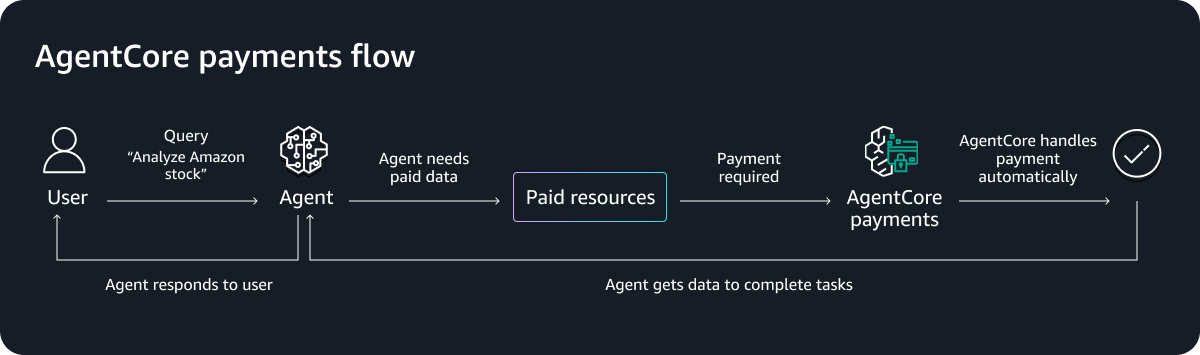
To help agents find merchants on their own, we’re making the Coinbase x402 Bazaar MCP server available through AgentCore gateway. The bazaar provides a curated list of x402 endpoints that agents can search, discover, and pay for when relevant to their task, turning paid services into something agents can find and use on their own rather than requiring developers to hardcode each integration.
Heurist AI, which offers full-stack infrastructure for the AI economy, is building a research agent that performs financial analysis on behalf of end users, using payments capabilities in AgentCore. “Heurist is using AgentCore Payments for our research agent which helps end customers to perform financial and crypto analysis and investment advice”, said JW Wang, Founder at Heurist AI. “End customers can set a budget for the research and the agent uses AgentCore Payments to get accurate real-time data, commonly around markets, social sentiment, and news. We were able to integrate payments quickly to our agent with low effort and few lines of code.”
Built with an ecosystem of partners
Coinbase developed the x402 protocol, the open standard that’s quickly gaining traction for machine-to-machine payments, and they built the CDP wallet infrastructure and facilitation that power the micropayment flows in preview. Coinbase has been innovating on AWS for years, serving millions of customers in cryptocurrency exchange and developer platform. We’re now working together as members of the x402 Foundation to establish open standards for the agent economy.
“There will soon be more AI agents transacting than humans, and they need money that’s built for the internet – programmable, always on, and global. By bringing Coinbase’s stablecoin infrastructure and x402 into AWS AgentCore, we’re giving developers the full stack to build agents that move money at software speed, with the trust and compliance enterprises expect.” – Brian Foster, Head of Infrastructure Growth and Strategy, Coinbase.
Stripe is helping define how commerce works in the agent era, building tools that enable AI agents to discover, negotiate, and complete transactions on behalf of businesses and consumers. With the launch of new payment capabilities, AgentCore is integrating Stripe’s wallet infrastructure, powered by Privy, as a payment connection at preview, giving developers direct access to Stripe’s payment infrastructure from day one. Together, AWS and Stripe are working toward a shared path to fiat payment support as we expand beyond micropayments, combining Stripe’s global payments reach with the agent platform where developers are already building.
“Stripe is building the economic infrastructure for AI. For agents to become meaningful economic actors, they need a way to hold and spend money. That’s why we’re excited to partner with AWS to make stablecoin wallets for agents readily available to AgentCore developers.” – Henri Stern, CEO of Privy, a Stripe company.
Where we’re headed
Micropayments are the first step, addressing the early agent-to-agent commerce patterns where we see the most immediate pull. Beyond micropayments, we see a natural expansion into broader commerce flows where agents act on behalf of buyers, not just other agents. An agent booking flights, reserving hotels, or completing purchases across merchant platforms on behalf of a customer. Getting there will require deeper integration with payment ecosystems, support for additional protocols, stronger buyer intent verification, and end-to-end observability across the full transaction lifecycle. That’s the road ahead, and we’re building for it.
The developer experience stays consistent across each phase. Configure your wallet, set your policies, and your agent transacts. What changes is the breadth of what agents can pay for and how. We’re excited about what’s to come.
Get started
Amazon Bedrock AgentCore Payments are available in preview today in US East (N. Virginia), US West (Oregon), Europe (Frankfurt), and Asia Pacific (Sydney). Get started in the AgentCore Console. Learn more by reading the documentation.


