
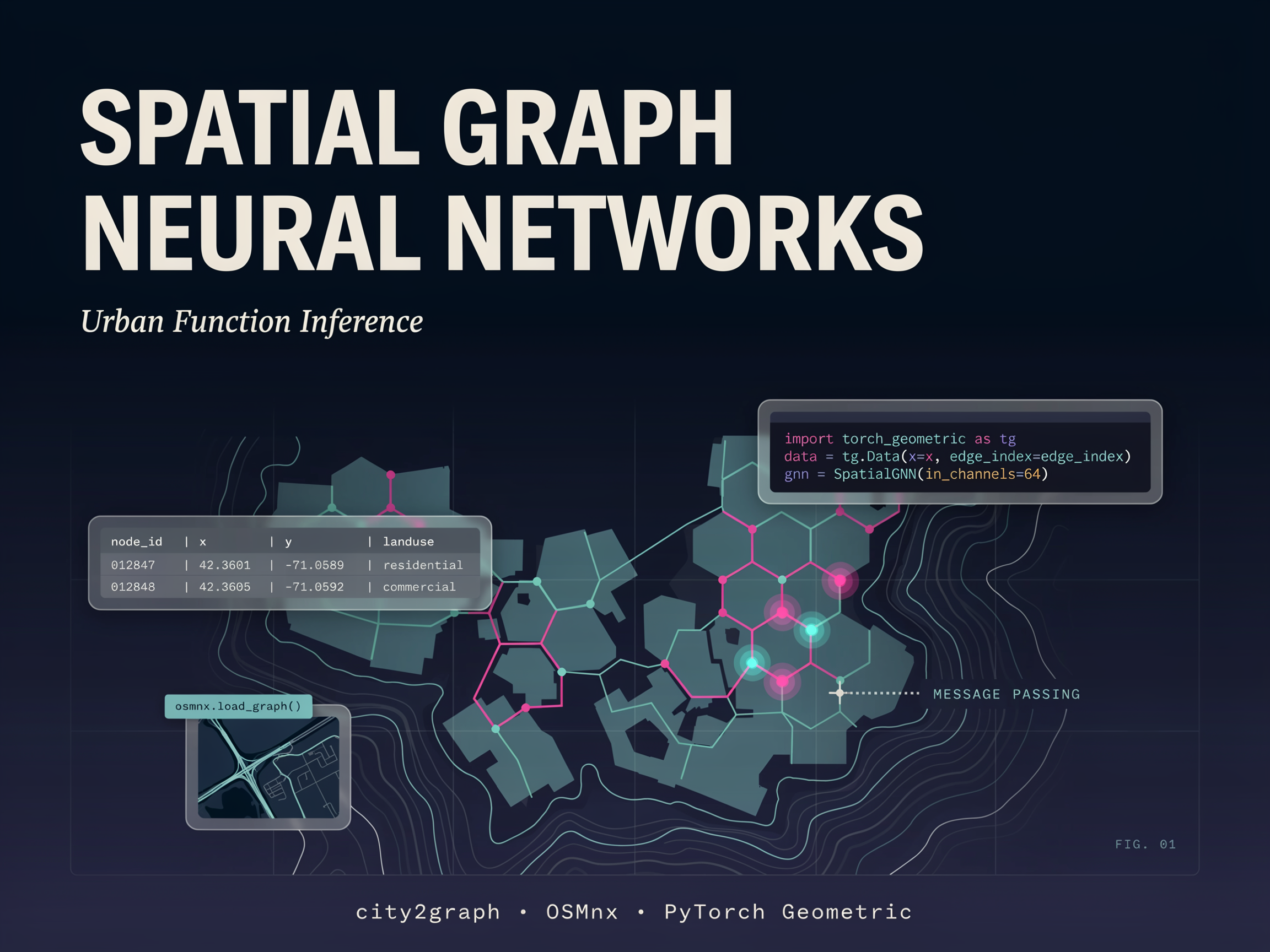
In this tutorial, we build an end-to-end spatial graph learning pipeline using city2graph. We start by collecting real urban POI data and street network information from OpenStreetMap, with a synthetic fallback to ensure the workflow remains reliable. We then engineer spatial features, construct multiple proximity graph families, and compare how different graph-building strategies represent the same urban environment. After that, we create both heterogeneous and homogeneous graph structures, convert them into PyTorch Geometric format, and train a GraphSAGE model to predict POI categories from spatial structure. Through this process, we integrate geospatial data processing, graph construction, and GNN-based urban function inference into a single practical workflow.
Installing city2graph and Importing Geospatial and Graph Learning Libraries
!pip -q install "city2graph[cpu]" osmnx contextily scikit-learn 2>/dev/null
import warnings, numpy as np, pandas as pd, geopandas as gpd
warnings.filterwarnings("ignore")
from shapely.geometry import Point
import matplotlib.pyplot as plt
import city2graph as c2g
print("city2graph version:", getattr(c2g, "__version__", "unknown"))
print("PyTorch / PyG available:", c2g.is_torch_available())
import torch
import torch.nn.functional as F
from torch_geometric.nn import SAGEConv, to_hetero
from torch_geometric.utils import to_undirected
from sklearn.preprocessing import StandardScaler
from sklearn.neighbors import NearestNeighbors
from sklearn.metrics import accuracy_score, f1_score
from sklearn.decomposition import PCA
SEED = 42
np.random.seed(SEED); torch.manual_seed(SEED)
We begin by installing the required libraries and importing the geospatial, graph learning, and machine learning tools used throughout the tutorial. We verify that city2graph and PyTorch Geometric are available so the rest of the workflow can run properly. We also set a fixed random seed to make the graph construction, training split, and model results more reproducible.
Collecting OpenStreetMap POI Data with a Synthetic Fallback
CENTER = (35.6595, 139.7005)
DIST_M = 1100
TAG_QUERIES = {
   "food":      {"amenity": ["restaurant", "cafe", "fast_food", "bar", "pub"]},
   "retail":    {"shop": True},
   "education": {"amenity": ["school", "university", "college", "kindergarten", "library"]},
   "health":    {"amenity": ["hospital", "clinic", "pharmacy", "doctors", "dentist"]},
}
def to_points(gdf):
   g = gdf.copy()
   g["geometry"] = g.geometry.representative_point()
   return g
poi_gdf, segments_gdf = None, None
try:
   import osmnx as ox
   ox.settings.use_cache = True
   ox.settings.log_console = False
   frames = []
   for label, tags in TAG_QUERIES.items():
       try:
           f = ox.features_from_point(CENTER, tags=tags, dist=DIST_M)
           f = f[f.geometry.notna()]
           if len(f):
               f = to_points(f)[["geometry"]].copy()
               f["category"] = label
               frames.append(f)
       except Exception as e:
           print(f"  (skip {label}: {e})")
   if not frames:
       raise RuntimeError("No POIs returned from Overpass.")
   poi_gdf = gpd.GeoDataFrame(pd.concat(frames, ignore_index=True), crs="EPSG:4326")
   G = ox.graph_from_point(CENTER, dist=DIST_M, network_type="walk")
   segments_gdf = ox.graph_to_gdfs(G, nodes=False, edges=True).reset_index(drop=True)[["geometry"]]
   print(f"OSM acquisition OK -> {len(poi_gdf)} POIs, {len(segments_gdf)} street segments")
except Exception as e:
   print(f"OSM unavailable ({e}) -> generating synthetic clustered POIs.")
   rng = np.random.default_rng(SEED)
   cats = list(TAG_QUERIES.keys())
   centers = rng.uniform(-0.01, 0.01, size=(8, 2)) + np.array(CENTER[::-1])
   rows = []
   for ci, c in enumerate(centers):
       dom = cats[ci % len(cats)]
       n = rng.integers(40, 90)
       pts = c + rng.normal(0, 0.0016, size=(n, 2))
       for (lon, lat) in pts:
           cat = dom if rng.random() < 0.75 else rng.choice(cats)
           rows.append({"geometry": Point(lon, lat), "category": cat})
   poi_gdf = gpd.GeoDataFrame(rows, crs="EPSG:4326")
   segments_gdf = None
   print(f"Synthetic dataset -> {len(poi_gdf)} POIs")
if len(poi_gdf) > 700:
   poi_gdf = poi_gdf.sample(700, random_state=SEED).reset_index(drop=True)
metric_crs = poi_gdf.estimate_utm_crs()
poi_gdf = poi_gdf.to_crs(metric_crs).reset_index(drop=True)
if segments_gdf is not None:
   segments_gdf = segments_gdf.to_crs(metric_crs)
print("Class balance:n", poi_gdf["category"].value_counts())
We collect real POI data from OpenStreetMap around Shibuya, Tokyo, and group the locations into broad urban function categories such as food, retail, education, and health. We also download the walkable street network so that the POIs can later be connected with urban-form features. If the OSM request fails, we generate a synthetic clustered dataset, which keeps the tutorial runnable even when online data access is unavailable.
Engineering Spatial Features and Building Proximity Graph Families
poi_gdf["cx"] = poi_gdf.geometry.x
poi_gdf["cy"] = poi_gdf.geometry.y
coords = poi_gdf[["cx", "cy"]].to_numpy()
nn = NearestNeighbors(radius=150.0).fit(coords)
poi_gdf["local_density"] = [len(idx) - 1 for idx in nn.radius_neighbors(coords, return_distance=False)]
if segments_gdf is not None and len(segments_gdf):
   try:
       joined = gpd.sjoin_nearest(poi_gdf[["geometry"]], segments_gdf[["geometry"]],
                                  distance_col="dist_street")
       poi_gdf["dist_street"] = joined.groupby(level=0)["dist_street"].min().reindex(poi_gdf.index).fillna(0.0)
   except Exception:
       poi_gdf["dist_street"] = 0.0
else:
   poi_gdf["dist_street"] = 0.0
poi_gdf["category"] = poi_gdf["category"].astype("category")
poi_gdf["label"] = poi_gdf["category"].cat.codes.astype(int)
CLASS_NAMES = list(poi_gdf["category"].cat.categories)
print("Classes:", CLASS_NAMES)
def graph_stats(name, builder):
   try:
       nodes, edges = builder()
       deg = pd.Series(np.r_[edges.index.get_level_values(0),
                             edges.index.get_level_values(1)]).value_counts()
       return name, len(edges), round(deg.mean(), 2), (nodes, edges)
   except Exception as e:
       return name, f"ERR: {e}", None, None
builders = {
   "KNN (k=8)":  lambda: c2g.knn_graph(poi_gdf, distance_metric="euclidean", k=8, as_nx=False),
   "Delaunay":   lambda: c2g.delaunay_graph(poi_gdf, as_nx=False),
   "Gabriel":    lambda: c2g.gabriel_graph(poi_gdf, as_nx=False),
   "RNG":        lambda: c2g.relative_neighborhood_graph(poi_gdf, as_nx=False),
   "EMST":       lambda: c2g.euclidean_minimum_spanning_tree(poi_gdf, as_nx=False),
   "Waxman":     lambda: c2g.waxman_graph(poi_gdf, distance_metric="euclidean", r0=150, beta=0.6),
}
print("n--- Proximity graph comparison ---")
print(f"{'graph':<14}{'#edges':>10}{'avg_degree':>12}")
built = {}
for nm, b in builders.items():
   name, ne, avgdeg, payload = graph_stats(nm, b)
   print(f"{name:<14}{str(ne):>10}{str(avgdeg):>12}")
   if payload: built[nm] = payload
fig, axes = plt.subplots(1, 3, figsize=(16, 5))
for ax, key in zip(axes, ["KNN (k=8)", "Delaunay", "EMST"]):
   if key in built:
       n_, e_ = built[key]
       e_.plot(ax=ax, linewidth=0.4, color="#3b7dd8", alpha=0.6)
       poi_gdf.plot(ax=ax, markersize=4, color="#d83b5c")
       ax.set_title(key); ax.set_axis_off()
plt.suptitle("Spatial graph topologies on the same POI set", y=1.02)
plt.tight_layout(); plt.show()
We engineer spatial features for each POI by extracting its projected coordinates, calculating local density, and estimating distance to the nearest street segment. We then assign category labels and build several families of proximity graphs, including KNN, Delaunay, Gabriel, RNG, EMST, and Waxman. We compare their edge counts and average degrees, then visualize selected graph topologies to see how differently they connect the same set of POIs.
Constructing Heterogeneous and Homogeneous Graphs in PyTorch Geometric
nodes_dict = {}
for cat in CLASS_NAMES:
   sub = poi_gdf[poi_gdf["category"] == cat].copy().reset_index(drop=True)
   nodes_dict[cat] = sub[["geometry", "cx", "cy", "local_density"]]
try:
   _, bridge_edges = c2g.bridge_nodes(nodes_dict, proximity_method="knn", k=3,
                                      distance_metric="euclidean")
   hetero = c2g.gdf_to_pyg(
       nodes_dict, bridge_edges,
       node_feature_cols={cat: ["cx", "cy", "local_density"] for cat in CLASS_NAMES},
   )
   print("nHeteroData node types:", hetero.node_types)
   print("HeteroData edge types:")
   for et in hetero.edge_types:
       print(f"   {et}: {hetero[et].edge_index.shape[1]} edges")
except Exception as e:
   hetero = None
   print("Heterogeneous build skipped:", e)
nodes, edges = c2g.knn_graph(poi_gdf, distance_metric="euclidean", k=8, as_nx=False)
deg = pd.Series(np.r_[edges.index.get_level_values(0),
                     edges.index.get_level_values(1)]).value_counts()
nodes["degree"] = deg.reindex(nodes.index).fillna(0).astype(float)
for col in ["cx", "cy", "local_density", "dist_street", "label"]:
   if col not in nodes.columns:
       nodes[col] = poi_gdf.loc[nodes.index, col].values
FEATS = ["cx", "cy", "local_density", "dist_street", "degree"]
nodes[FEATS] = StandardScaler().fit_transform(nodes[FEATS].astype(float))
data = c2g.gdf_to_pyg(nodes, edges, node_feature_cols=FEATS, node_label_cols=["label"])
data.edge_index = to_undirected(data.edge_index)
data.x = data.x.float()
y = data.y.long().view(-1)
N, num_classes = data.num_nodes, int(y.max()) + 1
print(f"nHomogeneous Data: {N} nodes, {data.edge_index.shape[1]} directed-edges, "
     f"{data.x.shape[1]} features, {num_classes} classes")
We construct a heterogeneous multi-layer graph by separating POIs into node types based on their urban function categories. We then use bridge edges to connect nearby nodes across different layers and convert the result into PyTorch Geometric HeteroData format. After that, we build a homogeneous KNN graph, attach degree and engineered features, standardize them, and prepare the final PyG Data object for GraphSAGE training.
Defining and Training a GraphSAGE Model for POI Classification
perm = torch.randperm(N, generator=torch.Generator().manual_seed(SEED))
n_tr, n_va = int(0.6 * N), int(0.2 * N)
train_mask = torch.zeros(N, dtype=torch.bool); train_mask[perm[:n_tr]] = True
val_mask   = torch.zeros(N, dtype=torch.bool); val_mask[perm[n_tr:n_tr + n_va]] = True
test_mask  = torch.zeros(N, dtype=torch.bool); test_mask[perm[n_tr + n_va:]] = True
class GraphSAGE(torch.nn.Module):
   def __init__(self, in_dim, hidden, out_dim, p=0.3):
       super().__init__()
       self.c1 = SAGEConv(in_dim, hidden)
       self.c2 = SAGEConv(hidden, hidden)
       self.lin = torch.nn.Linear(hidden, out_dim)
       self.p = p
   def forward(self, x, ei, return_emb=False):
       h = F.relu(self.c1(x, ei))
       h = F.dropout(h, p=self.p, training=self.training)
       h = F.relu(self.c2(h, ei))
       out = self.lin(h)
       return (out, h) if return_emb else out
model = GraphSAGE(data.x.shape[1], 64, num_classes)
opt = torch.optim.Adam(model.parameters(), lr=0.01, weight_decay=5e-4)
def evaluate(mask):
   model.eval()
   with torch.no_grad():
       pred = model(data.x, data.edge_index).argmax(1)
   yt, yp = y[mask].numpy(), pred[mask].numpy()
   return accuracy_score(yt, yp), f1_score(yt, yp, average="macro")
print("n--- Training GraphSAGE ---")
best_val, best_state = 0.0, None
for epoch in range(1, 201):
   model.train(); opt.zero_grad()
   out = model(data.x, data.edge_index)
   loss = F.cross_entropy(out[train_mask], y[train_mask])
   loss.backward(); opt.step()
   if epoch % 20 == 0:
       va_acc, va_f1 = evaluate(val_mask)
       if va_acc > best_val:
           best_val, best_state = va_acc, {k: v.clone() for k, v in model.state_dict().items()}
       print(f"epoch {epoch:3d} | loss {loss.item():.3f} | val_acc {va_acc:.3f} | val_f1 {va_f1:.3f}")
if best_state: model.load_state_dict(best_state)
te_acc, te_f1 = evaluate(test_mask)
print(f"nTEST  accuracy={te_acc:.3f}  macro-F1={te_f1:.3f}")
We split the graph nodes into training, validation, and test masks so the model can learn and be evaluated properly. We define a two-layer GraphSAGE model that learns node representations from both node features and graph structure. We train the model for 200 epochs, monitor validation accuracy and macro-F1, save the best model state, and finally report test performance.
Visualizing Embeddings and Running a Heterogeneous GNN Forward Pass
model.eval()
with torch.no_grad():
logits, emb = model(data.x, data.edge_index, return_emb=True)
pred = logits.argmax(1).numpy()
emb2d = PCA(n_components=2).fit_transform(emb.numpy())
fig, axes = plt.subplots(1, 2, figsize=(15, 6))
for cls in range(num_classes):
m = y.numpy() == cls
axes[0].scatter(emb2d[m, 0], emb2d[m, 1], s=10, label=CLASS_NAMES[cls], alpha=0.7)
axes[0].set_title("GraphSAGE node embeddings (PCA), coloured by TRUE class")
axes[0].legend(fontsize=8); axes[0].set_xticks([]); axes[0].set_yticks([])
plot_gdf = nodes.copy(); plot_gdf["pred"] = pred
plot_gdf["pred_name"] = [CLASS_NAMES[p] for p in pred]
plot_gdf.plot(ax=axes[1], column="pred_name", legend=True, markersize=12, cmap="tab10")
axes[1].set_title("Predicted urban function (mapped back to geography)")
axes[1].set_axis_off()
try:
import contextily as ctx
ctx.add_basemap(axes[1], crs=plot_gdf.crs, source=ctx.providers.CartoDB.Positron)
except Exception:
pass
plt.tight_layout(); plt.show()
if hetero is not None:
try:
for nt in hetero.node_types:
hetero[nt].x = hetero[nt].x.float()
class HGNN(torch.nn.Module):
def __init__(self, hid, out):
super().__init__()
self.c1 = SAGEConv((-1, -1), hid)
self.c2 = SAGEConv((-1, -1), out)
def forward(self, x, ei):
x = {k: F.relu(v) for k, v in self.c1(x, ei).items()}
return self.c2(x, ei)
hmodel = to_hetero(HGNN(32, 16), hetero.metadata(), aggr="sum")
out_dict = hmodel(hetero.x_dict, hetero.edge_index_dict)
print("nHeterogeneous GNN output embedding shapes:")
for nt, t in out_dict.items():
print(f" {nt}: {tuple(t.shape)}")
except Exception as e:
print("Hetero GNN forward skipped:", e)
print("n Done — proximity comparison, hetero construction, and a trained spatial GNN.")
We use the trained GraphSAGE model to extract node embeddings and predictions from the homogeneous graph. We reduce the learned embeddings with PCA and visualize them alongside a geographic prediction map to understand how the model separates urban functions. We also run a heterogeneous GNN forward pass with to_hetero, showing that the tutorial supports both homogeneous training and heterogeneous graph experimentation.
Key Takeaways
- city2graph turns raw OpenStreetMap POI and street data into spatial graphs.
- Six proximity graph families (KNN, Delaunay, Gabriel, RNG, EMST, Waxman) connect the same POIs differently.
- A synthetic clustered fallback keeps the workflow runnable without OSM access.
- A two-layer GraphSAGE model predicts urban function categories from spatial structure.
- The pipeline supports both homogeneous training and heterogeneous graph experimentation via to_hetero.
Conclusion
In conclusion, we completed a full spatial GNN pipeline that transforms raw city data into graph-based learning and visualization. We compared several proximity graph methods, built a heterogeneous multi-layer graph, trained a homogeneous GraphSAGE classifier, and inspected the learned embeddings and geographic predictions. It gives us a practical understanding of how spatial relationships among POIs can be represented as graph structures and used to predict urban functions. It also shows how city2graph, GeoPandas, OSMnx, and PyTorch Geometric work together to support advanced geospatial machine learning experiments in a Colab-friendly setup.
Check out the Full Codes with Notebook here. Also, feel free to follow us on Twitter and don’t forget to join our 150k+ML SubReddit and Subscribe to our Newsletter. Wait! are you on telegram? now you can join us on telegram as well.
Need to partner with us for promoting your GitHub Repo OR Hugging Face Page OR Product Release OR Webinar etc.? Connect with us
The post A Coding Implementation on Spatial Graph Neural Networks for Urban Function Inference Using city2graph, OSMnx, and PyTorch Geometric appeared first on MarkTechPost.


