
Blockchain Adoption Moves Beyond Pure Crypto
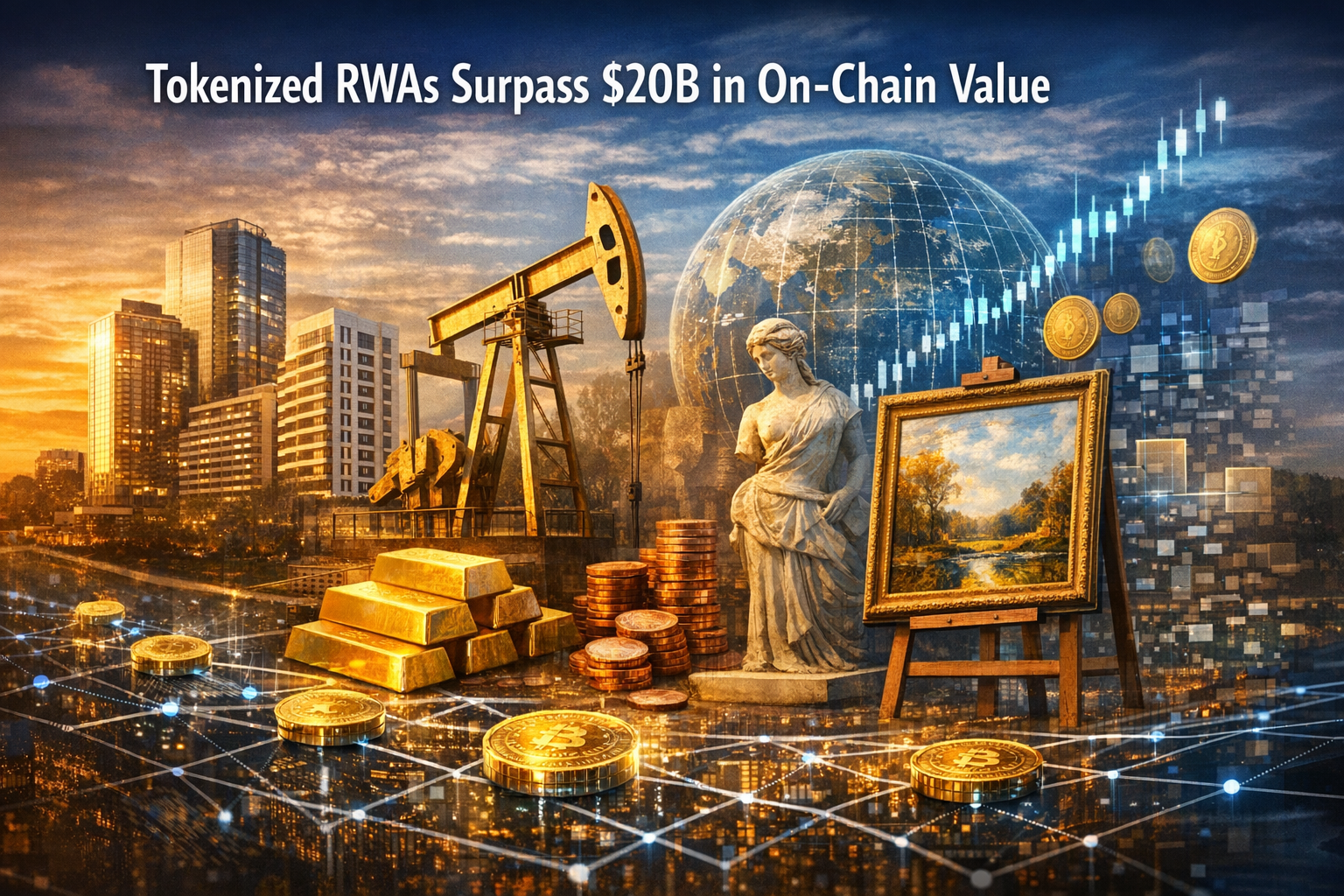
The tokenization of real-world assets (RWAs) has officially crossed a major milestone. According to recent on-chain data, tokenized assets such as real estate, commodities, art, and traditional financial instruments have now surpassed $20 billion in total on-chain value. This achievement signals a powerful shift in how blockchain technology is being adopted — not just as a speculative playground for cryptocurrencies, but as a foundational layer for global finance and asset ownership.
As markets mature and institutional interest grows, tokenized RWAs are emerging as one of the most compelling narratives in the blockchain ecosystem.
What Are Tokenized Real-World Assets?
Tokenized RWAs are digital representations of physical or traditional financial assets recorded on a blockchain. These tokens are typically backed 1:1 by real assets and can represent ownership, debt, or revenue rights.
Common examples include:
-
Tokenized real estate (commercial buildings, residential properties)
-
Commodities such as gold, oil, and agricultural products
-
Fine art and collectibles
-
Treasury bills, bonds, and private credit
-
Carbon credits and infrastructure assets
By placing these assets on-chain, blockchain enables faster settlement, fractional ownership, global accessibility, and increased transparency — advantages that traditional financial systems struggle to match.
Why the $20B Milestone Matters
Crossing the $20 billion mark is not just a symbolic win — it reflects real momentum across multiple fronts.
First, it confirms growing institutional participation. Asset managers, fintech firms, and even traditional banks are actively experimenting with tokenized products. Many now view blockchain rails as more efficient alternatives to legacy clearing and settlement systems.
Second, it highlights real utility beyond speculation. Unlike meme coins or purely narrative-driven tokens, RWAs are backed by tangible value and cash-flow-generating assets. This makes them especially attractive during periods of market uncertainty.
Finally, the milestone underscores blockchain’s role as a financial infrastructure layer, not merely a new asset class. RWAs blur the line between traditional finance and decentralized systems — a convergence many believe will define the next decade.
Key Drivers Behind RWA Growth
Institutional Demand
Institutions are seeking yield, efficiency, and diversification. Tokenized assets offer programmable compliance, near-instant settlement, and reduced counterparty risk — all while maintaining exposure to familiar asset classes.
Regulatory Progress
Clearer regulatory frameworks in regions like Europe, the Middle East, and parts of Asia have given companies the confidence to launch compliant tokenized products. Regulatory clarity is a major catalyst for scale.
Improved Blockchain Infrastructure
Scalable networks, better custody solutions, and enterprise-grade smart contracts have made it easier to manage large-value assets on-chain without compromising security.
Fractional Ownership
Tokenization allows high-value assets — such as real estate or rare art — to be divided into smaller units, dramatically lowering the barrier to entry for investors worldwide.
Real Estate and Treasuries Lead the Way
Among all RWA categories, real estate and tokenized U.S. Treasuries currently dominate on-chain value.
Tokenized Treasuries, in particular, have gained traction as investors seek low-risk yield alternatives within the crypto ecosystem. These assets provide stable returns while remaining fully programmable and composable with DeFi protocols.
Real estate tokenization continues to expand as property owners and developers explore new funding models and liquidity options without relying solely on traditional banks.
The Role of DeFi in RWA Expansion
Decentralized finance plays a crucial role in unlocking the full potential of tokenized assets. Once RWAs are on-chain, they can be:
-
Used as collateral in lending protocols
-
Integrated into yield strategies
-
Traded 24/7 on decentralized marketplaces
-
Combined with AI-driven portfolio tools
This composability transforms traditionally illiquid assets into dynamic financial instruments.
Challenges Still Remain
Despite rapid growth, tokenized RWAs face several challenges:
-
Legal enforcement across jurisdictions
-
Custody and asset verification standards
-
Liquidity fragmentation
-
Education gaps among traditional investors
However, these issues are increasingly being addressed through standardized frameworks, trusted custodians, and hybrid on-chain/off-chain governance models.
What Comes Next for Tokenized RWAs?
Most analysts believe the $20 billion milestone is only the beginning. Projections for the coming years range from hundreds of billions to trillions of dollars in tokenized assets as adoption accelerates.
As blockchain technology continues to integrate with traditional finance, tokenized RWAs are positioned to become a core pillar of global markets — bridging physical assets, digital infrastructure, and decentralized innovation.
The rise of tokenized real-world assets marks a turning point for blockchain adoption. Moving beyond speculative narratives, the industry is now proving its ability to support real value, real yield, and real-world impact.
With over $20 billion already secured on-chain, RWAs are no longer an experiment — they are a rapidly growing financial reality.