
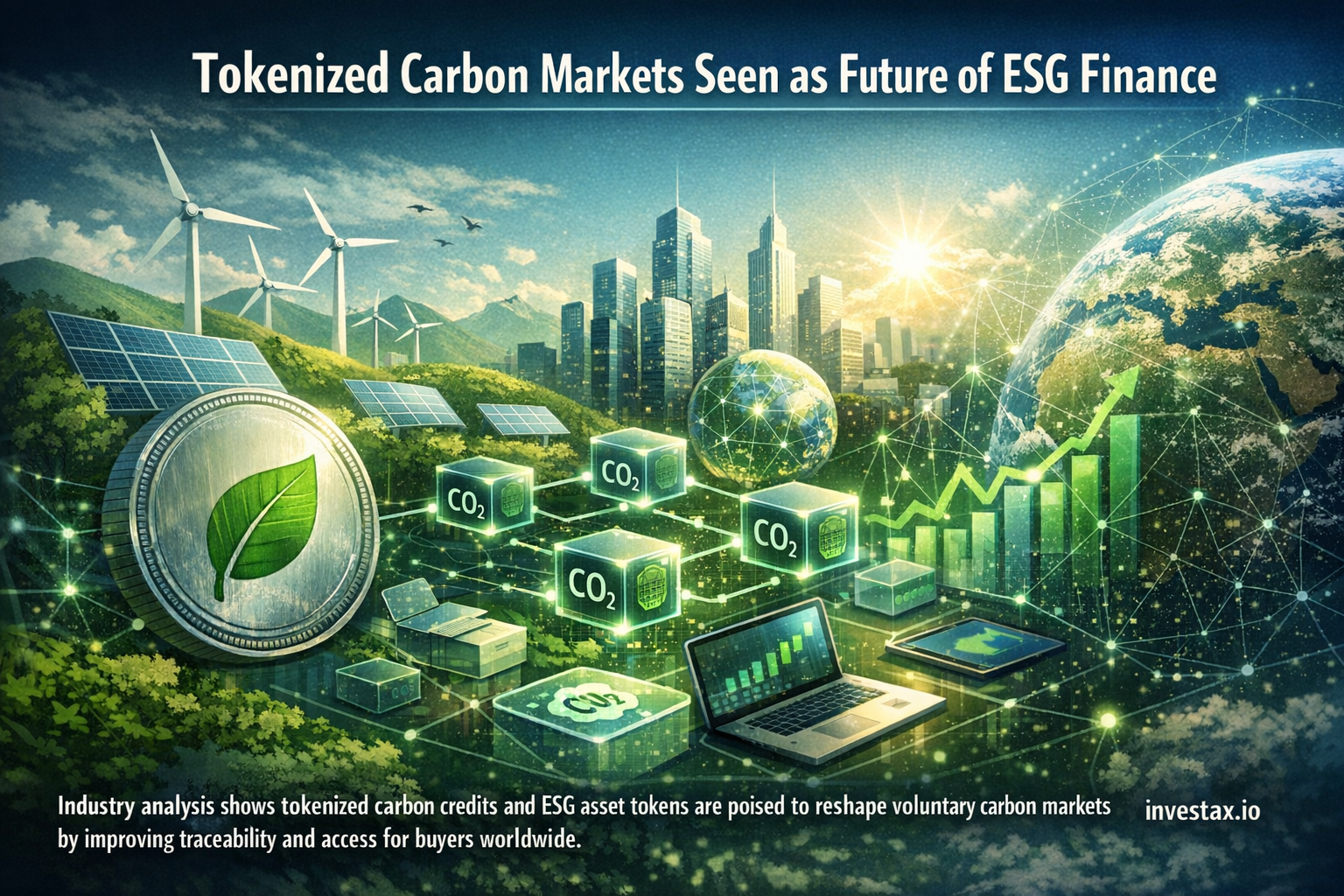
The global push toward sustainability is reshaping financial markets, and few areas illustrate this transformation more clearly than carbon markets. As governments, corporations, and investors seek credible ways to meet climate targets, tokenized carbon credits and ESG-linked digital assets are emerging as a powerful solution. Industry analysis increasingly suggests that blockchain-based carbon markets could become a cornerstone of the next generation of ESG finance.
Traditional voluntary carbon markets have long struggled with issues such as limited transparency, fragmented standards, double counting, and restricted access for smaller participants. Tokenization, supported by distributed ledger technology, offers a structural upgrade that addresses many of these weaknesses while unlocking new opportunities for global participation and capital efficiency.
The Limitations of Traditional Carbon Markets
Voluntary carbon markets play a critical role in climate action by allowing companies to offset emissions through verified environmental projects. However, these markets are often criticized for being opaque and inefficient. Credits are typically tracked through centralized registries, making it difficult for buyers to verify origin, ownership history, or retirement status in real time.
Additionally, high minimum investment thresholds and complex settlement processes limit access to large corporations and specialized intermediaries. Smaller firms, individual investors, and emerging-market participants are often excluded, reducing overall market liquidity and slowing climate capital flows.
These challenges have created demand for a more transparent, accessible, and technologically advanced framework—one that tokenization is well positioned to deliver.
How Tokenization Transforms Carbon Credits
Tokenization converts carbon credits into blockchain-based digital tokens, each representing a verified unit of carbon reduction or removal. Once issued on-chain, these tokens benefit from immutability, traceability, and real-time auditability, allowing every transaction to be transparently recorded and publicly verifiable.
Smart contracts automate issuance, transfer, and retirement, significantly reducing operational friction. Buyers can instantly confirm whether a credit has already been used, eliminating the risk of double counting—one of the most persistent credibility concerns in carbon markets.
By fractionalizing carbon assets, tokenization also lowers entry barriers. Investors can gain exposure to ESG assets at smaller ticket sizes, while project developers gain faster and broader access to global capital.
Expanding Access to Global ESG Capital
One of the most transformative impacts of tokenized carbon markets is the democratization of ESG finance. Blockchain infrastructure enables cross-border participation without reliance on traditional intermediaries, opening markets to participants from regions previously underserved by climate finance.
Institutional investors benefit from improved compliance and reporting, while corporates gain access to transparent offsets aligned with sustainability disclosures. Retail investors, meanwhile, can directly participate in climate-positive assets, aligning personal capital with environmental impact.
This increased accessibility has the potential to dramatically scale voluntary carbon markets, channeling capital more efficiently into renewable energy, reforestation, carbon capture, and biodiversity projects worldwide.
Trust, Standards, and Institutional Adoption
Despite its promise, tokenized carbon markets must address standardization and governance to achieve mainstream adoption. Industry leaders and platforms are working closely with established verification bodies to ensure that on-chain tokens are backed by high-integrity, real-world environmental assets.
Clear frameworks around project validation, lifecycle tracking, and regulatory compliance are essential for institutional trust. As these standards mature, tokenized carbon credits are increasingly viewed not as speculative instruments, but as credible ESG financial assets suitable for long-term portfolios.
Platforms such as Investax and other digital asset infrastructure providers are actively shaping this ecosystem, combining blockchain innovation with regulatory alignment and ESG best practices.
The Future of ESG Finance Is On-Chain
As sustainability reporting becomes mandatory in many jurisdictions and net-zero commitments intensify, demand for transparent, verifiable carbon solutions will only grow. Tokenized carbon markets offer a scalable, technology-driven response that aligns environmental integrity with financial efficiency.
Looking ahead, carbon credits may evolve into programmable financial instruments, integrated with decentralized finance, automated compliance systems, and global ESG marketplaces. This convergence positions tokenization not merely as an upgrade to carbon markets, but as a foundational layer for the future of ESG finance.
In a world where trust, transparency, and impact measurement are paramount, tokenized carbon assets stand out as a practical and forward-looking solution—bridging climate goals with the digital transformation of global finance.


