In 2025, the tokenization of real-world assets (RWAs) has shifted from a promising concept to a full-scale institutional movement. What began as experimental pilots by fintech startups has evolved into one of the most transformational trends in global finance, with traditional institutions—banks, asset managers, sovereign funds, and corporates—deploying real capital into blockchain-based asset rails.
The result? Faster settlement, programmable compliance, global liquidity pools, fractional ownership, and radically more transparent market infrastructure.
And nowhere is this acceleration more visible than in the tokenization of U.S. Treasuries, real estate, private credit, and carbon markets—segments now reshaping how ESG finance and global capital markets operate.
U.S. Treasuries: The Breakout Tokenized Asset Class
Tokenized U.S. Treasuries are the breakout success story of 2025.
A short time ago, the idea of government debt on public blockchains appeared unrealistic due to regulatory constraints and perceived risk. Yet today, tokenized T-bills represent billions in circulating supply across major chains.
Why institutions are moving Treasuries on-chain
-
Instant global settlement instead of T+2 timelines
-
24/7 secondary market liquidity
-
Programmable collateral for on-chain money markets
-
Lower operational costs compared to legacy infrastructure
-
High transparency and auditability
Tokenized Treasuries have become the preferred low-risk yield instrument for both Web3-native treasuries and traditional asset managers experimenting with blockchain rails.Real Estate Tokenization: From Illiquid to Efficient
Real estate—one of the world’s most illiquid asset classes—is undergoing significant transformation through tokenization.
In 2025, institutional platforms now offer fractionalized ownership of commercial and residential assets with fully compliant, on-chain records.
The impact
-
Investors can buy fractions of buildings, not entire properties.
-
Global investor access expands dramatically.
-
Secondary markets offer exit liquidity where none existed.
-
Compliance is automated via smart contracts.
Tokenized real estate funds are now integrating ESG scoring and real-time sustainability data, creating new standards for transparency in property-based impact investing.
Private Credit: Tokenization Unlocks Efficiency and Scale
The private credit boom continues in 2025—and tokenization has become one of the biggest enablers of its growth.
Why private credit is a perfect match for tokenization
-
Complex loan contracts become programmable
-
Investor distributions execute automatically
-
Risk reporting integrates real-time data
-
Underwriting models can be tied directly to off-chain performance inputs
Institutional players are increasingly using tokenization to expand lending capacity, especially in emerging markets where traditional banking infrastructure is slower and more expensive.
Carbon Credits: A New Era of Transparent ESG Finance
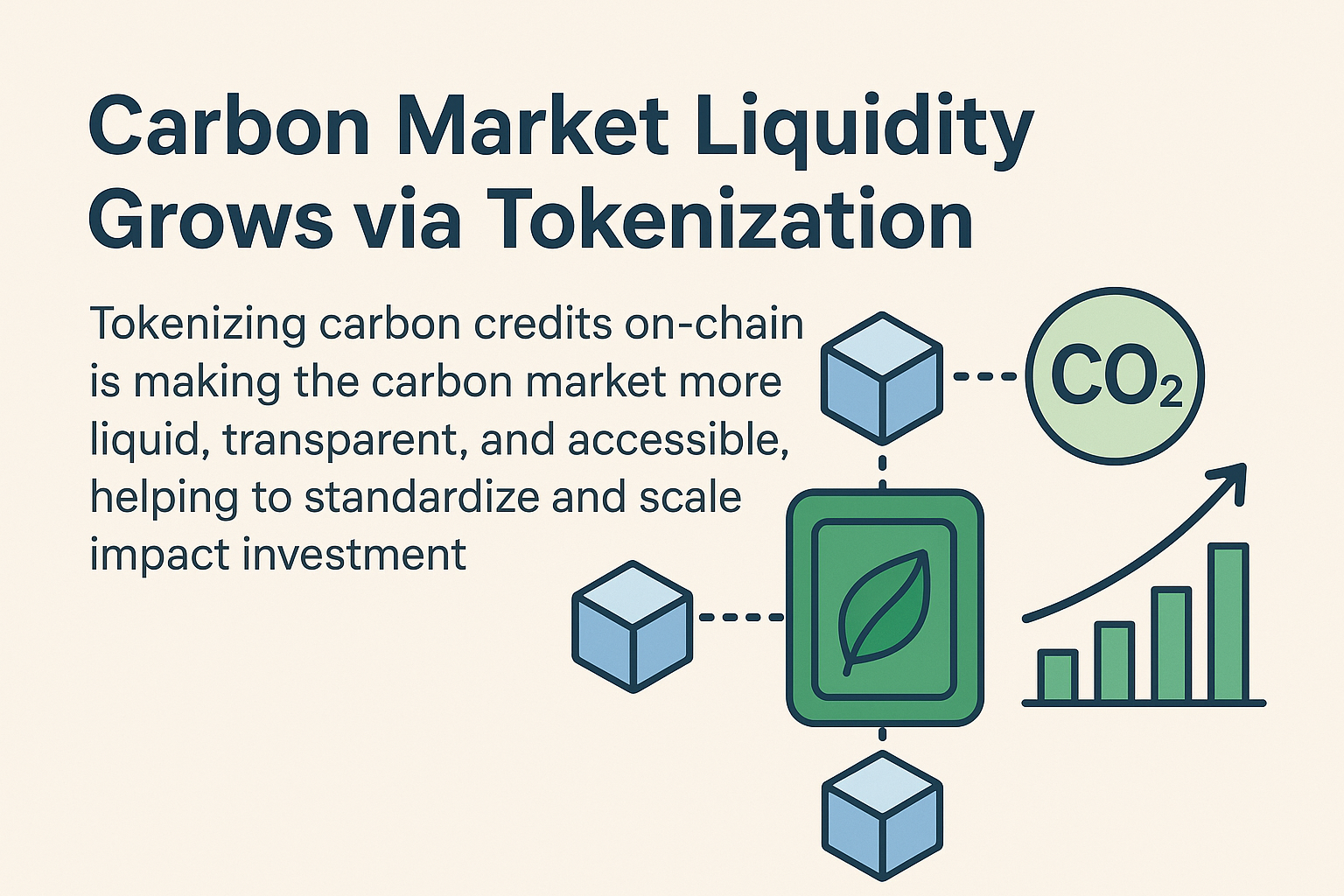
Carbon markets have historically suffered from fragmentation, opacity, and double-counting risks.
Tokenization in 2025 is directly addressing these issues, with ESG funds, corporates, and climate-tech firms adopting blockchain-verified carbon credits.
What’s changing
-
Every credit has proof of origin and immutable metadata
-
Verification becomes more reliable
-
Credits can trade globally with instant settlement
-
ESG reporting improves due to transparent on-chain tracking
This is redefining ESG finance and pushing sustainability markets toward true digital-first efficiency.
Why Tokenization Is Inevitable
Across all sectors, institutions are realizing the same core benefits:
1. Programmability
Assets, rules, and compliance logic become “living” components rather than static documents.
2. Global Liquidity
Capital flows borderlessly, untethered from legacy limitations.
3. Fractional Ownership
Investors access asset classes that were once available only to large institutions.
4. Radical Transparency
On-chain data replaces opaque, slow, paper-based workflows.
5. Interoperability
Tokenized assets plug into DeFi, CeFi, and emerging cross-chain ecosystems.
Together, these advantages are reshaping the financial industry in ways comparable to the early days of the internet.
2025: The Year Tokenization Becomes Mainstream
The surge in tokenized U.S. Treasuries, real estate, private credit, and carbon credits is only the beginning.
As infrastructure matures and regulatory clarity expands, tokenization is transitioning from “promising” to “standard.”
Institutions now understand that the future of assets isn’t just digital—it’s programmable, global, and on-chain.