
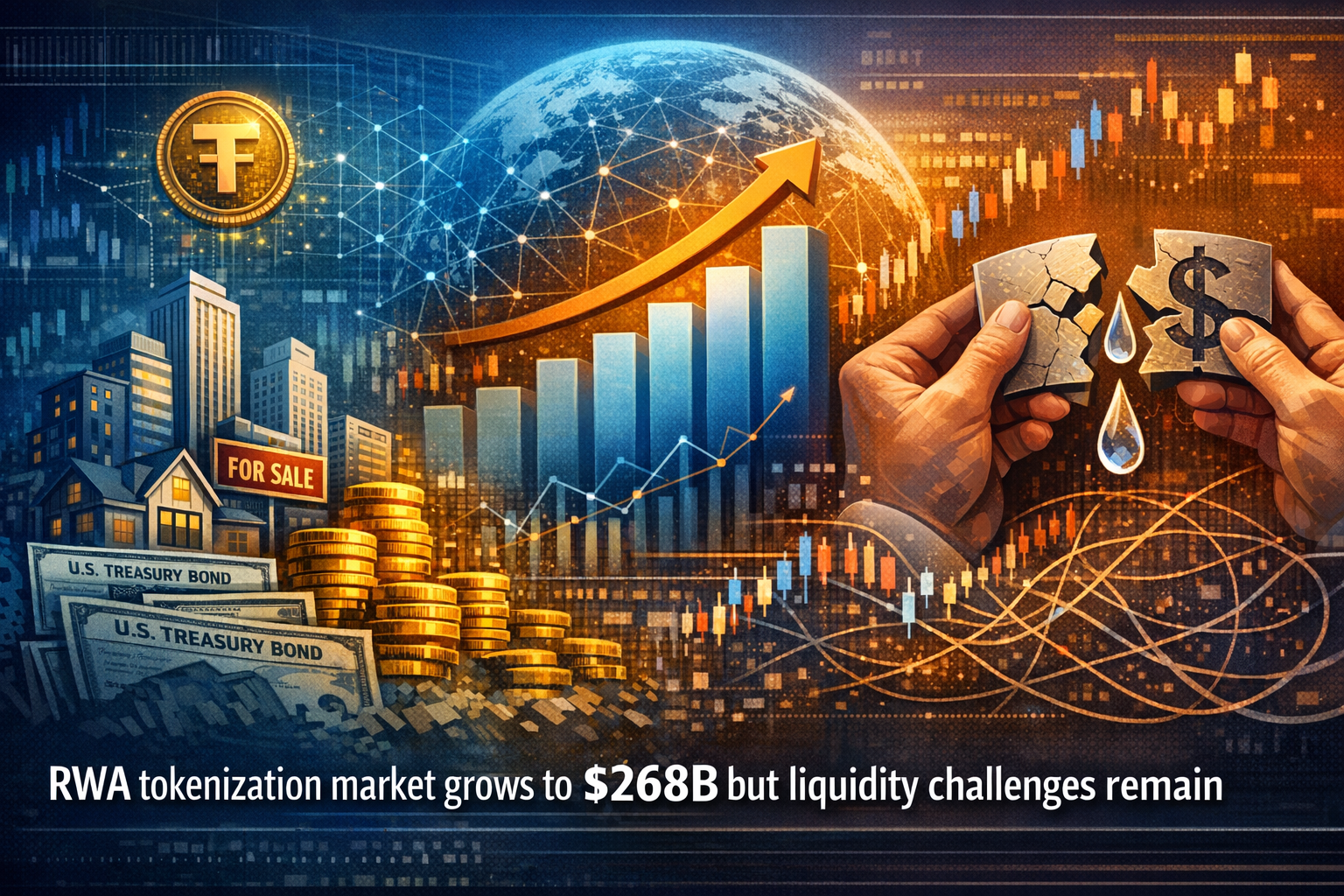
The tokenization of real-world assets (RWAs) has officially entered a new phase of growth. With the market approaching $26.5 billion in on-chain value, RWAs are no longer an experimental niche — they are becoming a meaningful pillar of the broader digital asset ecosystem. From tokenized U.S. Treasuries to real estate, commodities, and private credit, blockchain-based representations of traditional assets are expanding rapidly.
Yet despite this impressive headline number, the industry faces a critical hurdle: liquidity remains fragmented and uneven, preventing RWAs from reaching their full potential.
From Concept to Capital: How RWAs Reached $26B
Only a few years ago, RWA tokenization was largely theoretical. Today, major financial institutions, fintech startups, and crypto-native protocols are actively deploying products that bring traditional assets on-chain.
The fastest-growing segments include:
Tokenized Treasury bills and money market funds, offering crypto investors yield backed by government debt
Real estate tokens, enabling fractional ownership of properties
Private credit and structured products, providing access to institutional-grade returns
Commodities and alternative assets, such as gold and carbon credits
This growth has been fueled by several converging trends:
Institutional comfort with blockchain infrastructure
Regulatory frameworks becoming clearer in key jurisdictions
Demand for yield in a post-zero-interest-rate world
Improved custody, compliance, and identity solutions
Together, these factors have pushed RWA tokenization close to the $26.5B mark, signaling genuine adoption beyond speculative crypto trading.
Liquidity: The Missing Piece
While issuance is accelerating, liquidity has not kept pace.
Many tokenized assets still trade in isolated pools or permissioned environments, limiting participation and price discovery. Unlike native crypto assets, RWAs often carry:
Transfer restrictions
KYC and accreditation requirements
Jurisdictional limitations
Manual settlement processes bridged into automated systems
As a result, secondary markets remain thin. Investors may be able to buy tokenized assets easily, but selling them at scale — or quickly — can be far more difficult.
This creates several problems:
Wider bid–ask spreads
Inconsistent pricing across platforms
Reduced capital efficiency
Lower appeal for active traders and institutions
Without deep, unified liquidity, RWAs risk becoming long-term hold instruments rather than dynamic financial primitives.
Pricing Complexity Adds Another Layer of Friction
Unlike cryptocurrencies, RWAs depend on off-chain valuation models.
Real estate requires appraisals. Private credit depends on borrower performance. Treasury tokens must track underlying yields and maturity profiles. Each asset class introduces its own pricing logic, data sources, and update cycles.
This complexity makes it harder to:
Build automated market makers
Create composable DeFi strategies
Enable real-time arbitrage
Standardize risk assessment
In short, RWAs are bridging two very different worlds: the deterministic logic of blockchains and the probabilistic nature of traditional finance.
Real Estate and Treasuries Lead — But With Different Dynamics
Tokenized Treasuries have emerged as one of the strongest performers in the RWA space. Their appeal is simple: predictable yield, low risk, and global accessibility. These products increasingly resemble on-chain savings accounts for crypto-native capital.
Real estate, meanwhile, tells a different story.
While property tokenization promises fractional ownership and broader access, it faces deeper liquidity challenges. Real estate is inherently illiquid, slow-moving, and locally regulated. Putting it on-chain improves transparency and accessibility, but it does not magically transform buildings into highly tradable assets.
This contrast highlights a key lesson: not all RWAs benefit equally from tokenization.
Assets with standardized pricing and frequent settlement cycles adapt more easily to blockchain rails.
Infrastructure Is Catching Up
The good news is that the ecosystem is evolving quickly.
Several developments are helping close the liquidity gap:
Cross-chain interoperability for RWA tokens
Institutional-grade decentralized exchanges
On-chain identity and compliance layers
Better oracle systems for real-world pricing data
Token standards designed specifically for regulated assets
At the same time, traditional financial players are experimenting with blockchain-native settlement, which could eventually unlock near-instant clearing and global liquidity pools.
As these pieces mature, RWAs may begin to behave less like static representations of off-chain assets and more like fully programmable financial instruments.
What Comes Next?
The $26B milestone is important — but it’s only the beginning.
The next phase of RWA growth will likely focus on:
Deeper secondary markets
Unified liquidity venues
Improved transparency around pricing
Greater institutional participation
Regulatory alignment across regions
If these challenges are addressed, RWAs could become one of the most transformative applications of blockchain technology, bridging trillions of dollars in traditional finance with decentralized infrastructure.
RWA tokenization has proven its viability. Capital is flowing, products are launching, and institutions are paying attention.
But scale alone is not enough.
For RWAs to truly reshape global finance, liquidity must become as native as issuance. Until then, the market will continue to grow — but below its true potential.
The foundations are being laid. The question now is how quickly the ecosystem can turn tokenized assets from promising experiments into liquid, composable, and globally accessible financial building blocks.