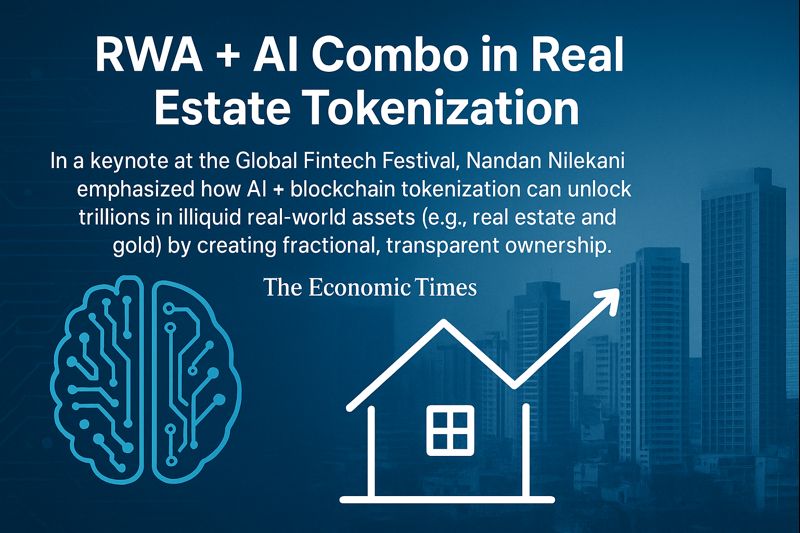
At the Global Fintech Festival, Nandan Nilekani delivered a message that is quickly becoming one of the defining narratives of modern finance: AI combined with blockchain-based tokenization is unlocking a new era for real-world assets (RWAs). What was once illiquid, slow, and inaccessible—such as real estate or gold—can now be digitized, fractionally owned, and traded with near-instant transparency.
This isn’t just a technological trend. It’s the beginning of a trillion-dollar shift.
Why Traditional Real Estate Is Ripe for Disruption
Real estate has always been one of the most valuable asset classes on the planet, yet also one of the most illiquid. Barriers like high capital requirements, lengthy legal processes, geographic limitations, and fragmented data have kept millions of investors sidelined.
Tokenization changes this paradigm by converting property ownership into digital tokens, each representing a fraction of the asset. These tokens can be traded, transferred, or used as collateral—instantly and securely.
But adding AI into the equation accelerates everything.
How AI Supercharges RWA Tokenization
AI is not just a nice add-on; it’s the engine that transforms tokenization from a digital format into a living, adaptive financial system. Here’s how:
1. Automated Asset Valuation
AI models can continuously update property valuations based on:
-
market activity
-
local economic trends
-
historical patterns
-
real-time comparable sales
Investors get up-to-date pricing without relying on slow, manual appraisal cycles.
2. Smart Risk Management
AI can analyze thousands of data points—from neighborhood crime rates to rental yield projections—helping platforms detect anomalies or predict potential downturns early.
3. Fractional Ownership Optimization
Tokenization platforms can use AI to dynamically:
-
adjust token supply
-
recommend optimal liquidity pools
-
forecast investor demand
This means smoother trading and more stable pricing.
4. Transparent & Verified Ownership
Blockchain ensures ownership is tamper-proof, while AI can automate compliance checks (KYC/AML), ownership verification, and identity risk scoring.
Together, they form the backbone of a safer, more open investment ecosystem.
A Trillion-Dollar Opportunity
Nilekani’s keynote highlighted a bold but increasingly realistic estimate: AI + tokenization could unlock trillions in dormant real-world assets.
Why? Because the platform economy thrives when:
-
ownership becomes fractional,
-
markets become global,
-
transactions become instantaneous, and
-
data becomes intelligent.
Real estate, gold, private credit, infrastructure, and even collectibles all stand to gain. Institutions are already exploring these models, and retail investors are following closely behind.
What Comes Next?
Expect to see:
-
tokenized REITs with AI-powered yield strategies
-
decentralized property markets
-
globalized access to local real estate deals
-
fully automated property leasing, rent distribution, and governance
-
on-chain mortgages and collateralization
The combination of AI intelligence and blockchain certainty is redefining what ownership means in the 21st century.
Real estate tokenization is no longer just a theory—it’s an emerging global market. AI is its catalyst, and blockchains are its foundation. Together, they are transforming illiquid physical assets into liquid, programmable digital economies.
As Nilekani emphasized, we are only at the beginning of this transformation. The next decade will likely see the largest shift of wealth into digital formats in history—and real estate will be at the center of it.