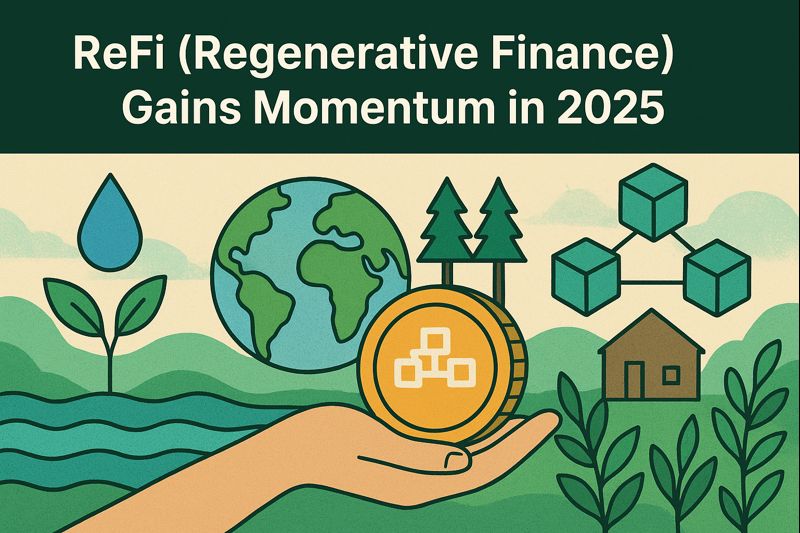
In 2025, Regenerative Finance (ReFi) is no longer a niche corner of Web3—it has become one of the most influential movements reshaping how blockchain, climate stewardship, and community-based economics intersect. As the world faces deep ecological and social challenges, ReFi introduces a model that moves beyond sustainability to full regeneration: rebuilding ecosystems, replenishing shared natural resources, and strengthening local communities.
While traditional finance measures value primarily through capital growth, ReFi expands the definition of value itself. Clean water access, soil restoration, biodiversity recovery, community governance, and carbon-negative infrastructure are no longer viewed as “externalities.” Instead, they are tokenized as on-chain assets—transparent, verifiable, and directly investable.
Tokenized Ecological and Social Assets
The real power behind ReFi lies in blockchain’s ability to create liquid, scalable markets around natural and social goods that were previously hard to measure or monetize. In 2025, the fastest-growing ReFi applications include:
1. Clean Water Tokens
Water scarcity has become one of the decade’s most pressing challenges. Web3 projects now issue water-rights tokens backed by verifiable freshwater availability and purification output. Investors contribute capital to expand water-purification systems, while local communities gain stable access to clean water.
2. Nature-Backed DAOs
Community-governed DAOs are emerging to preserve forests, wetlands, and marine ecosystems. These DAOs issue tokens representing real ecological impact—such as hectares preserved or biodiversity recovery metrics—measured by IoT sensors and satellite imaging.
By putting governance and ownership into the hands of local communities, ReFi empowers the same people who rely on the ecosystem to also benefit from its long-term restoration.
3. Sustainable Housing Protocols
Housing projects leveraging ReFi tokenization are introducing new models for affordable, green living. Impact-weighted tokens capture metrics like energy efficiency, carbon reduction, and community well-being, enabling investors to fund housing that actively improves both human and environmental outcomes.
Why 2025 Is the Breakout Year for ReFi
A convergence of forces is pushing ReFi into the mainstream:
-
Growing climate urgency has intensified demand for transparent, measurable impact.
-
Institutional adoption is rapidly increasing, with funds seeking regenerative assets as part of ESG mandates.
-
Blockchain maturity finally provides the infrastructure to verify real-world ecological data on-chain.
-
Local communities are gaining financial sovereignty through DAO-based, regenerative micro-economies.
The result is a shift toward economic models that don’t just extract value—but create it for both people and the planet.
The Future: Regenerative Economies at Global Scale
As ReFi expands, it may redefine the next generation of global markets. Imagine:
-
Cities where carbon-negative transportation is incentivized via impact tokens
-
Farms where soil regeneration increases community-based token rewards
-
Oceans where cleanup efforts are funded through blue-economy DAOs
-
Nations integrating regenerative assets into official economic strategy
ReFi is not a trend—it is an emerging economic operating system that aligns financial incentives with planetary well-being. And in 2025, this vision is becoming real.