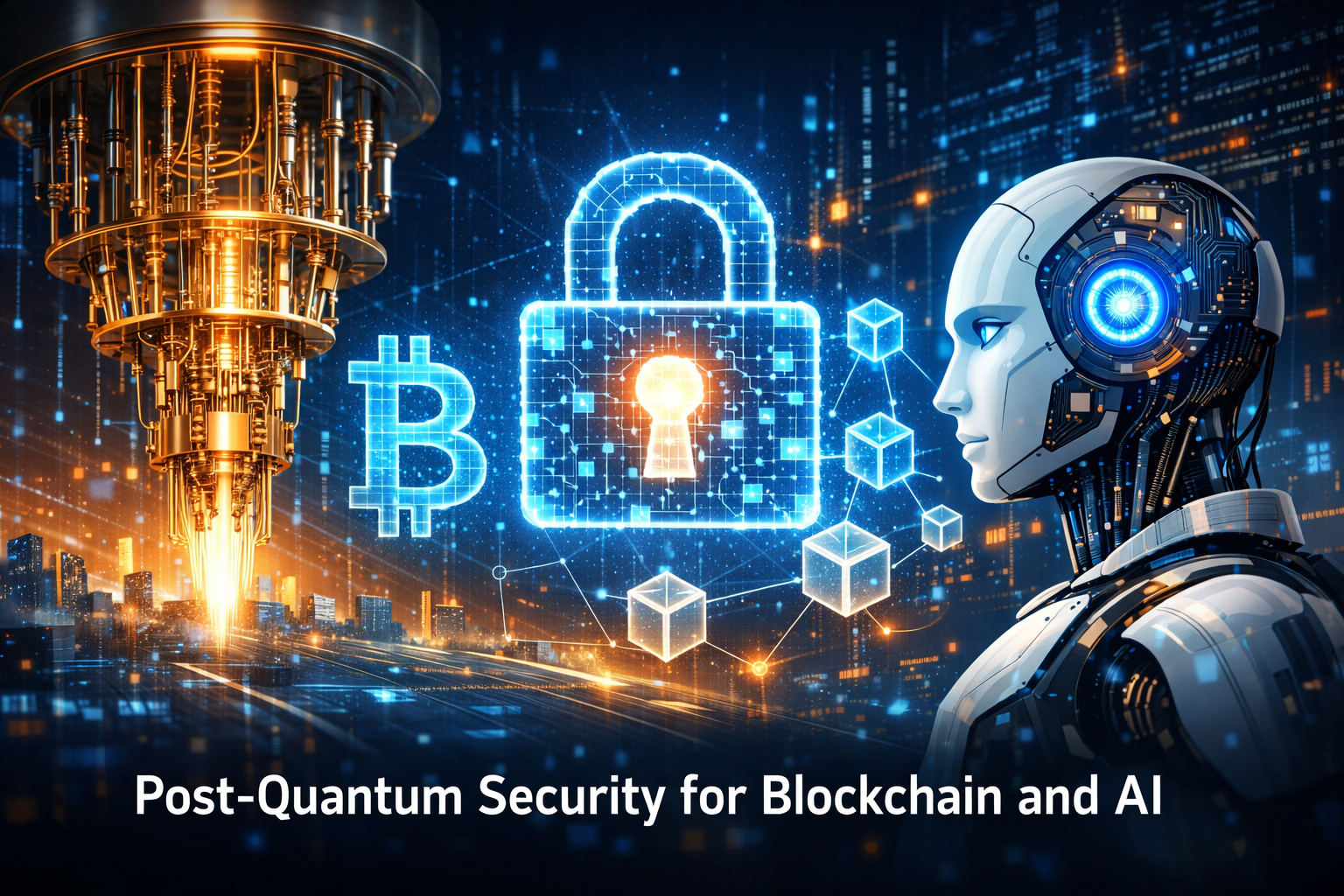
Quantum computing is rapidly transitioning from theoretical research to practical engineering. While today’s quantum machines are still limited, their future capabilities pose a profound challenge to the cryptographic foundations of modern digital systems. Among the most exposed technologies is blockchain, whose security model relies heavily on public-key cryptography that could eventually be broken by sufficiently powerful quantum computers.
This looming threat is accelerating a new wave of innovation: post-quantum security. Blockchain projects, protocol designers, and infrastructure providers are now racing to develop quantum-resistant cryptographic schemes that can protect digital assets, smart contracts, tokenized systems, and autonomous AI agents well into the future.
Why Quantum Computing Is a Threat to Blockchain
Most blockchains today rely on elliptic curve cryptography (ECC) and hash-based mechanisms to secure transactions, wallets, and consensus. While these systems are considered secure against classical computers, quantum algorithms—most notably Shor’s algorithm—could theoretically break widely used digital signature schemes once quantum hardware reaches sufficient scale and stability.
For blockchain networks, the implications are severe:
Wallet compromise: Public keys exposed on-chain could allow attackers to derive private keys.
Asset theft: Tokens, NFTs, and tokenized real-world assets could be drained without recourse.
Smart contract manipulation: Malicious actors could impersonate legitimate signers or governance participants.
Loss of trust: The immutability that defines blockchain becomes a liability if past transactions can be exploited.
Even if large-scale quantum attacks are still years away, blockchain data is permanent. Transactions signed today may be vulnerable tomorrow, making early mitigation essential.
The Rise of Post-Quantum Cryptography in Blockchain
In response, blockchain ecosystems are increasingly prioritizing post-quantum cryptography (PQC)—cryptographic methods designed to resist both classical and quantum attacks. These include lattice-based, hash-based, multivariate, and code-based signature schemes.
Key areas of innovation include:
Quantum-Resistant Signature Schemes
New digital signature algorithms are being explored to replace or augment existing ECC-based systems. These signatures are designed to remain secure even in a post-quantum world, though they often come with trade-offs such as larger key sizes or higher computational costs.
Protocol-Level Upgrades
Some blockchain projects are planning long-term protocol upgrades that allow seamless migration to quantum-safe cryptography. This includes hybrid approaches, where classical and post-quantum signatures coexist during a transition period.
Secure Key Management
Advanced key rotation, address abstraction, and signature aggregation techniques are being developed to minimize the exposure of public keys and reduce attack surfaces.
Protecting Tokenized Systems and Digital Economies
As tokenization expands—from cryptocurrencies to real-world assets like real estate, commodities, and intellectual property—the need for quantum-resistant security becomes even more urgent. Tokenized systems often represent legal ownership or economic rights, meaning a cryptographic failure could have real-world financial and legal consequences.
Post-quantum security ensures that:
Long-lived assets remain protected over decades
Institutional investors can trust blockchain infrastructure
Regulatory-grade security standards can be met
Cross-chain and custodial systems are resilient to future threats
In this context, quantum resistance is no longer an experimental feature—it is a prerequisite for sustainable digital finance.
AI Agents and Autonomous Systems: A New Risk Surface
Another emerging dimension is the rise of AI agents operating on-chain. These agents can manage wallets, execute smart contracts, negotiate transactions, and make autonomous decisions. While powerful, they also expand the cybersecurity attack surface.
If quantum-enabled attackers can compromise agent identities or signatures, entire automated systems could be hijacked. Post-quantum cryptography helps ensure that AI agents remain verifiable, tamper-resistant, and accountable—even in adversarial future environments.
Preparing Today for Tomorrow’s Threats
The shift toward post-quantum blockchain security is not driven by panic, but by foresight. History has shown that cryptographic transitions take years—sometimes decades—to fully deploy. Waiting until quantum computers are already capable of breaking existing systems would be far too late.
Forward-looking blockchain projects are already:
Experimenting with quantum-safe testnets
Engaging in cryptographic standardization efforts
Designing upgrade paths for legacy wallets and contracts
Educating users and developers about future-proof security
Quantum computing represents both a technological breakthrough and a security reckoning. For blockchain, it challenges long-standing assumptions about cryptographic permanence. The industry’s proactive embrace of post-quantum security reflects a broader maturation—one that acknowledges long-term risks and responds with innovation.
By investing today in quantum-resistant signatures, protocols, and architectures, blockchain ecosystems can continue to safeguard digital assets, smart contracts, tokenized systems, and AI agents against the cybersecurity threats of tomorrow. In doing so, they reinforce trust in decentralized technologies as a foundation for the future digital economy.