

Ethereum lost the critical $3,000 level on Sunday, sliding toward $2,800 and triggering a new wave of fear across the market. The drop highlights a deepening corrective phase that has pushed short-term investors into heavy unrealized losses, prompting many to reassess their risk exposure.
Adding to the uncertainty, fresh on-chain data has revealed renewed distribution from major holders. According to data from Arkham, shared by Lookonchain, the well-known whale 0xdECF deposited another 5,000 ETH—roughly $15.05 million—into Binance.
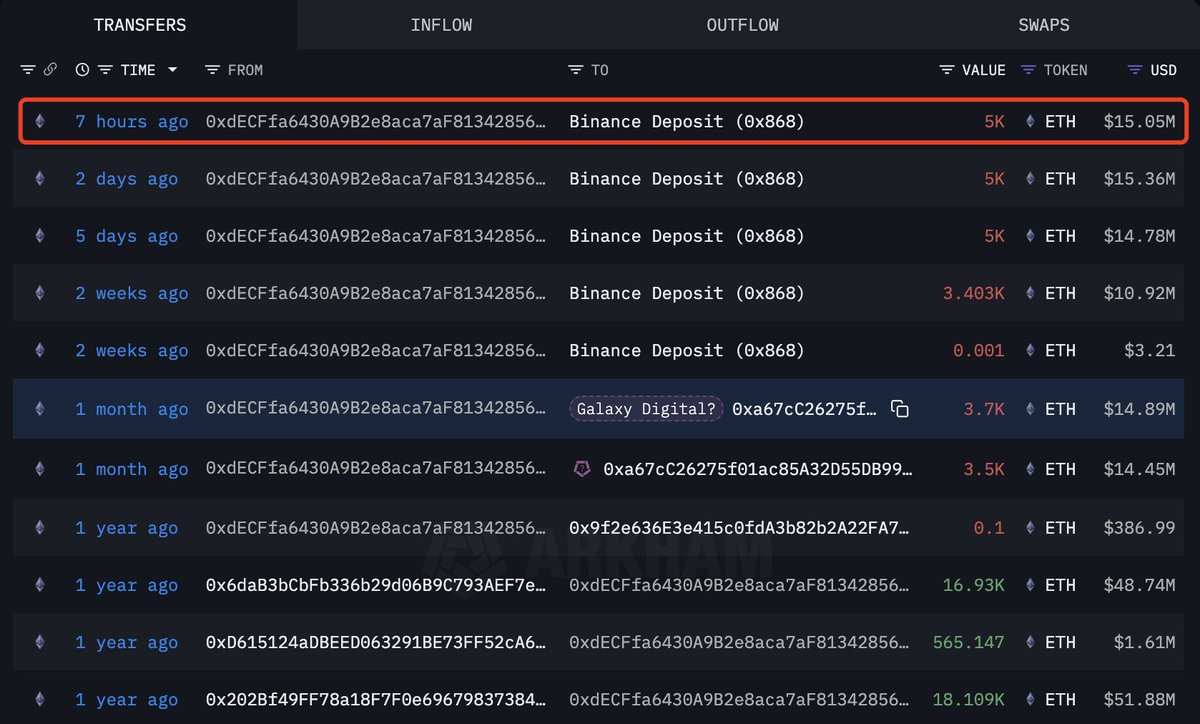
This move expands a pattern of consistent selling pressure from large wallets, often seen during heightened market stress. While one whale does not define the broader trend, these deposits usually reinforce bearish sentiment among traders who monitor exchange inflows as a proxy for potential sell-side liquidity.
Whale Distribution Deepens Amid Broader Market Anxiety
Since October 28, the same whale wallet has accelerated its selling activity, unloading 25,603 ETH—approximately $85.44 million—across Binance and Galaxy Digital. Despite this aggressive distribution, the wallet still holds 10,000 ETH valued at roughly $30.34 million, leaving open the possibility of continued sell pressure if market conditions weaken further. Large-scale movements like these often signal a shift in sentiment from sophisticated holders who tend to anticipate volatility earlier than the broader market.
This selling spree comes at a moment when confidence is already fragile. The recent Tether FUD, fueled by speculation around reserve transparency and potential regulatory scrutiny, has added stress to liquidity conditions.
Meanwhile, renewed headlines about a supposed China Bitcoin ban have resurfaced on social media, amplifying fear across both retail traders and short-term investors. Although neither narrative reflects new fundamental risks, emotional markets often react sharply to sensational news during corrective phases.
Together, these factors create a backdrop where whale distributions gain outsized influence. If the remaining 10,000 ETH enters exchanges, it could deepen short-term downside pressure. Conversely, a pause in selling may suggest that the whale views current levels as near-capitulation territory, offering a potential floor for stabilization.
Ethereum Price Tests Support as Downtrend Remains Intact
Ethereum’s 4-hour chart shows a market still struggling to regain momentum after losing the $3,000 handle. The broader structure remains decisively bearish, with price trading below the 50 SMA, 100 SMA, and 200 SMA—a clear indication that sellers continue to control the trend. Each attempt to recover above the moving averages has been rejected, reinforcing the downtrend that began in late October and has continued through November.

The recent bounce from the $2,750–$2,800 support zone shows that buyers are defending this level, but the reaction lacks conviction. Volume remains muted, and the latest attempt to reclaim $3,000 quickly failed, forming another lower high. This signals hesitation and suggests that bulls are not yet strong enough to shift market structure.
The compression seen toward the end of the chart formed a small symmetrical triangle, but the breakdown that followed confirms that sellers still dominate short-term momentum. As long as ETH remains below the 200 EMA—now near $3,350—the macro trend favors continuation to the downside.
If $2,800 breaks cleanly, the next liquidity pockets sit around $2,600 and $2,450, levels that could attract stronger buyer interest. For now, Ethereum must reclaim $3,000 with sustained volume to neutralize bearish pressure.
Featured image from ChatGPT, chart from TradingView.com