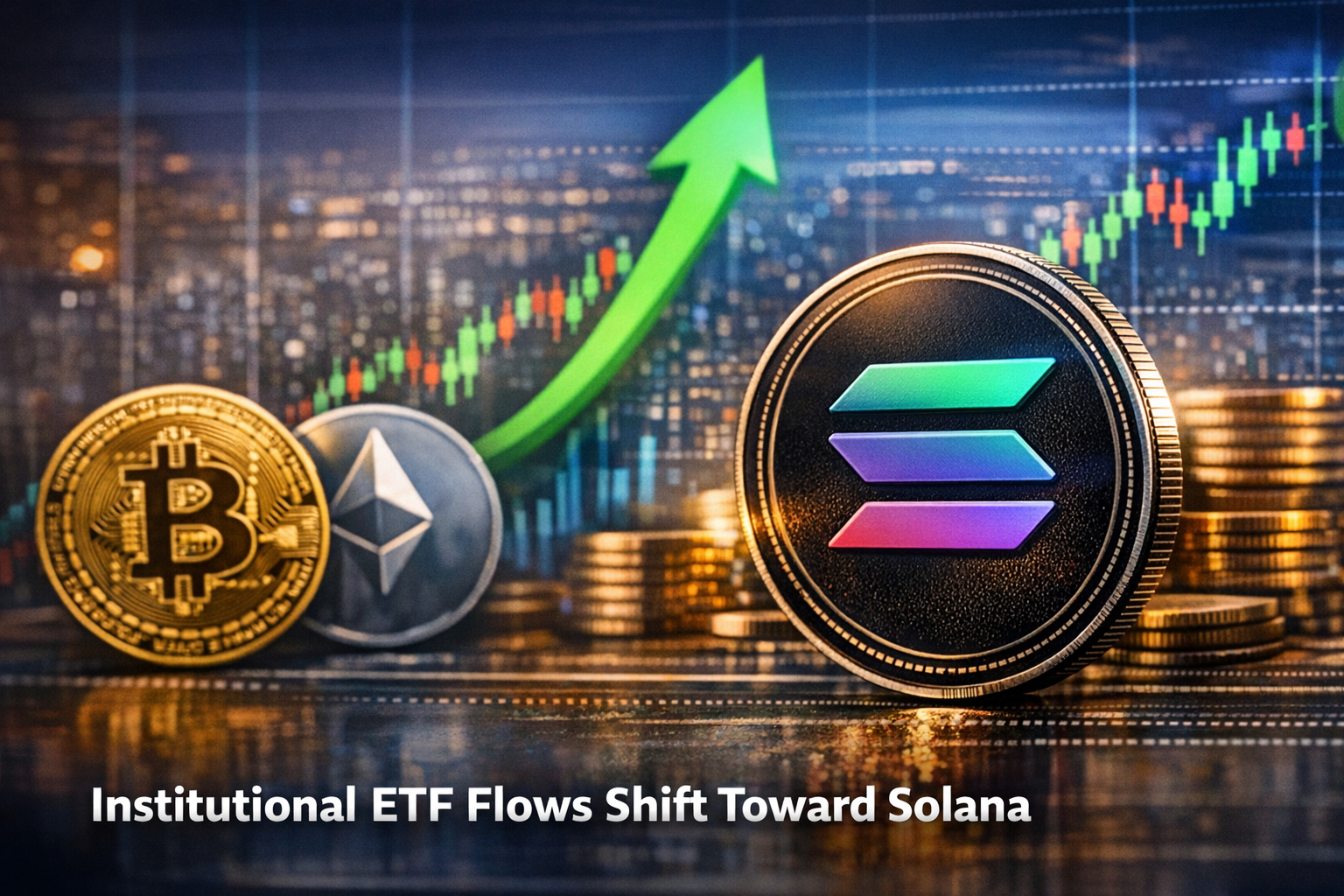
Institutional investors are once again reshaping the cryptocurrency landscape—this time with a noticeable shift toward Solana-focused exchange-traded funds (ETFs). While Bitcoin and Ethereum have long dominated institutional crypto allocations, recent capital flows suggest that large investors are beginning to diversify more aggressively into high-growth altcoins. This emerging trend may signal the early stages of a broader altcoin rotation cycle, one that could redefine portfolio strategies across the digital asset ecosystem.
The Changing Landscape of Institutional Crypto Investment
For years, Bitcoin has served as the primary gateway for institutional investors entering crypto markets. Its status as the first cryptocurrency, combined with its relative maturity and liquidity, made it the default choice for funds seeking exposure to digital assets. Ethereum followed closely behind, offering institutional investors access to decentralized finance (DeFi), smart contracts, and a rapidly expanding blockchain economy.
However, institutional strategies are evolving. Instead of concentrating solely on large-cap assets, investors are increasingly seeking asymmetric upside opportunities—assets that offer higher growth potential relative to their current market size. Solana has emerged as one of the most compelling candidates in this category.
Recent ETF flow data indicates that Solana-focused investment products are attracting growing interest, while flows into Bitcoin and Ethereum ETFs remain mixed. This shift does not necessarily signal a loss of confidence in the dominant cryptocurrencies. Rather, it reflects a natural progression in institutional investment behavior: once core positions are established, capital begins to move into emerging opportunities with higher expected returns.
Why Solana Is Attracting Institutional Attention
Several key factors explain why institutional investors are increasingly favoring Solana ETFs:
1. High Performance and Scalability
Solana’s blockchain architecture was designed to prioritize speed and efficiency. Capable of processing thousands of transactions per second with low fees, Solana offers a scalable infrastructure that appeals to both developers and investors. This technical advantage makes it well-suited for applications such as decentralized exchanges, NFT platforms, and high-frequency trading environments.
For institutional investors, scalability is not just a technical feature—it is a prerequisite for long-term viability. Blockchains that cannot scale efficiently risk losing relevance as adoption grows. Solana’s ability to maintain performance under heavy demand strengthens its investment case.
2. Growing Ecosystem and Developer Activity
Institutional investors closely monitor ecosystem growth as an indicator of future value. Solana has seen a surge in developer activity, new protocols, and user adoption over the past two years. From decentralized finance platforms to gaming and tokenized assets, the network’s expanding ecosystem demonstrates increasing real-world utility.
This ecosystem expansion creates network effects: the more developers and users join, the more valuable the network becomes. Institutional investors often seek exposure to these growth cycles early, before valuations fully reflect future adoption.
3. Portfolio Diversification Strategies
Modern institutional portfolio management emphasizes diversification—not only across traditional asset classes, but also within emerging asset classes like cryptocurrency. Allocating capital to Solana allows funds to diversify their crypto exposure beyond Bitcoin and Ethereum, reducing concentration risk while increasing potential upside.
Diversification also enables institutions to participate in broader sector growth rather than relying on a single dominant asset.
4. ETF Accessibility Lowers Barriers
ETFs have become one of the most important vehicles for institutional crypto adoption. They provide regulated, familiar investment structures that allow institutions to gain exposure without directly holding cryptocurrencies.
Solana ETFs offer a convenient and compliant pathway for investors to add SOL exposure within traditional portfolios. This accessibility accelerates capital inflows and contributes to increased legitimacy.
Signs of an Emerging Altcoin Rotation Cycle
Market cycles in cryptocurrency often follow predictable patterns. Bitcoin typically leads early in a bull cycle, attracting institutional capital due to its stability and reputation. Ethereum follows, benefiting from increased confidence in blockchain technology. Finally, capital begins rotating into smaller altcoins with higher growth potential.
This rotation pattern has been observed in previous cycles, including the 2017 and 2021 bull markets. The current shift toward Solana ETFs may represent the early phase of a similar cycle.
Several indicators support this thesis:
Increasing institutional ETF inflows into Solana
Mixed or stabilizing flows into Bitcoin and Ethereum products
Rising developer and ecosystem activity on alternative chains
Growing investor appetite for higher-risk, higher-reward assets
If this trend continues, Solana could serve as a leading indicator for broader altcoin market strength.
Institutional Behavior Signals Market Confidence
Institutional investors are typically slower to move than retail investors, but their decisions often carry greater long-term significance. Institutions conduct extensive due diligence, evaluating technical fundamentals, ecosystem health, liquidity, and long-term sustainability.
When institutional capital begins flowing into altcoins like Solana, it suggests growing confidence not only in the asset itself, but in the broader maturity of the cryptocurrency market.
This shift also reflects a deeper structural change: cryptocurrency is no longer viewed as a single-asset investment dominated by Bitcoin. Instead, it is increasingly seen as a diverse asset class with multiple viable platforms competing for capital.
Potential Implications for the Broader Crypto Market
The rise in Solana ETF demand could have several important implications:
Increased Market Liquidity
Institutional inflows bring substantial capital, improving liquidity and reducing volatility over time. This increased liquidity can attract even more investors, creating a positive feedback loop.
Greater Institutional Legitimacy for Altcoins
As institutions allocate capital beyond Bitcoin and Ethereum, altcoins gain legitimacy as serious investment assets rather than speculative instruments.
Accelerated Innovation and Ecosystem Growth
Capital inflows often fuel development, attracting more builders, startups, and infrastructure providers to the ecosystem. This accelerates technological innovation and network adoption.
Expanded Crypto Portfolio Models
Institutional portfolio strategies may evolve to include diversified crypto allocations, similar to traditional equity portfolios that include both large-cap and growth stocks.
Risks and Considerations
Despite the growing optimism, risks remain. Solana, like all emerging technologies, faces competition from other blockchains. Regulatory developments could also impact ETF availability and institutional participation.
Additionally, institutional flows can shift quickly in response to macroeconomic conditions, interest rates, and global risk sentiment.
Investors should view this trend as part of a broader market evolution rather than a guaranteed outcome.
The Bigger Picture: A Maturing Asset Class
The shift in ETF flows toward Solana represents more than just a short-term trend—it reflects the ongoing maturation of cryptocurrency as an institutional asset class.
In early years, crypto investment was dominated by speculation and retail enthusiasm. Today, institutional capital is driving strategic allocation decisions based on infrastructure quality, scalability, and long-term growth potential.
This evolution mirrors the development of other emerging technologies throughout history. Early leaders establish the foundation, but innovation and competition create new opportunities for growth.
Solana’s rising institutional demand may signal that the crypto market is entering its next phase—one defined by diversification, competition, and broader adoption.
Institutional ETF flows shifting toward Solana highlight a significant transition in crypto investment strategy. Rather than focusing exclusively on Bitcoin and Ethereum, institutional investors are increasingly exploring high-growth altcoins that offer scalability, innovation, and diversification benefits.
While it remains too early to declare a full altcoin rotation, the current trend suggests that institutional capital is beginning to position itself for the next phase of the crypto market cycle.
If sustained, this shift could mark the beginning of a new era—one where Solana and other high-performance blockchains play a central role in institutional crypto portfolios.