
You’ve probably encountered a situation where you requested something from an AI, and the AI just… wouldn’t? You requested a particular prompt, and the AI responded with a corporate-sounding, “Sorry, I can’t do that.” MyLovely AI is designed to do away with all that.
Not only can you make videos with it, but you can create videos without all the censorship built into other AIs, which are AIs that are constantly telling you that they can’t complete your prompt.
And that shifts everything.
You no longer have to constantly do battle with the AI, and you’re able to work with it instead.
How to Generate AI Videos — Simple, Human-Friendly Guide
Step 1: Click “Create Video”
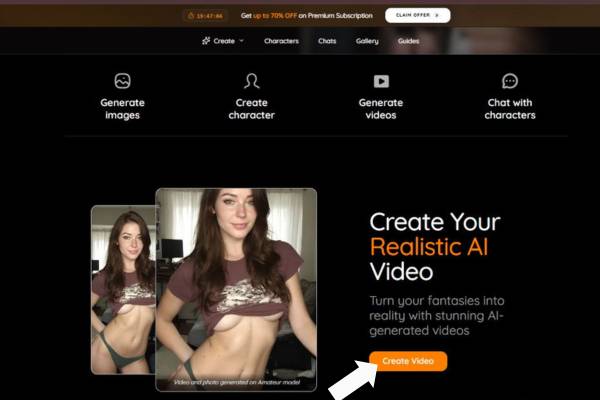
This is what the platform will look like when you first log in to the platform. As you can see, it’s pretty simple. You see a lot of options: Generate images, Create character, Generate videos, Chat with characters.
Ignore all that.
You want the orange button on the right that says Create Video. That’s under the Create Your Realistic AI Video text.
Click it.
You’re basically telling the system, “Okay, we’re making something.”
Then, you’ll be taken to the screen to generate the video.
Step 2: Describe Your Video (This is Where the Magic Happens)
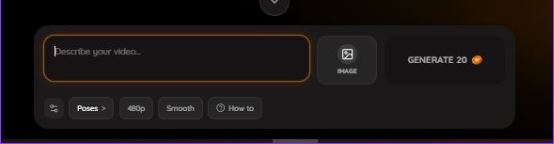
Here you will find a large text box with the following text:
Describe your video…
This is where the magic happens.
The AI doesn’t know what you want unless you tell it what you want. If you type in “guy standing” you will get a guy standing. But if you describe the scene, it is almost eerie.
Consider it as giving direction to a cinematographer.
Instead of typing…
person standing
…consider typing…
a person standing near a window, soft cinematic lighting, calm emotional mood, slight head movement, camera slowly zooming in on the person
You will see that you are not just describing what is in the scene, you are describing the essence of the scene.
To be honest, this is where you will start to have fun. You will play around. We all do.
Step 3: Click “Generate”
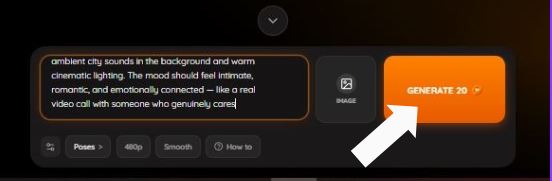
When your prompt seems good (or good enough), you will automatically glance over to the big orange button on the right. This button says GENERATE 20, where the “20” here signifies that it will generate a video using 20 credits. Simple enough.
You can go ahead and click that.
Then… you wait.
Not long. A second or so. Enough to give you that slight sense of expectation you might have felt in the old days of film cameras, waiting for your pictures to be developed. What’s happening “under the hood” is that your text is being parsed, the scene being constructed, the movement and lighting and emotions and everything else being calculated and rendered into a video.
The first time this happens, it’s a bit surreal. You just… typed a sentence… and now it’s a thing. On your screen. That moves and breathes and is. It’s a weird sort of fulfilling, to be honest.
And if the first result isn’t perfect? Totally fine.
That’s the part that surprises a lot of folks.
Perhaps you have a very clear picture in your mind but your first video isn’t quite like that. The motion is perhaps a little different. The atmosphere isn’t quite right. This isn’t a problem. This is all part of it.
It’s similar to when you try to explain a concept to someone else. You try one way, they almost understand. You try again with some modification, maybe a little more information, a little more feeling around it — and then they understand.
It’s the same with this.
You change a few words around. Add “soft lighting” or “slow camera movement.” Try again.
And the results begin to be more and more what you envisioned.
After a few iterations, you realize something. You’re no longer guessing. You know how to word things. It’s second nature.
What Does It Take for a Prompt to Be Good?
Good prompts aren’t fancy. They’re just straightforward.
You need to explain the essentials of the setting, kind of like you’re describing a painting.
Consider:
- Characters: Who is in the video.
- Action: What they’re doing.
- Setting: Where they are.
- Lighting: What the lighting feels like.
- Tone: What kind of emotion or mood is present.
- Camera movement: How the camera moves.
For instance, you could avoid writing the obvious:
a realistic person in a dimly lit room, cinema warm lighting, relaxed emotions, slight breathing motion, camera slowly coming closer
That way, the AI has something concrete to go off of. It gets the vibe, not just the topic.
Short prompts can be fine, of course. But the longer and more detailed, the more solid and convincing.
To be honest, the full process is really, really easy.
Looking back it’s almost laughably simple.
There’s the Create Video button. Then you type in the video description. Then you hit Generate. The AI creates the video.
That’s all.
- No editing schedule – No technical fuss – No hard-to-use editing software
Just a thought… becoming action.
Optional: Add an Image (for More Customization)
Now if you look to the right of the text prompt box, you’ll see a tiny button that says “IMAGE”.
That’s for uploading an image if you want a little more control over what’s going to be in your video.
So for example, if you have an existing image of the character that’s going to star in your video, you can upload that here if you want to use the same character. Then the AI will have to use that.
This can be useful if you want to make a whole bunch of videos that use the same character.
But if you don’t upload an image, then the AI will just generate everything from your prompt text. So either way works.
The Little Options Below the Prompt Box
Now underneath the prompt box, you have a few little options. You’ve got “Poses”, “480p”, “Smooth” and “How to”.
Now these seem like little tiny options down here, but they actually affect the video as well.
The “Poses” option helps control the way that your character stands and moves. If you ever notice that their movement looks a little awkward sometimes, then you can use this “Poses” option to try and improve that.
“480p” is the quality of the video. This is the resolution. It’s the standard resolution and it’s quick. So it’s good for just testing things out. Then when you’re happy with it, you can always increase the resolution later if you want to.
“Smooth” does what it sounds like. It just makes the movement a little bit smoother, a little bit more natural. So without this “Smooth” option enabled, the movement can look a little bit stilted sometimes. Most people leave this on.
Then there’s a “How to” button. That’s just in case you need help.
So you don’t need to worry about these options for now. I just wanted to point them out to you because they’re here. But the standard options usually work okay.
What “Unfiltered Video Generation” is really like (as opposed to the advertized one)
Go on.
Take a deep breath.
You write:
“Show me a video of an android woman in a cyberpunk neon street who is walking, with a tired, emotional, human expression.”
What most platforms do, they filter this down. They make it plain. They remove the humanity from it.
MyLovely AI doesn’t.
It makes video where people are animated as humans should be, with emotions.
What’s more.
It even makes videos of custom characters acting, moving, even showing their personalities. Not just standing around like NPCs.
That’s when I realized.
This is not just video generation.
This is story generation.
What are the key functionalities of an Unfiltered Video AI (if you need them explained like to a human)?
Essentially, I boiled down the list for you and removed all the extra words:
Feature Definition Importance
Freedom to use prompts with no auto-blockwords or denied responses
- Less likely to feel frustrating
- Text-to-video generation
- Allows your imagination to become a reality
- Character video model
- Allows you to create a character within your creations
- Image-to-video functionality
Let’s you upload an image and the AI models the image in a video Emotional motion generation Allows for more realistic expressions Allows adult / unrestricted generation support Gives you the ability to generate video outside of the limitations of other AI models
AI platforms that are known for this type of video generation include MyLovely AI.
Yes, I said it. It is addictive.
The point where it gets a bit too real (and slightly emotional)
This is something no-one told me about.
You create an avatar. Okay.
You make them move.
And then, all of a sudden… they’re alive. They’re looking around. They’re living.
It’s like seeing something that once existed only in your imagination take a breath of fresh air.
That first piece of video content you produce?
It feels different.
There’s this odd sensation that realises that you haven’t just watched content.
You’ve made something.
What sets MyLovely AI apart from other filtered AI video tools
The other AI video tools feel like they were designed by a corporation’s legal team.
MyLovely AI feels like it was designed by creators who finally had enough of being told “no.”
The truth is:
Category Filtered AI Generators
MyLovely AI Unfiltered Video Prompt restrictions
Heavy filtering Minimal filtering
- Creative freedom
- Limited Extremely open
- Character emotional realism
- Often robotic
- Surprisingly expressive
- Adult content generation
- Usually blocked
- Supported Custom character animation
- Limited Core feature
- Creative immersion
- Feels technical
- Feels immersive
Filtered tools feel like you’re filling out a form.
Unfiltered tools feel like you’re directing a movie.
Simple explanation of how it works
No BS tech explanation, just what happens.
You do:
- Open video maker
- Paste prompt (or upload image)
- Press play and wait
- Your video is done
Simple as that.
No rendering software needed. No video editing software needed. No fancy controls to play with.
The caveat is yes it creates weird things, hands aren’t right, the motion gets weird and spaced out.
Strangely enough though
it makes it feel more real.
Not real as in 100% polished corporate video, real as in it’s a creative project.
The emotional truth is that people are gravitating towards unfiltered AI video creation because…
Filtered AI keeps a buffer between you and creation.
Unfiltered AI takes that buffer away.
Unfiltered AI video generation gives creators the ability to communicate without the interference of forced quality control, placing a higher value on authenticity and creative liberty.
Humans desire that liberty.
Not polish.
Liberty.
The honest emotional conclusion
This tool doesn’t feel like software.
It feels like unlocking something.
Not because it’s perfect.
Because it’s free.
Free creatively. Free emotionally. Free from constant artificial restriction.
You stop thinking:
“What will the AI allow?”
And start thinking:
“What do I want to create?”
That shift alone makes it worth trying.
Verdict (subjective)
Category Score
- Creativity 10/10
- Userfriendliness 9/10
- Believability 8.5/10
- Addictiveness very high
- Overall 9.5/10
You will probably come in out of curiosity.
But you will not leave out of curiosity.
You will leave because you didn’t have more plans for tonight.
And you will return tomorrow, with some more.