

When critical services depend on quick action, from the safety of vulnerable children to environmental protection, you need working AI solutions in weeks, not years. Amazon recently announced an investment of up to $50 billion in expanded AI and supercomputing infrastructure for US government agencies, demonstrating both the urgency and commitment from Amazon Web Services (AWS) to accelerating public sector innovation. The AWS Generative AI Innovation Center is already making this happen, consistently delivering production-ready solutions for government organizations.
What makes this time different
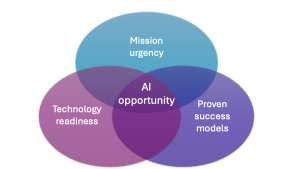
The convergence of three factors makes this technology moment different:
- Mission urgency – Public sector organizations currently face the challenge of managing both growing workloads in mission-critical areas, such as veterans’ benefits claims and bridge safety inspections, and workforce and budget limitations.
- Technology readiness – Production-ready AI solutions can now be deployed securely and at scale, with unprecedented compute capacity being built specifically for US government requirements.
- Proven success models – Early adopters have demonstrated that rapid AI implementation is possible in government settings, creating blueprints for others to follow.
Drawing from over a thousand implementations, the Innovation Center combines AWS infrastructure and security conformance to help you transform mission delivery.
Accelerating real-world innovation
Public sector organizations working to improve mission speed and effectiveness can collaborate with the Innovation Center to develop targeted solutions. These three case studies show this approach in action.
AI systems that support critical care to protect vulnerable children
When protecting a child’s welfare, having key information surface at exactly the right moment is crucial. Systems must work reliably, every time.
This was the challenge the Miracle Foundation faced when managing foster care caseloads globally. In the span of weeks, the Innovation Center worked alongside caseworkers to build a production AI assistant that analyzes case files, flags urgent situations, and recommends evidence-based interventions tailored to each child’s unique circumstances.
“When a caseworker misses an urgent signal in a child’s file, it can have life-changing consequences,” explains Innovation Center strategist Brittany Roush. “We were building a system that needed to surface critical information at exactly the right moment.”
The solution aims to help caseworkers make faster, more informed decisions for vulnerable children around the world. It also includes built-in enterprise-grade security, designed for scalability and delivered with comprehensive knowledge transfer so the Miracle Foundation team can fully manage and evolve their system.
It’s important to start with actual users on day one. The Miracle Foundation team interfaced directly with caseworkers to understand workflows before writing a single line of code. This user-first approach removed months of work to gather requirements and iterate through revisions.
Innovation at institutional scale
The University of Texas at Austin (UT Austin) approached the Innovation Center about personalized academic support for 52,000 students. The team delivered UT Sage, a production AI tutoring service designed by learning scientists and trained by faculty, which is now in open beta across the UT Austin campus. Unlike generic AI tools, UT Sage provides custom, course-specific support while maintaining academic integrity standards. “It’s like having a knowledgeable teaching assistant available whenever you need help,” one student reported during testing.
“The UT Sage project empowers our faculty to create personalized learning tools, designed to motivate student engagement,” said Julie Schell, Assistant Vice Provost and Director of the Office of Academic Technology. “With the potential to deploy across hundreds of courses, we are aiming to enhance learning outcomes and reduce the time and effort required to design student-centered, high-quality course materials.”
Build flexible foundations, not point solutions. The team architected UT Sage as a service that faculty could adapt to specific courses. This extensible design enabled institutional scale from day one, avoiding the trap of a successful pilot that never scales, which can plague technology projects.
Transforming government speed with the EPA
The U.S. Environmental Protection Agency partnered with the innovation center to transform document processing workflows that used to take weeks or months. The team, in partnership with the EPA, delivered two breakthrough solutions that demonstrate both the team’s velocity and increasing technical complexity:
- Chemical risk assessment acceleration – An intelligent document processing system that evaluates research studies against predetermined scientific criteria. What once required hours of manual review by EPA scientists now takes minutes. The system achieved an 85% reduction in processing time while maintaining 85% accuracy. Processing 250 documents costs the team $40 through the system, compared to requiring 500 hours of scientist time manually.
- Federal Insecticide, Fungicide, and Rodenticide Act (FIFRA) application reviews – Automated creation of data evaluation records (DERs) from health and safety studies for pesticide applications under FIFRA. This process traditionally took EPA reviewers 4 months of manual work. The AI solution now generates these critical regulatory documents in seconds, achieving a 99% cost reduction while potentially accelerating approval timelines for safe pesticide products.
Both solutions incorporate rigorous human-in-the-loop review processes to maintain scientific integrity and regulatory compliance alignment. EPA scientists oversee AI-generated assessments, but they can now focus their expertise on analysis and decision-making rather than manual data processing.
“We’re not replacing scientific judgment,” explained an EPA team member. “We’re eliminating the tedious work so our scientists can spend more time on what matters most—protecting public health and the environment.”
The EPA cases demonstrate that AI augmentation can deliver both speed and trust. The team designed review workflows into the architecture to improve trust, making the systems immediately acceptable to scientific staff and leadership.
Strategies to increase the pace of innovation
Experts at the Innovation Center have developed several strategies to help organizations excel with generative AI. To facilitate building your own production systems and increase the pace of innovation, follow these best practices:
- Build on day 1, not week 6 – Traditional projects spend months on requirements and architecture. The Innovation Center starts building immediately, using extensive libraries of reusable, secure infrastructure-as-code (IaC) components. They also use tools such as Kiro, an AI integrated development environment (IDE) that efficiently converts developer prompts into detailed specifications and working code. This approach has been refined with each engagement, meaning the team is building increasingly complex use cases faster than ever before. Access to the expanded government AI infrastructure of AWS can further accelerate this development process, so you can tackle increasingly sophisticated use cases.
- Get the right people on your team – Each engagement brings together scientists, architects, security experts, and domain specialists who understand public sector missions. This cross-functional composition minimizes the typical back-and-forth that often complicates requirement gathering and refinement. Everyone who’s needed to make decisions is already in the discussion, collaboratively working toward a common goal.
- Knowledge transfer happens throughout, not at the end – Don’t wait to think about technology hand-offs. Advancing a project to the next team without prior coordination is rarely an effective strategy. The deep collaboration between stakeholders working alongside Innovation Center experts happens throughout development. Knowledge transfer occurs naturally in daily collaboration, with formal documentation being handed off at the end. The Innovation Center team then continues to support in an advisory capacity until the solution goes into production.
- Harness the secure and reliable infrastructure and services of AWS – For public sector organizations, moving fast can’t mean compromising on security or compliance. Every solution is architected on secure AWS infrastructure with the ability to meet even stringent Federal Risk and Authorization Management Program (FedRAMP) High requirements. The Innovation Center follows a secure-by-design approach where compliance alignment is woven into the entire development lifecycle. By making compliance alignment concurrent, not sequential, the team demonstrates that security and speed aren’t trade-offs. The upcoming expansion of the AWS government cloud infrastructure further strengthens these security and compliance capabilities, providing you with one of the most comprehensive and secure AI computing environments.
Next steps in public sector AI
Every case study in this post started with a specific, pressing challenge. Each example achieved institutional scale by delivering value quickly, not by waiting for the perfect moment. Start with one persistent operational need, deliver results in weeks, then expand. With the AWS investment of up to $50 billion in purpose-built government AI infrastructure, these transformations can now happen at even greater scale and speed. Each successful engagement creates a blueprint for the next, continuously expanding what’s possible for public sector AI.
Learn more about the AWS Generative AI Innovation Center and how they’re helping public sector organizations turn AI potential into production reality.
About the authors
 Kate Zimmerman serves as the Generative AI Innovation Center Geo Leader for Worldwide Public Sector at AWS. Kate leads a team of generative AI strategists and scientists, architecting innovative solutions for public sector organizations globally. Her role combines strategic leadership with hands-on technical expertise, and she works directly with Director, VP, and C-level executives to drive GenAI adoption and deliver mission-critical outcomes. With 13+ years of experience spanning commercial cloud, defense, national security, and aerospace, Kate brings a unique perspective to driving transformative AI/ML solutions. Previously, as Chief Scientist & VP of Data and Analytics at HawkEye 360, she led 50+ developers, engineers, and scientists to launch the company’s first production AI/ML capabilities. Her tenure at AWS included leadership roles as Senior Manager & Principal Architect of the ML Solutions Lab, where she accelerated AI/ML adoption among national security customers, and Senior Solutions Architect supporting the National Reconnaissance Office. Kate also served in the USAF on active duty for 5 years developing advance satellite systems and continues to serve as a reservist supporting strategic AI/ML initiatives with the USAF 804th Test Group.
 Sri Elaprolu serves as Director of the AWS Generative AI Innovation Center, where he leverages nearly three decades of technology leadership experience to drive artificial intelligence and machine learning innovation. In this role, he leads a global team of machine learning scientists and engineers who develop and deploy advanced generative and agentic AI solutions for enterprise and government organizations facing complex business challenges. Throughout his nearly 13-year tenure at AWS, Sri has held progressively senior positions, including leadership of ML science teams that partnered with high-profile organizations such as the NFL, Cerner, and NASA. These collaborations enabled AWS customers to harness AI and ML technologies for transformative business and operational outcomes. Prior to joining AWS, he spent 14 years at Northrop Grumman, where he successfully managed product development and software engineering teams. Sri holds a Master’s degree in Engineering Science and an MBA with a concentration in general management, providing him with both the technical depth and business acumen essential for his current leadership role.