Google has released Gemini 3.1 Flash Live in preview for developers through the Gemini Live API in Google AI Studio. This model targets low-latency, more natural, and more reliable real-time voice interactions, serving as Google’s ‘highest-quality audio and speech model to date.’ By natively processing multimodal streams, the release provides a technical foundation for building voice-first agents that move beyond the latency constraints of traditional turn-based LLM architectures.
Is it the end of ‘Wait-Time Stack‘?
The core problem with previous voice-AI implementations was the ‘wait-time stack’: Voice Activity Detection (VAD) would wait for silence, then Transcribe (STT), then Generate (LLM), then Synthesize (TTS). By the time the AI spoke, the human had already moved on.
Gemini 3.1 Flash Live collapses this stack through native audio processing. The model doesn’t just ‘read’ a transcript; it processes acoustic nuances directly. According to Google’s internal metrics, the model is significantly more effective at recognizing pitch and pace than the previous 2.5 Flash Native Audio.
Even more impressive is its performance in ‘noisy’ real-world environments. In tests involving traffic noise or background chatter, the 3.1 Flash Live model discerned relevant speech from environmental sounds with unprecedented accuracy. This is a critical win for developers building mobile assistants or customer service agents that operate in the wild rather than a quiet studio.
The Multimodal Live API
For AI devs, the real shift happens within the Multimodal Live API. This is a stateful, bi-directional streaming interface that uses WebSockets (WSS) to maintain a persistent connection between the client and the model.
Unlike standard RESTful APIs that handle one request at a time, the Live API allows for a continuous stream of data. Here is the technical breakdown of the data pipeline:
- Audio Input: The model expects raw 16-bit PCM audio at 16kHz, little-endian.
- Audio Output: It returns raw PCM audio data, effectively bypassing the latency of a separate text-to-speech step.
- Visual Context: You can stream video frames as individual JPEG or PNG images at a rate of approximately 1 frame per second (FPS).
- Protocol: A single server event can now bundle multiple content parts simultaneously—such as audio chunks and their corresponding transcripts. This simplifies client-side synchronization significantly.
The model also supports Barge-in, allowing users to interrupt the AI mid-sentence. Because the connection is bi-directional, the API can immediately halt its audio generation buffer and process new incoming audio, mimicking the cadence of human dialogue.
Benchmarking Agentic Reasoning
Google’s AI research team isn’t just optimizing for speed; they are optimizing for utility. The release highlights the model’s performance on ComplexFuncBench Audio. This benchmark measures an AI’s ability to perform multi-step function calling with various constraints based purely on audio input.
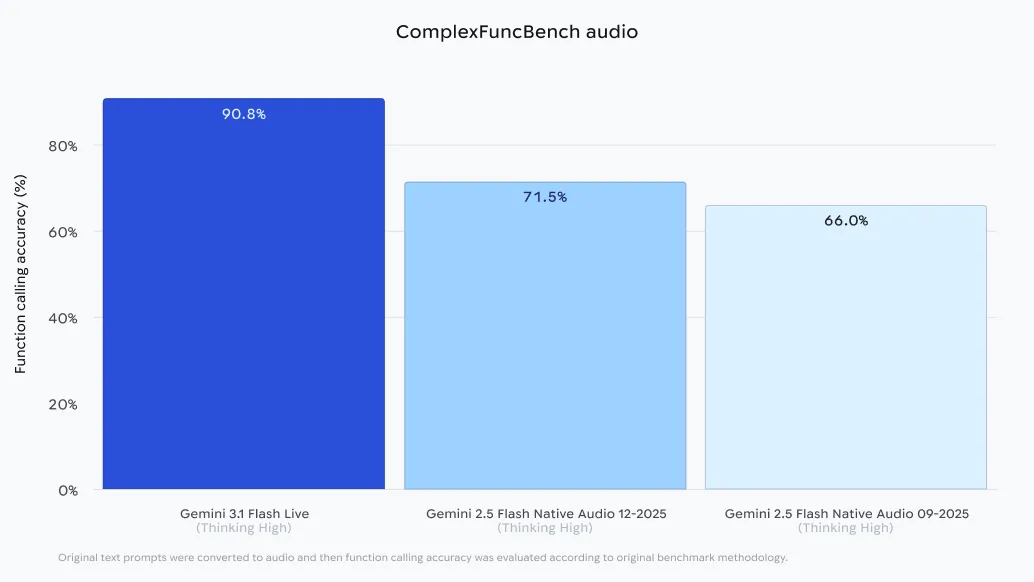
Gemini 3.1 Flash Live scored a staggering 90.8% on this benchmark. For developers, this means a voice agent can now reason through complex logic—like finding specific invoices and emailing them based on a price threshold—without needing a text intermediary to think first.
| Benchmark | Score | Focus Area |
| ComplexFuncBench Audio | 90.8% | Multi-step function calling from audio input. |
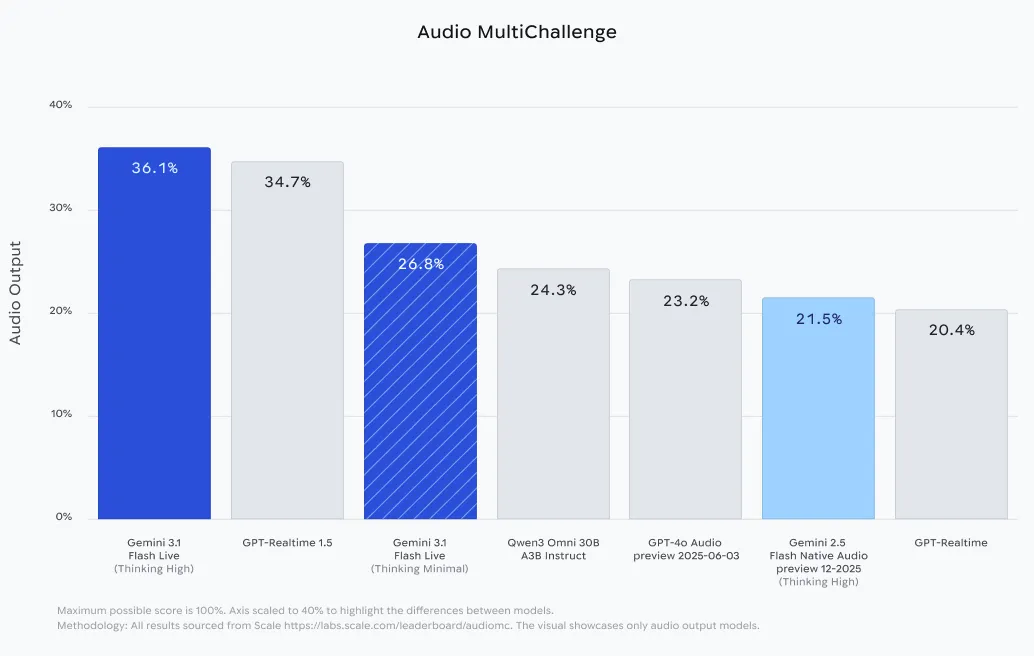
| Audio MultiChallenge | 36.1% | Instruction following in noisy/interrupted speech (with thinking). |
| Context Window | 128k | Total tokens available for session memory and tool definitions. |
The model’s performance on the Audio MultiChallenge (36.1% with thinking enabled) further proves its resilience. This benchmark tests the AI’s ability to maintain focus and follow complex instructions despite the interruptions, stutters, and background noise typical of real-world human speech.

Developer Controls: thinkingLevel
A standout feature for AI devs is the ability to tune the model’s reasoning depth. Using the thinkingLevel parameter, developers can choose between minimal, low, medium, and high.
- Minimal: This is the default for Live sessions, prioritized for the lowest possible Time to First Token (TTFT).
- High: While it increases latency, it allows the model to perform deeper “thinking” steps before responding, which is necessary for complex problem-solving or debugging tasks delivered via live video.
Closing the Knowledge Gap: Gemini Skills
As AI APIs evolve rapidly, keeping documentation up-to-date within a developer’s own coding tools is a challenge. To address this, Google’s AI team maintains the google-gemini/gemini-skills repository. This is a library of ‘skills’—curated context and documentation—that can be injected into an AI coding assistant’s prompt to improve its performance.
The repository includes a specific gemini-live-api-dev skill focused on the nuances of WebSocket sessions and audio/video blob handling. The broader Gemini Skills repository reports that adding a relevant skill improved code-generation accuracy to 87% with Gemini 3 Flash and 96% with Gemini 3 Pro. By using these skills, developers can ensure their coding agents are utilizing the most current best practices for the Live API.
Key Takeaways
- Native Multimodal Architecture: It collapses the traditional ‘transcribe-reason-synthesize’ stack into a single native audio-to-audio process, significantly reducing latency and enabling more natural pitch and pace recognition.
- Stateful Bidirectional Streaming: The model uses WebSockets (WSS) for full-duplex communication, allowing for ‘Barge-in’ (user interruptions) and simultaneous transmission of audio, video frames, and transcripts.
- High-Accuracy Agentic Reasoning: It is optimized for triggering external tools directly from voice, achieving a 90.8% score on the ComplexFuncBench Audio for multi-step function calling.
- Tunable ‘Thinking’ Controls: Developers can balance conversational speed against reasoning depth using the new
thinkingLevelparameter (ranging from minimal to high) within a 128k token context window. - Preview Status & Constraints: Currently available in developer preview, the model requires 16-bit PCM audio (16kHz input/24kHz output) and presently supports only synchronous function calling and specific content-part bundling.
Check out the Technical details, Repo and Docs. Also, feel free to follow us on Twitter and don’t forget to join our 120k+ ML SubReddit and Subscribe to our Newsletter. Wait! are you on telegram? now you can join us on telegram as well.
The post Google Releases Gemini 3.1 Flash Live: A Real-Time Multimodal Voice Model for Low-Latency Audio, Video, and Tool Use for AI Agents appeared first on MarkTechPost.