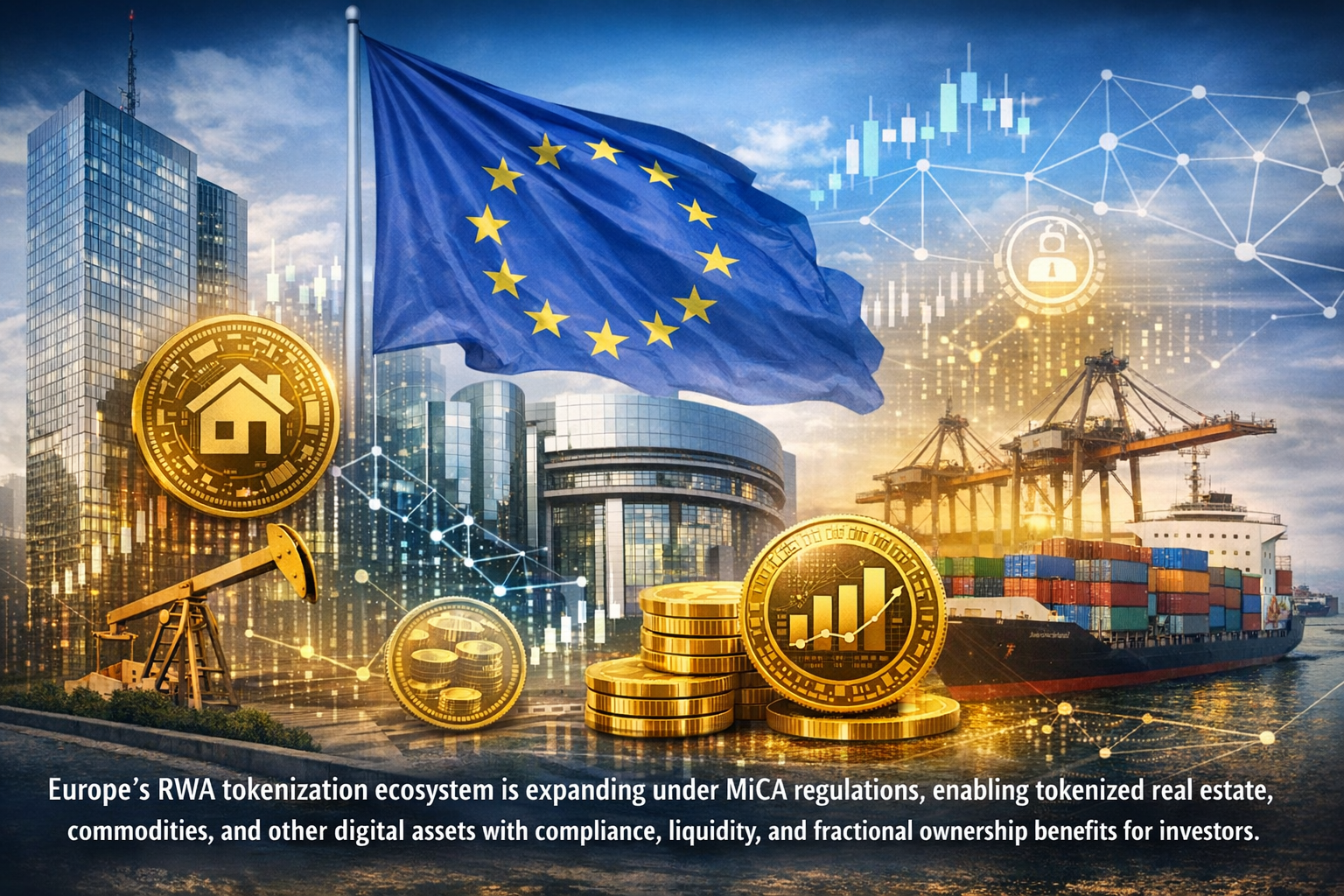
Europe is quietly positioning itself at the forefront of one of the most transformative trends in digital finance: real-world asset (RWA) tokenization. While much of the crypto conversation still revolves around volatile tokens and speculative narratives, a more structural shift is underway across the European Union. Under the Markets in Crypto-Assets (MiCA) regulatory framework, tokenized real estate, commodities, and other tangible assets are beginning to move from experimental pilots into regulated, investable products.
This evolution signals more than just technological progress—it represents a fundamental rethinking of how ownership, liquidity, and access to capital markets can function in a digital-first economy.
What Is RWA Tokenization—and Why Europe Matters
RWA tokenization refers to the process of representing physical or traditional financial assets on blockchain networks. These assets can include property, commodities such as gold or oil, treasury instruments, carbon credits, and even infrastructure projects. By converting ownership rights into digital tokens, issuers can enable fractional ownership, near-instant settlement, programmable compliance, and global accessibility.
Europe’s role is especially important because it is pursuing this innovation within a clear regulatory perimeter. Unlike jurisdictions that rely on regulatory ambiguity or enforcement after the fact, the EU has chosen a structured approach. MiCA provides a harmonized legal framework across member states, covering everything from stablecoins and crypto service providers to disclosure requirements and consumer protections.
For institutional investors and enterprises, this clarity changes everything.
Regulation does not slow innovation—it enables it. With legal certainty in place, banks, asset managers, fintech firms, and blockchain startups can collaborate without constantly navigating fragmented national rules or legal gray zones.
Tokenized Real Estate: Unlocking Liquidity in Europe’s Largest Asset Class
Real estate remains one of Europe’s most valuable yet illiquid asset classes. Traditionally, investing in property requires significant capital, long transaction timelines, and complex legal processes. Tokenization directly addresses these inefficiencies.
Through blockchain-based platforms, property ownership can now be divided into digital shares, allowing investors to participate with smaller amounts of capital. This fractional model opens doors for retail investors while giving property developers access to broader funding pools.
More importantly, tokenized real estate introduces secondary market liquidity. Instead of being locked into multi-year commitments, investors can trade tokenized property stakes on compliant digital marketplaces. Smart contracts automate rent distribution, corporate actions, and compliance checks, reducing operational overhead while increasing transparency.
Across Europe, pilot projects are already demonstrating how residential buildings, commercial offices, and mixed-use developments can be brought on-chain under regulated structures.
Commodities and Trade Finance Enter the Blockchain Era
Beyond property, commodities are becoming a major focus of Europe’s RWA ecosystem. Tokenized gold, energy assets, and agricultural products offer real-time settlement, improved traceability, and reduced counterparty risk. For industries reliant on complex supply chains, blockchain introduces a single source of truth that can streamline logistics, financing, and auditing.
Trade finance is another area seeing rapid experimentation. By tokenizing invoices, shipping documents, and warehouse receipts, companies can unlock working capital faster while lenders gain greater visibility into collateral and transaction flows.
Ports, logistics hubs, and commodity exchanges across Europe are exploring these models, signaling a broader shift toward digitally native infrastructure for global trade.
MiCA as the Foundation for Scalable Adoption
The Markets in Crypto-Assets regulation acts as the backbone of this transformation. MiCA establishes standardized rules for crypto-asset issuance, custody, and service provision across all EU member states. For RWA tokenization, this means:
Clear requirements for asset-backed tokens
Licensing frameworks for platforms and custodians
Consumer protection standards
Operational and capital requirements for service providers
Cross-border passporting within the EU
This unified approach removes one of the biggest historical barriers to adoption: regulatory fragmentation. A tokenization platform licensed in one EU country can operate across the entire bloc, enabling true scale.
As a result, Europe is becoming increasingly attractive for global firms seeking to launch compliant digital asset products.
Fractional Ownership Meets Institutional Standards
One of the most powerful outcomes of RWA tokenization is the democratization of access to traditionally exclusive investments. High-value assets—prime real estate, commodities, or structured products—can now be divided into smaller units, allowing a wider range of participants to engage.
At the same time, MiCA ensures that these offerings meet institutional-grade standards. Identity verification, anti-money laundering controls, investor disclosures, and custody rules are embedded into the ecosystem. This combination of accessibility and compliance creates a rare alignment between retail inclusion and institutional trust.
For asset managers, this opens new distribution channels. For investors, it provides exposure to diversified portfolios that were previously out of reach.
Interoperability with DeFi and Traditional Finance
Europe’s RWA push is not happening in isolation. Tokenized assets are increasingly designed to interoperate with decentralized finance protocols while remaining compliant with regulatory requirements. This hybrid model allows RWAs to be used as collateral, integrated into yield strategies, or combined with on-chain derivatives—all within controlled environments.
Meanwhile, traditional financial institutions are experimenting with blockchain settlement layers, tokenized bonds, and digital money solutions. Central bank digital currency pilots and regulated stablecoins are laying the groundwork for fully on-chain capital markets.
The long-term vision is clear: a financial system where real-world assets, digital money, and programmable contracts coexist seamlessly.
Challenges Remain—but Momentum Is Building
Despite the progress, challenges persist. Liquidity is still developing, valuation standards are evolving, and interoperability across blockchains remains a work in progress. Legal frameworks for certain asset classes continue to mature, and market education is ongoing.
Yet the trajectory is unmistakable.
With MiCA providing regulatory certainty and infrastructure providers rapidly advancing their platforms, Europe is building a sustainable foundation for RWA tokenization. What began as niche experimentation is now transitioning into production-grade financial infrastructure.
A Glimpse Into Europe’s Digital Asset Future
Real-world asset tokenization represents more than a new investment trend—it marks the digitization of ownership itself. Europe’s approach demonstrates that innovation and regulation do not need to be at odds. By combining blockchain technology with robust legal frameworks, the EU is crafting a model that other regions are likely to follow.
As tokenized real estate, commodities, and financial instruments continue to come online, Europe is shaping a future where capital moves faster, ownership becomes more inclusive, and financial markets operate with unprecedented transparency.
The next phase of digital finance will not be defined solely by cryptocurrencies. It will be driven by real assets, real utility, and real regulatory clarity—and Europe is leading the way.