
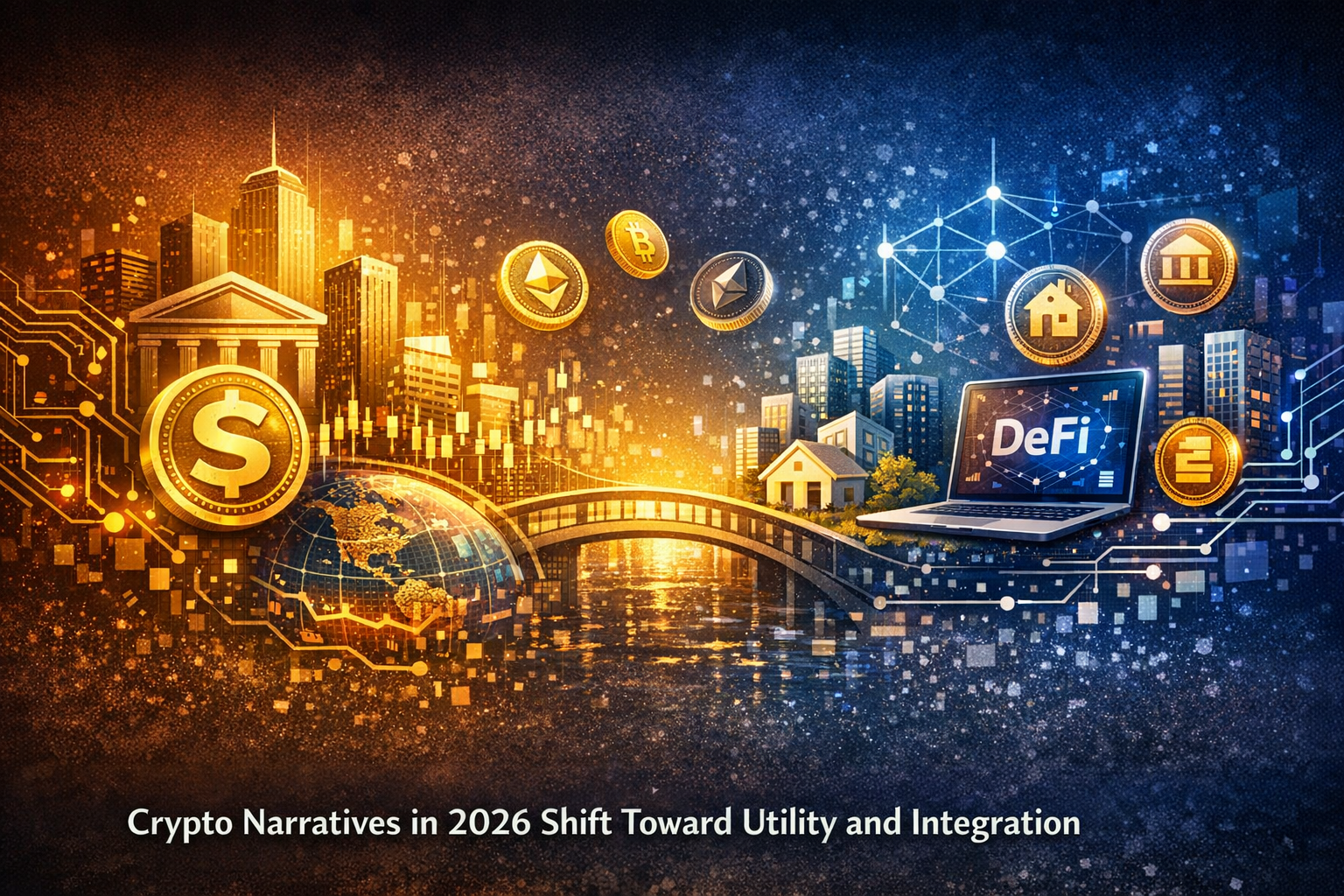
For much of its history, the cryptocurrency market has been driven by speculation, hype cycles, and short-term price action. While those elements haven’t disappeared entirely, 2026 marks a clear narrative shift. This year, crypto is increasingly defined by real-world utility, infrastructure development, and deep integration with traditional finance rather than pure speculation.
This evolution reflects both market maturity and growing institutional involvement. As regulatory clarity improves and blockchain technology becomes more robust, the conversation around crypto is changing — from “What will pump next?” to “What actually works at scale?”
From Speculation to Practical Use Cases
The early days of crypto were dominated by narratives of exponential returns and disruptive promises that often lacked tangible delivery. In contrast, the dominant narratives in 2026 emphasize functionality, reliability, and long-term value creation.
Projects that survive and thrive today are those that solve concrete problems: faster settlement, lower costs, transparent ownership, and programmable financial logic. Investors and users alike are placing greater importance on sustainable ecosystems rather than short-lived trends.
This shift is especially visible in sectors like stablecoins, decentralized finance infrastructure, and real-world asset (RWA) tokenization.
Stablecoins as the Backbone of Digital Finance
Stablecoins have emerged as one of the most critical components of the modern crypto economy. In 2026, they are no longer viewed merely as trading tools but as core financial primitives.
Their role has expanded into:
Cross-border payments and remittances
On-chain liquidity for DeFi protocols
Settlement layers for tokenized assets
Bridges between traditional finance and blockchain networks
With major financial institutions exploring or deploying stablecoin-based solutions, the narrative has shifted from “Are stablecoins safe?” to “How can they scale globally?” This evolution highlights crypto’s growing relevance in everyday financial operations.
DeFi Infrastructure Grows Up
Decentralized finance in 2026 looks very different from its early experimental phase. The focus is now on infrastructure rather than novelty. Instead of chasing unsustainable yields, DeFi platforms are building reliable systems for lending, trading, liquidity management, and risk mitigation.
Key themes shaping the DeFi narrative include:
Modular and composable protocols
Institutional-grade security and audits
Improved user experience and abstraction
Compliance-friendly architecture
This infrastructure-first approach allows DeFi to integrate more smoothly with traditional financial systems, making it accessible not just to crypto-native users but also to enterprises and institutions.
Tokenization of Real-World Assets Takes Center Stage
One of the most powerful narratives in 2026 is the tokenization of real-world assets. From real estate and bonds to commodities and private equity, RWA tokenization bridges the gap between physical assets and digital markets.
Tokenization offers clear advantages:
Fractional ownership and increased liquidity
Transparent ownership records
Faster settlement and reduced intermediaries
Global access to previously illiquid markets
As traditional financial players embrace blockchain-based asset issuance, tokenization is no longer a theoretical concept — it’s becoming a foundational layer of modern finance.
Integration with Traditional Finance Accelerates
Perhaps the most defining aspect of crypto narratives in 2026 is integration rather than opposition. The old idea of crypto versus traditional finance is giving way to a more pragmatic reality where both systems coexist and complement each other.
Banks, asset managers, and fintech firms are increasingly leveraging blockchain technology for:
Asset custody
Settlement and clearing
Token issuance
Data transparency and reporting
This integration reinforces the perception of crypto as infrastructure rather than an alternative fringe system.
A More Mature Market Narrative
The narrative shift in 2026 reflects a broader maturation of the crypto industry. While volatility and speculation remain part of the ecosystem, they are no longer the primary story. Instead, crypto is being evaluated on its ability to deliver measurable value, scale responsibly, and integrate seamlessly into global finance.
As utility-driven narratives dominate, projects that focus on real adoption, strong fundamentals, and long-term relevance are gaining the spotlight. The result is a more resilient market — one that prioritizes substance over noise.
Crypto in 2026 is no longer just about bold promises or rapid price movements. It’s about building systems that work, connecting digital innovation with real-world finance, and delivering tools that can operate at global scale.
The narrative has shifted — and with it, the future of crypto looks more grounded, more integrated, and ultimately more impactful than ever before.