
When US crypto regulators cracked down on Tornado Cash in 2022, the assumption was simple: shut down the tool, shut down the problem. It didn’t work out that way.
New research from the Cambridge Centre for Alternative Finance (CCAF) shows that coin mixer usage has climbed back toward pre-ban levels — and that the people most effectively pushed out by the sanctions were not the criminals, but ordinary users seeking financial privacy.
Railgun Now Dominates A Recovering Market
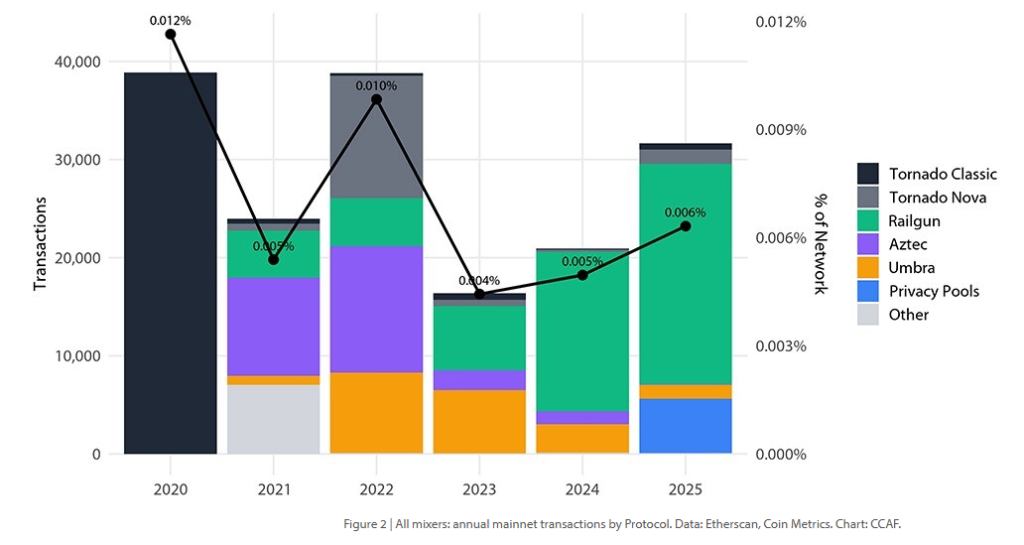
According to CCAF researchers Wenbin Wu and Keith Bear, total crypto mixer transactions reached approximately 32,000 in 2025 — a significant jump from roughly 21,000 in 2024 and 16,000 in 2023.
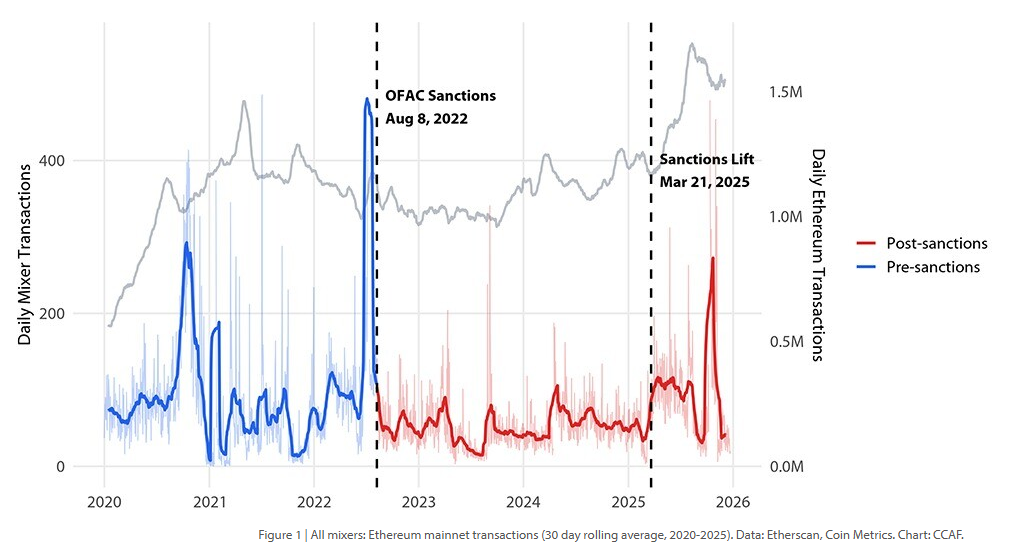
Usage has been climbing steadily since the US Treasury lifted its sanctions against Tornado Cash on March 21, 2025.
Railgun, a protocol that screens deposits against lists of flagged addresses, now handles 71% of all mixer transaction volume. Tornado Cash accounts for around 25% of 2025 transactions, while Privacy Pools holds the remaining 5%.
Both Railgun and Privacy Pools attempt to filter out known bad actors before crypto funds enter the system. But reports from CCAF note a meaningful gap — blacklists are updated only as new exploits are discovered, leaving a window where funds from freshly flagged addresses can still pass through.
Sanctions Scared Off Legitimate Users More Than Criminals
The 2022 crackdown caused immediate disruption. Tornado Cash’s daily transactions collapsed by 97% within days. Across the broader mixer market, volume fell 45%. But the disruption was uneven.
Wu told researchers that sanctions “primarily deterred compliant users while illicit actors adapted” — first by migrating to alternative platforms, then to cross-chain bridges and decentralized exchanges altogether.
Deposit patterns tell the same story. Before 2022, centralized exchanges — which require identity verification — contributed meaningfully to mixer funding. After the ban, those deposits essentially vanished. By 2025, 95% of all crypto mixer funding came from unlabeled wallet addresses with no recorded entity ties, up from 76% in 2020.
Most Transactions Now Happen Within 24 Hours
Before the ban, most mixer activity occurred more than 24 hours after wallet creation. That pattern has flipped. Researchers say this faster behavior is “consistent with users seeking to avoid identification.”
Still, a 2023 Federal Reserve Bank of St. Louis paper found that only around 30% of Tornado Cash traffic could be linked to illegitimate sources — a reminder that privacy tools serve lawful purposes too. The demand, from both camps, never went away.
Featured image from Unsplash, chart from TradingView