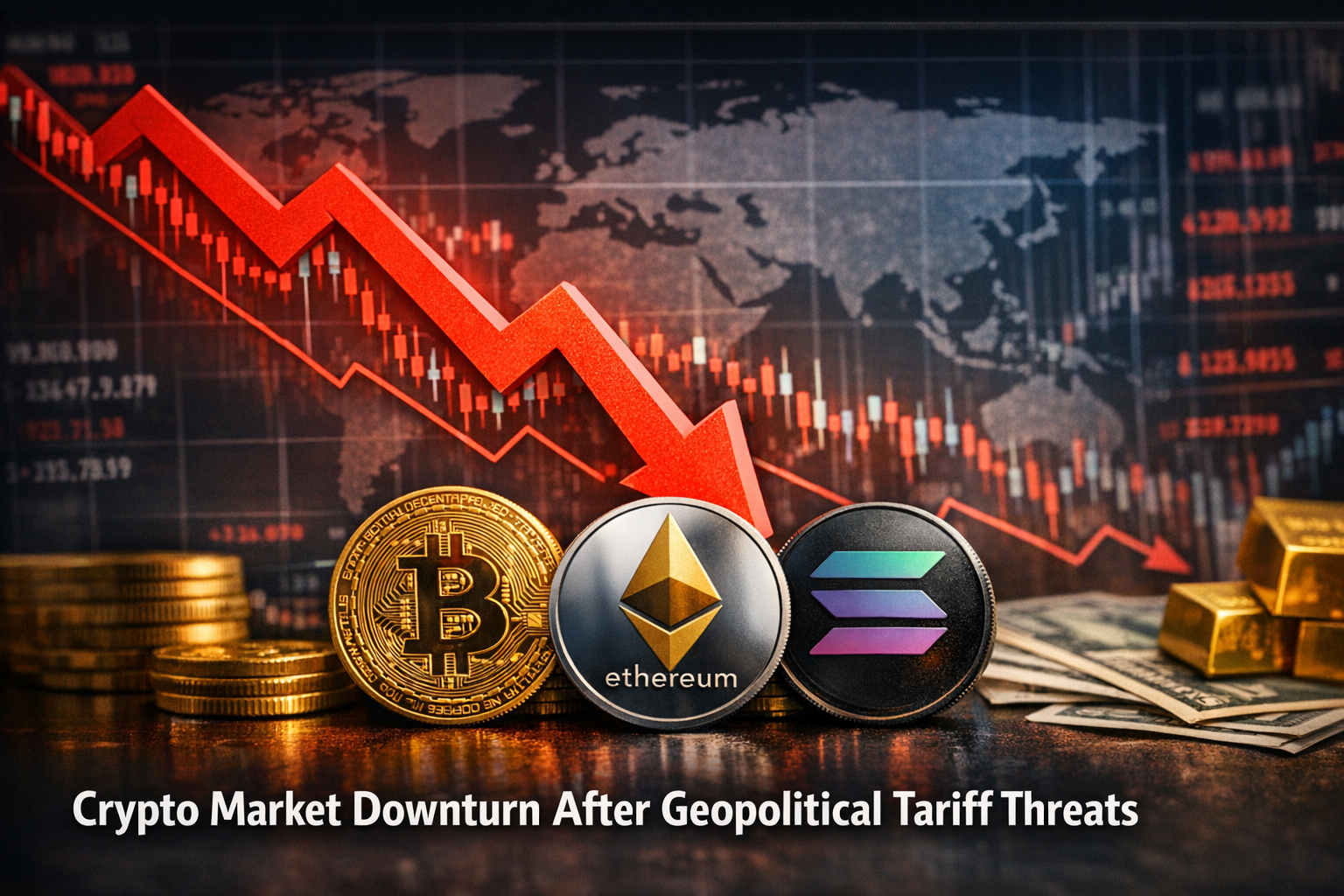
The cryptocurrency market faced renewed pressure this week as escalating geopolitical tensions between the United States and the European Union triggered a broad risk-off move across global financial markets. Fresh tariff threats reignited fears of a potential trade conflict, sending investors scrambling for safer assets — and pushing digital currencies sharply lower.
Bitcoin slipped below the psychologically important $92,000 level, while major altcoins such as Ether and Solana followed suit. The sell-off highlights once again how closely crypto markets are now intertwined with macroeconomic developments, despite their origins as decentralized and borderless financial systems.
Tariff Tensions Spark Risk-Off Sentiment
At the center of the downturn lies growing uncertainty surrounding proposed tariffs between the US and EU. Although details remain fluid, even the prospect of renewed trade barriers was enough to shake investor confidence. Traditional markets reacted swiftly, with equities pulling back and government bonds seeing increased demand.
Cryptocurrencies, often viewed as high-risk assets during periods of uncertainty, were not spared.
As global risk sentiment weakened, traders rotated capital out of volatile positions and into perceived safe havens such as the US dollar and sovereign debt. This shift in positioning created selling pressure across the crypto complex, leading to liquidations and accelerated downside momentum.
For Bitcoin, the move below $92K represented more than just a numerical milestone — it marked a break from recent consolidation ranges and prompted short-term traders to reassess their exposure.
Major Altcoins Feel the Impact
While Bitcoin typically sets the tone for the broader market, altcoins bore a significant share of the decline.
Ethereum, the backbone of decentralized finance and NFT ecosystems, slid alongside BTC as traders reduced leveraged positions. Solana, which has seen strong performance in recent months thanks to growing developer activity and ecosystem expansion, also gave back gains amid the broader market pullback.
Smaller-cap tokens experienced even sharper swings, underscoring how quickly liquidity can evaporate during periods of macro-driven stress.
This synchronized movement across assets reinforces a key reality of today’s crypto landscape: despite sector-specific narratives and technological progress, macro forces still dominate short-term price action.
Why Crypto Reacts to Global Politics
In theory, cryptocurrencies were designed to operate independently of traditional financial systems. In practice, institutional participation has changed that dynamic.
With hedge funds, asset managers, and corporate treasuries now active in digital assets, crypto increasingly trades like a risk-on instrument — rising when confidence is high and falling when uncertainty takes hold.
Geopolitical developments such as tariff disputes directly influence inflation expectations, interest rate outlooks, and currency stability. These factors, in turn, shape investor behavior across all asset classes, including crypto.
When trade tensions rise, markets begin pricing in slower economic growth and potential disruptions to global supply chains. That environment typically favors capital preservation over speculation.
What This Means for Investors
For long-term believers in blockchain technology, moments like these can be uncomfortable — but they are not unfamiliar.
Crypto markets have historically been volatile, often reacting sharply to external shocks before finding equilibrium. While short-term traders may focus on technical levels and momentum indicators, longer-term investors often view these pullbacks as opportunities to reassess strategy and conviction.
Key considerations during periods like this include:
Risk management: Ensuring position sizes align with personal risk tolerance.
Diversification: Avoiding overexposure to a single asset or sector.
Time horizon: Distinguishing between short-term market noise and long-term adoption trends.
It’s also worth remembering that regulatory clarity, institutional infrastructure, and real-world use cases continue to evolve — regardless of temporary price fluctuations.
Looking Ahead
Whether this downturn develops into a deeper correction or proves to be a short-lived reaction will largely depend on how geopolitical discussions unfold in the coming weeks.
If tariff threats escalate into concrete policy actions, markets could remain under pressure as uncertainty persists. On the other hand, any signs of compromise or de-escalation may quickly restore confidence and spark renewed buying interest across risk assets, including crypto.
For now, traders and investors alike are watching macro headlines closely, aware that in today’s interconnected financial world, global politics can move digital markets just as powerfully as on-chain metrics.
As always in crypto, volatility is part of the journey — and periods of uncertainty often set the stage for the next major move.