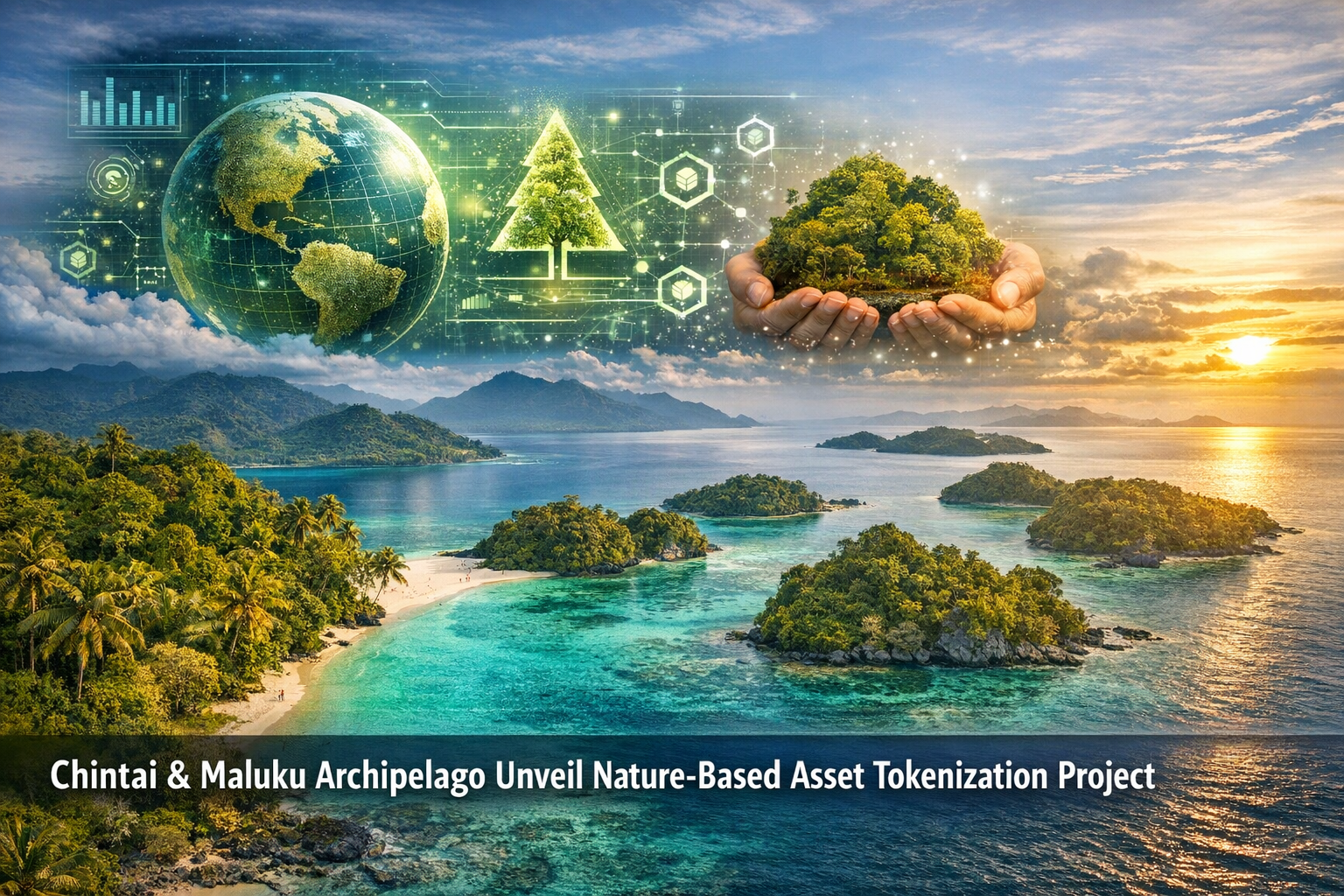
The convergence of blockchain technology and environmental stewardship is entering a powerful new chapter. In a landmark collaboration, Chintai and Indonesia’s Maluku Archipelago have announced a pioneering nature-based asset tokenization initiative—one positioned to become among the largest regulated projects of its kind. This ambitious effort aims to bridge real-world environmental conservation with digital capital markets, offering a new blueprint for sustainable finance in the Web3 era.
At its core, the project represents a shift in how natural resources are valued, protected, and funded. Rather than relying solely on traditional grants or government programs, Maluku’s rich ecosystems—its forests, coastal regions, and biodiversity—can now be transformed into regulated digital assets. These tokenized representations enable global investors to participate directly in conservation-driven economic activity, creating a transparent and scalable funding mechanism for nature.
Tokenizing Nature: A New Asset Class Emerges
Nature-based assets include resources such as forests, mangroves, coral reefs, and carbon-sequestering landscapes. Historically, these assets have been difficult to monetize responsibly without risking exploitation. Tokenization changes that equation.
By converting verified environmental assets into blockchain-based tokens, Chintai’s infrastructure allows these resources to be fractionalized, tracked, and traded in compliant digital markets. Each token can represent a measurable environmental benefit—such as preserved forest acreage or carbon capture potential—backed by real-world data and regulatory oversight.
This approach introduces several powerful advantages:
Transparency: On-chain records provide immutable proof of ownership and impact.
Accessibility: Fractionalization lowers the barrier to entry, enabling smaller investors to participate.
Liquidity: Digital markets allow nature-based assets to be traded more efficiently than traditional conservation instruments.
Accountability: Smart contracts and reporting frameworks help ensure funds are allocated directly to conservation outcomes.
In effect, environmental protection becomes investable—without sacrificing governance or credibility.
Why the Maluku Archipelago Matters
Located in eastern Indonesia, the Maluku Archipelago is renowned for its extraordinary biodiversity. Its islands host dense rainforests, vibrant coral reefs, and marine ecosystems that play a critical role in regional climate stability. At the same time, many local communities depend directly on these environments for their livelihoods.
The partnership with Chintai is designed not only to preserve these natural assets, but also to empower local economies. Capital raised through tokenization can be reinvested into sustainable development initiatives, conservation programs, and infrastructure improvements—creating a circular model where environmental protection and economic growth reinforce each other.
This localized impact is key. Rather than abstract ESG metrics, the project ties digital finance directly to real places, real ecosystems, and real people.
Chintai’s Regulated Infrastructure: Building Trust in Tokenized Markets
One of the most significant aspects of this initiative is its regulatory foundation. Chintai has established itself as a compliant digital asset platform, offering token issuance, trading, and lifecycle management within recognized legal frameworks.
For institutional participants, regulation is essential. Nature-based assets may be innovative, but they still require the same rigor as traditional securities: clear governance, investor protections, and transparent reporting. Chintai’s infrastructure provides exactly that, enabling the Maluku project to attract both impact-focused investors and larger financial players seeking credible exposure to sustainable assets.
This regulatory-first approach could prove decisive in bringing tokenized environmental assets into the mainstream.
A Blueprint for Sustainable Finance
Beyond its immediate scope, the Chintai–Maluku collaboration serves as a model for how blockchain can support global sustainability goals. Governments, regions, and conservation organizations worldwide face a common challenge: how to fund large-scale environmental protection in a way that is efficient, transparent, and attractive to capital markets.
Tokenization offers a compelling answer.
By standardizing nature-based assets on-chain, regions can unlock new funding channels while maintaining stewardship over their resources. Investors gain access to a new asset class aligned with climate objectives. And communities benefit from long-term, impact-driven development rather than short-term extraction.
This is not simply about digitizing nature—it’s about redefining how value flows between finance and the planet.
Looking Ahead
As real-world asset tokenization continues to accelerate, projects like this highlight the broader evolution of blockchain beyond speculation. The focus is shifting toward tangible utility: infrastructure, commodities, real estate, and now environmental assets.
The Chintai and Maluku Archipelago initiative stands at the intersection of technology, finance, and conservation. If successful, it could inspire similar programs across emerging markets and biodiversity-rich regions, transforming how the world funds climate resilience and ecological preservation.
In a time when environmental challenges demand innovative solutions, this partnership demonstrates that Web3 can be more than digital—it can be deeply grounded in the real world.
Nature, once overlooked by capital markets, is finally stepping onto the blockchain.