How On-Chain Carbon Credits Are Transforming Impact Investment
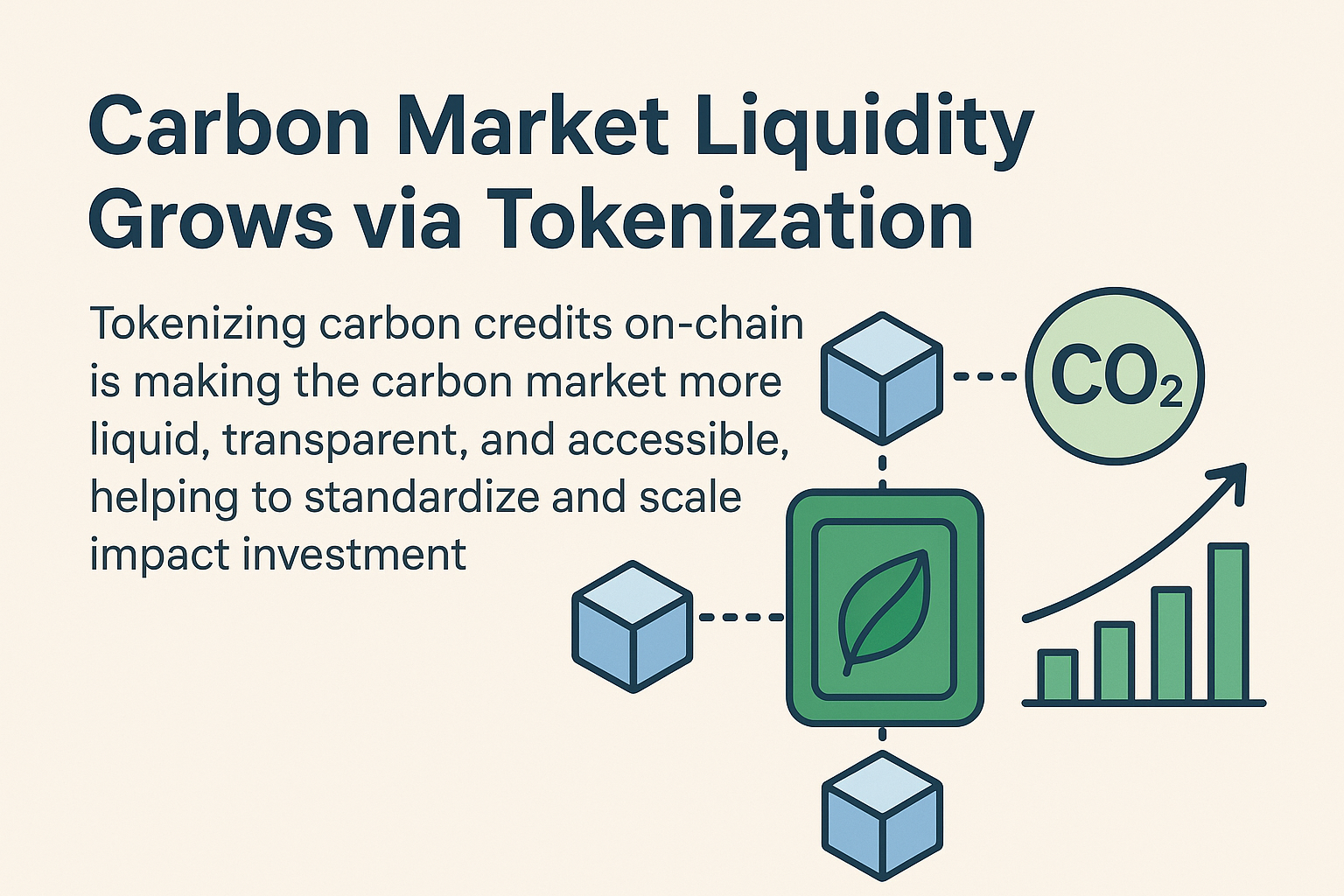
The global carbon market is undergoing a silent but powerful transformation. Once seen as fragmented, opaque, and dominated by large institutional players, the market for carbon credits is now being reshaped by blockchain technology and tokenization. By bringing carbon credits on-chain, innovators are introducing unprecedented levels of liquidity, transparency, accessibility, and standardization—unlocking new possibilities for climate finance and sustainable investing.
As governments, corporations, and individuals race to meet net-zero targets, demand for credible carbon offsets continues to rise. At the same time, investors are searching for impact-driven assets that align profit with planetary good. Tokenization sits at the intersection of these forces, offering a digital bridge between climate action and global capital markets.
Understanding the Traditional Carbon Market
Before diving into tokenization, it’s important to understand how the carbon market has traditionally worked.
Carbon credits represent the verified reduction or removal of one metric ton of carbon dioxide (or its equivalent) from the atmosphere. These credits are usually generated by projects such as:
-
Reforestation and afforestation
-
Renewable energy installations
-
Methane capture projects
-
Energy efficiency programs
-
Direct air capture technologies
There are two primary carbon markets:
-
Compliance Markets – Regulated systems where companies are legally required to offset emissions under cap-and-trade programs.
-
Voluntary Carbon Markets (VCM) – Businesses and individuals voluntarily purchase credits to meet sustainability goals or ESG commitments.
Despite their importance, traditional carbon markets suffer from several structural issues:
-
Low liquidity – Trades are slow and often negotiated privately.
-
Limited transparency – Data on credit origins, pricing, and ownership is fragmented.
-
High barriers to entry – Smaller investors struggle to participate.
-
Trust issues – Concerns about double counting, greenwashing, and questionable project quality.
This is exactly where tokenization changes the game.
What Does It Mean to Tokenize Carbon Credits?
Tokenization is the process of converting a real-world asset—in this case, a carbon credit—into a digital token that exists on a blockchain. Each token represents ownership of a verified carbon credit and can be:
-
Stored in a digital wallet
-
Traded on decentralized or centralized exchanges
-
Retired (burned) to claim the offset
Once on-chain, carbon credits become programmable financial assets. Smart contracts can automate settlement, enforce compliance rules, and ensure transparent tracking from issuance to retirement.
This simple technical shift has massive implications for market structure, efficiency, and scale.
How Tokenization Is Driving Liquidity Growth
1. Fractional Ownership Unlocks New Capital
One of the most powerful effects of tokenization is fractionalization. Instead of purchasing entire carbon credits in large lots, investors can buy small fractions of a credit. This dramatically lowers entry barriers and brings new participants into the market:
-
Retail investors
-
Small businesses
-
Climate-focused DAOs
-
ESG-focused fintech platforms
Higher participation leads directly to greater trading activity and deeper liquidity pools.
2. 24/7 Global Trading on Blockchain Networks
Traditional carbon markets are often limited by geography, business hours, and slow settlement processes. Tokenized carbon credits, however, trade on blockchain networks that operate 24/7 across borders.
This enables:
-
Real-time price discovery
-
Faster settlement (minutes instead of days)
-
Global access without intermediaries
-
More efficient arbitrage between markets
Liquidity thrives in environments where assets move freely and efficiently—and blockchain delivers exactly that.
3. Transparent, Verifiable Supply Chains
Every transaction on a blockchain is recorded on a public ledger. This means tokenized carbon credits provide full visibility into:
-
Project origin
-
Verification provider
-
Date of issuance
-
Ownership history
-
Retirement status
This level of transparency:
-
Reduces fraud and double counting
-
Boosts institutional confidence
-
Strengthens ESG reporting credibility
-
Improves regulatory oversight
As trust increases, more capital flows into the market—further improving liquidity.
Standardization: The Missing Piece Tokenization Solves
One of the biggest challenges in the voluntary carbon market has been the lack of global standards. Credits vary widely in quality, measurement methodologies, and verification rigor. Tokenization platforms are now acting as standard-setters by:
-
Applying consistent metadata structures
-
Enforcing verification requirements
-
Integrating trusted registries
-
Auditing smart contracts
This standardized digital layer makes carbon credits easier to evaluate, compare, and trade, which is essential for scaling the market globally.
The Rise of Impact Investment Through Tokenized Carbon
Tokenization does more than improve trading—it reshapes how capital flows into sustainability.
Democratizing Climate Finance
Previously, large corporations and funds dominated carbon markets. Now, individuals can directly invest in projects that:
-
Protect rainforests
-
Expand renewable energy
-
Support local environmental communities
With just a digital wallet, anyone can gain climate exposure and contribute to real-world emissions reduction.
Integrating Carbon Into DeFi
Decentralized Finance (DeFi) is now integrating tokenized carbon credits into:
-
Liquidity pools
-
Yield farming strategies
-
Carbon-backed stable assets
-
ESG-focused index products
This creates entirely new financial instruments where environmental performance becomes part of on-chain economic activity.
Corporate ESG and Automated Offsetting
Forward-thinking companies are embedding tokenized carbon directly into their operational systems. Smart contracts can automatically:
-
Calculate real-time emissions
-
Purchase matching credits on-chain
-
Retire them instantly
-
Generate auditable ESG records
This transforms carbon offsetting from a once-a-year accounting exercise into a living, automated sustainability process.
Challenges That Still Remain
Despite rapid progress, tokenized carbon markets are still evolving. Key challenges include:
-
Regulatory uncertainty across jurisdictions
-
Interoperability between carbon registries and blockchains
-
Verification quality of underlying environmental projects
-
Market fragmentation across different token standards
However, these challenges are being actively addressed through industry consortiums, evolving standards, and closer collaboration between climate scientists, regulators, and blockchain developers.
Why Tokenized Carbon Matters for the Global Economy
As the world transitions to a low-carbon future, carbon pricing is becoming a core economic signal. Tokenization enhances that signal by making carbon:
-
Easier to trade
-
Cheaper to access
-
Faster to verify
-
Harder to manipulate
This strengthens the global feedback loop between emissions, accountability, and financial incentives—which is crucial for meeting international climate targets.
The Road Ahead: From Niche to Global Infrastructure
Tokenized carbon markets are still young, but their growth trajectory is steep. In the coming years, we can expect to see:
-
Deeper integration with traditional financial institutions
-
Carbon-backed financial derivatives
-
AI-driven emissions tracking paired with on-chain settlement
-
Unified global standards for digital environmental assets
What was once a slow, opaque, and elite market is rapidly becoming a global, liquid, and transparent financial ecosystem for climate action.
Carbon market liquidity is growing—not by accident, but by design. Tokenization is transforming carbon credits from static certificates into dynamic digital assets that move at the speed of modern finance. By improving liquidity, transparency, and accessibility, on-chain carbon markets are laying the foundation for a truly scalable impact investment economy.
In a world where environmental responsibility and financial innovation must move together, tokenized carbon credits are proving that sustainability can be both measurable and market-driven.