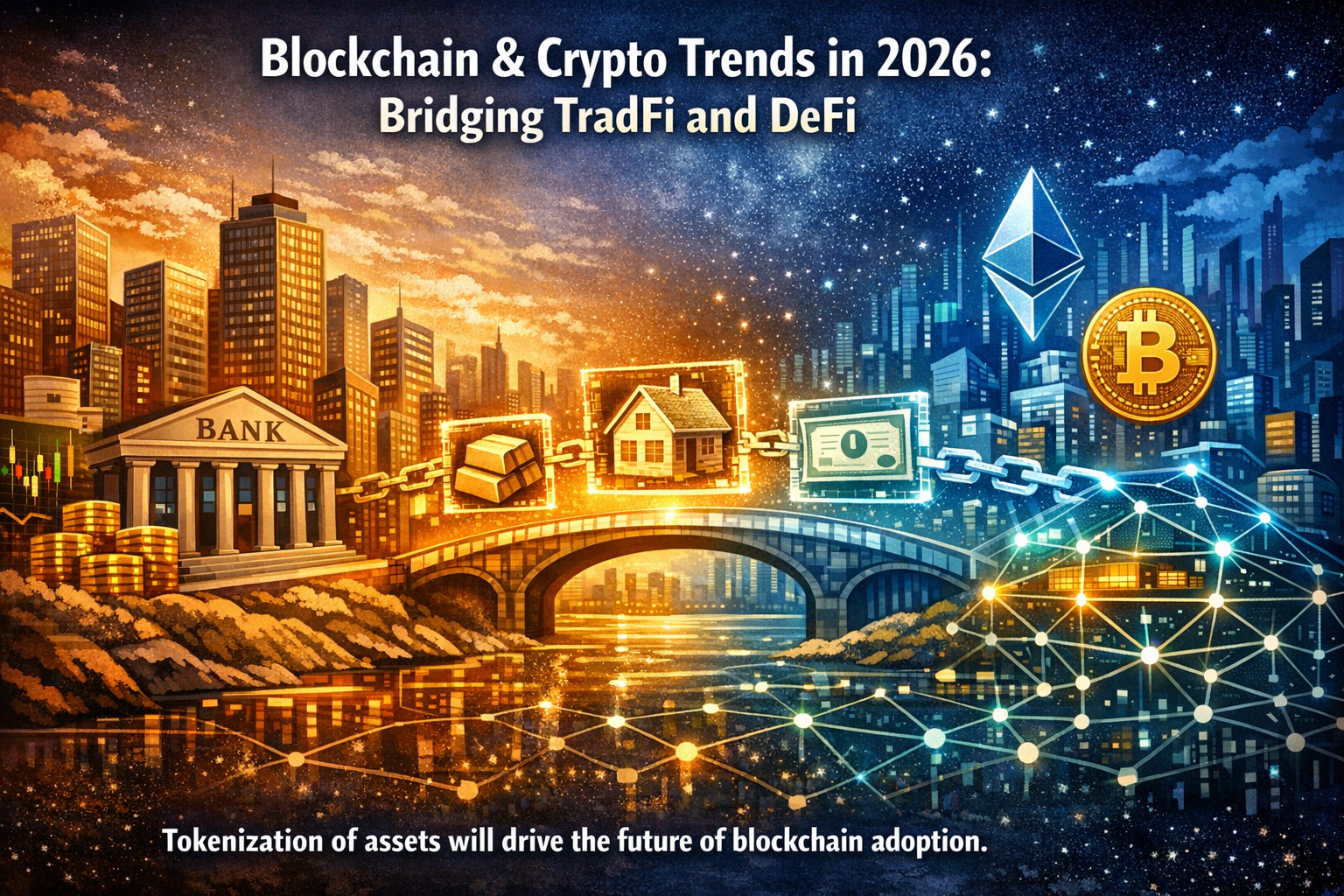
The blockchain industry has entered a transformative phase in 2026, where the lines between traditional finance (TradFi) and decentralized finance (DeFi) are becoming increasingly blurred. What was once seen as an experimental and disruptive alternative to conventional banking is now evolving into an integrated financial layer that complements and enhances existing systems. At the heart of this transformation lies one powerful concept: tokenization.
Tokenization—the process of converting real-world assets into digital tokens on a blockchain—is rapidly reshaping how people own, trade, and interact with value. From real estate and commodities to stocks and bonds, virtually any asset can now be represented digitally, unlocking unprecedented levels of accessibility, liquidity, and efficiency.
The Rise of Real-World Asset Tokenization
One of the most significant drivers of blockchain adoption in 2026 is the tokenization of real-world assets (RWAs). Traditionally, ownership of assets like real estate or private equity required large capital investments, complex legal processes, and limited access to global markets. Blockchain technology is changing that.
Through tokenization, assets can be divided into smaller digital fractions, allowing investors to own portions of high-value assets without needing millions in capital. For example, instead of purchasing an entire apartment building, an investor can own a fraction represented by tokens on a blockchain. This fractional ownership democratizes access to wealth-building opportunities that were previously restricted to institutions or wealthy individuals.
Tokenized assets also offer enhanced liquidity. Real estate, for instance, has historically been considered an illiquid asset due to the time and complexity involved in selling property. With tokenization, ownership can be transferred instantly on digital marketplaces, enabling faster and more efficient trading.
Bridging the Gap Between Traditional and Decentralized Finance
Rather than replacing traditional finance, blockchain is increasingly complementing it. Banks, asset managers, and financial institutions are now exploring blockchain infrastructure to improve settlement speeds, reduce operational costs, and increase transparency.
TradFi systems often rely on multiple intermediaries—clearinghouses, brokers, and custodians—to facilitate transactions. Each intermediary adds time, cost, and complexity. Blockchain simplifies this process by enabling direct peer-to-peer transactions with automated smart contracts. These contracts execute automatically when predefined conditions are met, eliminating the need for manual processing.
This integration is giving rise to hybrid financial models, where traditional institutions issue tokenized versions of securities while still operating within regulatory frameworks. This creates a bridge between the trust and stability of traditional finance and the efficiency and openness of decentralized systems.
Increased Accessibility and Global Participation
One of blockchain’s most transformative impacts is its ability to expand financial access globally. In traditional systems, geographic location, banking infrastructure, and regulatory barriers often limit participation. Blockchain removes many of these obstacles.
Anyone with an internet connection and a digital wallet can now access tokenized assets, decentralized lending platforms, and global markets. This opens the door for millions of people who were previously excluded from investment opportunities.
Emerging markets, in particular, stand to benefit significantly. Blockchain provides a transparent and accessible financial layer that can operate independently of legacy banking infrastructure, empowering individuals and businesses alike.
Institutional Adoption Accelerates Growth
Institutional adoption has been a major catalyst for blockchain’s evolution. In recent years, major financial firms have begun experimenting with tokenized bonds, digital securities, and blockchain-based settlement systems.
Institutions are attracted to blockchain’s ability to provide:
Faster transaction settlement (from days to seconds)
Reduced operational costs
Improved transparency and auditability
Enhanced security through cryptographic verification
As regulatory clarity improves in many jurisdictions, more institutions are expected to integrate blockchain technology into their core operations.
The Role of Smart Contracts in Financial Automation
Smart contracts are another key innovation driving the convergence of TradFi and DeFi. These programmable agreements automate financial processes such as lending, borrowing, and asset transfers.
For example, a tokenized bond can automatically distribute interest payments to token holders without requiring manual intervention. This automation reduces administrative overhead and minimizes the risk of human error.
Smart contracts also enable new financial products that were not previously possible, including decentralized lending protocols and automated asset management strategies.
Challenges and Considerations
Despite its rapid growth, blockchain adoption still faces several challenges. Regulatory uncertainty remains a key concern, as governments work to define frameworks for tokenized assets and decentralized platforms.
Security is another critical factor. While blockchain itself is highly secure, vulnerabilities in smart contract code or third-party platforms can still pose risks.
Scalability and user experience are also areas of ongoing improvement. However, advances in layer-2 scaling solutions and improved blockchain infrastructure are helping address these limitations.
The Future of Finance Is Hybrid
The future of finance is not purely traditional or purely decentralized—it is a hybrid of both. Blockchain is not replacing existing systems but enhancing them by providing faster, more efficient, and more accessible infrastructure.
Tokenization is at the center of this transformation. By turning real-world assets into digital tokens, blockchain is unlocking new opportunities for ownership, investment, and global participation.
As technology continues to mature and adoption grows, the integration between TradFi and DeFi will deepen. Financial institutions, investors, and individuals alike will benefit from a more open, efficient, and inclusive financial ecosystem.
In 2026 and beyond, blockchain is no longer just an emerging technology—it is becoming the foundation of the next generation of global finance.