

XRP is consolidating after several days of volatility and sharp price swings around the $1.50 level, as the market attempts to stabilize following recent directional uncertainty. While price action has slowed, traders remain cautious, watching for confirmation of either a continuation move or a deeper retrace.
Beneath the surface, on-chain data points to a notable shift in market behavior. According to a CryptoQuant report, high-value XRP withdrawals are becoming increasingly dominant across multiple exchanges, with Binance emerging as the primary hub for these movements.
The Multi-Exchange Daily Outflow (>1M XRP) metric, which filters for large transactions, highlights a clear trend: whale-driven flows are shaping current market dynamics. The data shows that Binance consistently records the largest withdrawals, underscoring its role as the central venue for large-scale XRP activity.

One of the most significant events occurred on February 6, when Binance saw a single-day outflow of 530 million XRP, far exceeding activity on other platforms. More recently, since mid-March, Binance has continued to lead, with average daily outflows approaching 50 million XRP.
At the same time, Coinbase recorded notable withdrawals in early March, suggesting that institutional or large-holder participation is not isolated, but rather part of a broader accumulation or redistribution phase.
Whale-Dominated Outflows Shape XRP Market Structure
The CryptoQuant report adds further clarity by breaking down XRP outflows by transfer size on Binance, offering a more granular view of who is driving current market activity. Rather than focusing on transaction count, this data isolates behavior based on the size of transfers, revealing a clear hierarchy among participants.

The most striking observation is the dominance of the >1 million XRP transfer group, which consistently accounts for the largest share of outflows. This confirms that whales are the primary force behind current movements, actively withdrawing significant amounts of XRP from the exchange. Such behavior is typically associated with strategic repositioning, whether for long-term storage, OTC activity, or redistribution across venues.
The >100,000 XRP segment ranks second, indicating that mid-sized players are also contributing to the trend, reinforcing the broader shift in liquidity away from exchanges. This layered participation suggests that outflows are not isolated to a few large entities, but reflect a wider segment of the market.
In contrast, smaller transfers below 10,000 XRP remain negligible, highlighting the limited impact of retail activity in current flows.
Structurally, this distribution confirms a whale-driven market environment, where large players dictate liquidity dynamics and influence short-term supply conditions.
XRP Remains Range-Bound Within a Broader Downtrend
XRP’s daily chart continues to reflect a persistent downtrend with limited signs of structural recovery, as price consolidates around the $1.40–$1.50 range. After the sharp breakdown in early February, where XRP briefly dropped toward $1.20, the asset has entered a sideways phase, suggesting temporary stabilization but not a confirmed reversal.
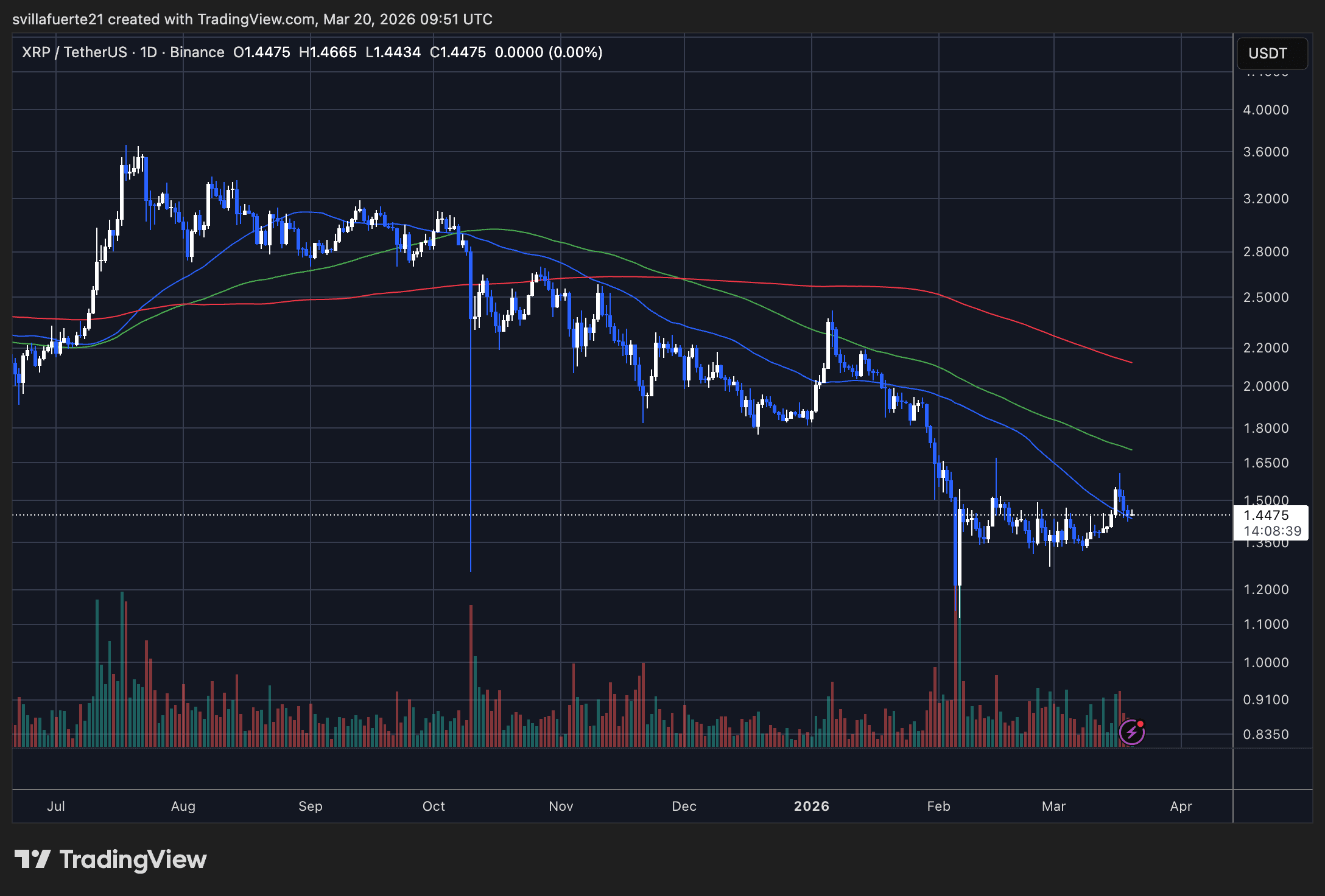
The broader trend remains intact. XRP is still trading below all major moving averages, including the 200-day, which is trending downward and acting as a key resistance level. The shorter-term averages are also declining, reinforcing the view that momentum remains weak despite recent consolidation.
Price action over the past weeks shows repeated rejections near the $1.50 level, indicating that this zone is functioning as a short-term resistance barrier. At the same time, the $1.30–$1.35 region has provided consistent support, forming a narrow trading range.
Volume analysis adds nuance. The capitulation event in February was accompanied by a significant spike in volume, while the current consolidation phase shows reduced activity, suggesting a lack of strong conviction from both buyers and sellers.
Featured image from ChatGPT, chart from TradingView.com