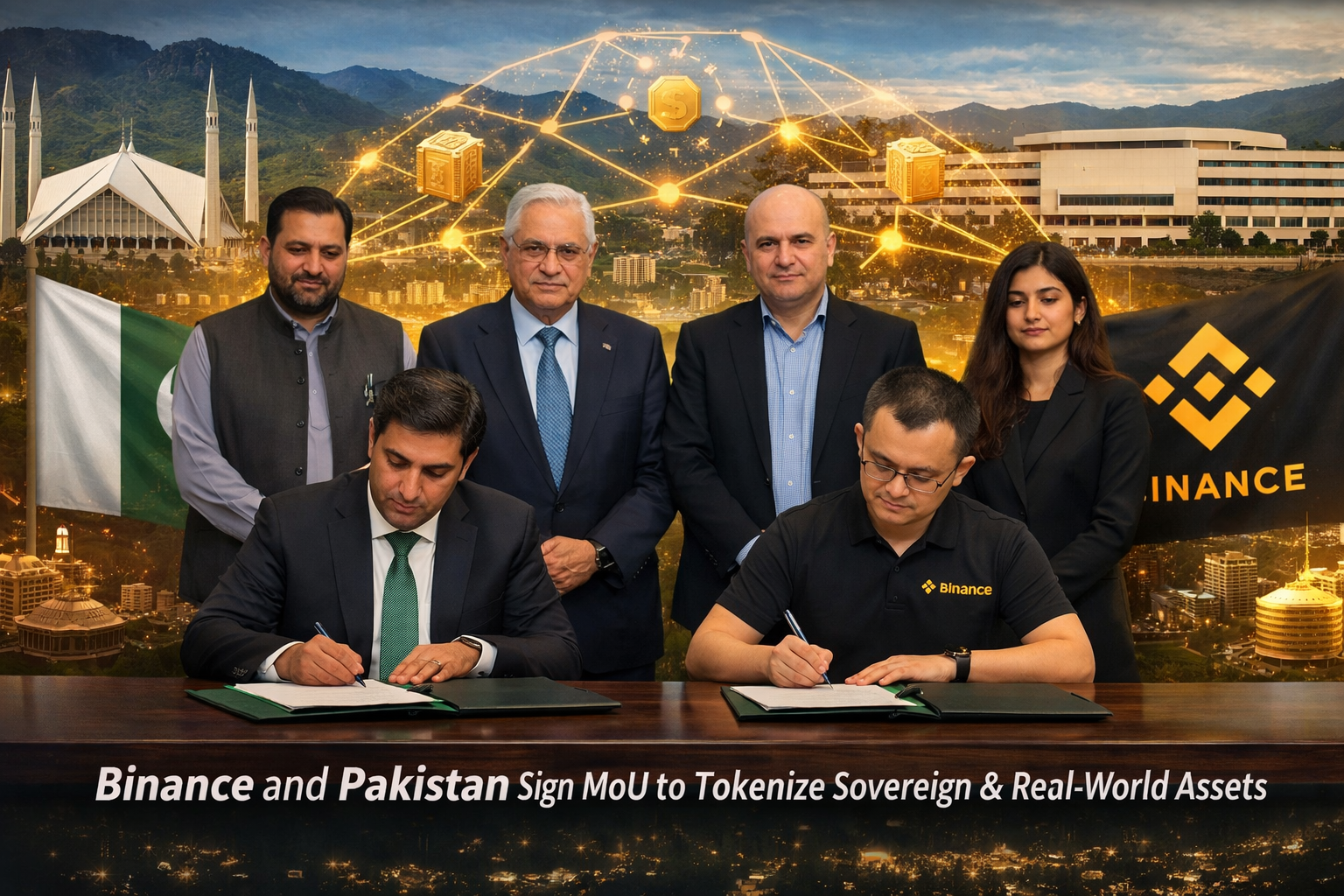
In a landmark move that underscores the accelerating convergence of public finance and blockchain technology, Binance and the Government of Pakistan have signed a Memorandum of Understanding (MoU) to explore the tokenization of sovereign and real-world assets (RWA). According to reports, the initiative could cover up to $2 billion worth of assets, marking one of the most ambitious public-sector tokenization explorations to date.
This development is more than a regional experiment—it represents a growing global shift toward blockchain-enabled capital markets, where governments, institutions, and investors are increasingly recognizing the efficiency, transparency, and liquidity benefits of tokenized assets.
A Major Signal for Public-Sector Blockchain Adoption
While private institutions and fintech firms have dominated the early phases of asset tokenization, sovereign participation has been comparatively limited. Pakistan’s decision to collaborate with Binance—a global leader in digital asset infrastructure—signals a new phase of public-sector engagement with blockchain technology.
Under the MoU, both parties will explore frameworks for tokenizing government-backed instruments and real-world assets, potentially including:
-
Sovereign bonds
-
Infrastructure-linked assets
-
State-owned real estate
-
Public investment projects
By placing these assets on blockchain rails, Pakistan aims to modernize its financial infrastructure while expanding access to capital markets beyond traditional intermediaries.
Why Tokenizing Sovereign Assets Matters
Tokenization converts real-world or financial assets into digital tokens recorded on a blockchain. For sovereign entities, this approach offers several strategic advantages:
1. Improved Transparency and Trust
Blockchain-based records provide immutable, auditable transaction histories—an attractive feature for governments seeking to strengthen investor confidence and reduce opacity.
2. Broader Investor Access
Tokenized sovereign assets can be fractionalized, lowering minimum investment thresholds and enabling participation from a wider pool of domestic and international investors.
3. Faster Settlement and Reduced Costs
On-chain issuance and settlement can significantly reduce administrative overhead, settlement delays, and reliance on multiple intermediaries.
4. Enhanced Liquidity
Tokenized assets can be traded on compliant digital marketplaces, potentially creating secondary liquidity for traditionally illiquid public assets.
Binance’s Expanding Role in RWA Infrastructure
For Binance, the partnership aligns with its broader strategy to support real-world asset tokenization and regulated blockchain adoption. Beyond being a crypto exchange, Binance has increasingly positioned itself as an infrastructure provider capable of supporting governments, institutions, and enterprises entering the digital asset economy.
This MoU reinforces Binance’s role in:
-
Designing tokenization frameworks
-
Advising on compliance-ready blockchain architecture
-
Supporting secure custody and issuance models
As RWA tokenization becomes a multi-trillion-dollar opportunity, collaborations like this highlight how major platforms are moving upstream—working directly with sovereign entities rather than solely serving retail crypto markets.
Pakistan’s Strategic Motivation
Pakistan’s interest in tokenization reflects broader economic and demographic dynamics. With a young, tech-savvy population and rising digital adoption, blockchain presents an opportunity to leapfrog legacy financial systems.
Key motivations likely include:
-
Attracting foreign investment through innovative capital structures
-
Increasing efficiency in public financing
-
Enhancing financial inclusion via digital ownership models
-
Positioning Pakistan as a regional blockchain innovation hub
If successful, this initiative could serve as a blueprint for other emerging markets seeking alternative financing mechanisms in a rapidly digitizing global economy.
The Bigger Picture: Governments Enter the RWA Era
Pakistan is not alone. Globally, governments and regulators are increasingly exploring blockchain-based solutions for public finance. From tokenized treasury instruments to digital infrastructure bonds, the concept of on-chain sovereign assets is gaining momentum.
This MoU fits into a broader narrative:
-
Tokenized investment funds are moving on-chain
-
Real estate and infrastructure assets are becoming digitally divisible
-
Digital ownership models are reshaping how capital is raised and deployed
What makes this case notable is its scale and public-sector focus, signaling that tokenization is no longer a fringe experiment but a serious policy consideration.
Challenges Ahead
Despite the promise, execution will be critical. Tokenizing sovereign assets raises complex questions around:
-
Regulatory compliance
-
Investor protection
-
Cross-border legal frameworks
-
Custody and governance models
The success of this initiative will depend on how effectively these challenges are addressed—and whether blockchain solutions can integrate seamlessly with existing financial and legal systems.
The MoU between Binance and Pakistan represents a significant milestone in the evolution of tokenized real-world assets. By exploring up to $2 billion in sovereign and public-sector assets on blockchain infrastructure, Pakistan is positioning itself at the forefront of a financial transformation that could redefine how governments raise capital and manage assets.
As institutional and public-sector adoption accelerates, initiatives like this highlight a clear trend: the future of finance is increasingly on-chain, transparent, and globally accessible.
If successful, this partnership may not only reshape Pakistan’s financial landscape—but also inspire governments worldwide to embrace the next generation of digital asset infrastructure.