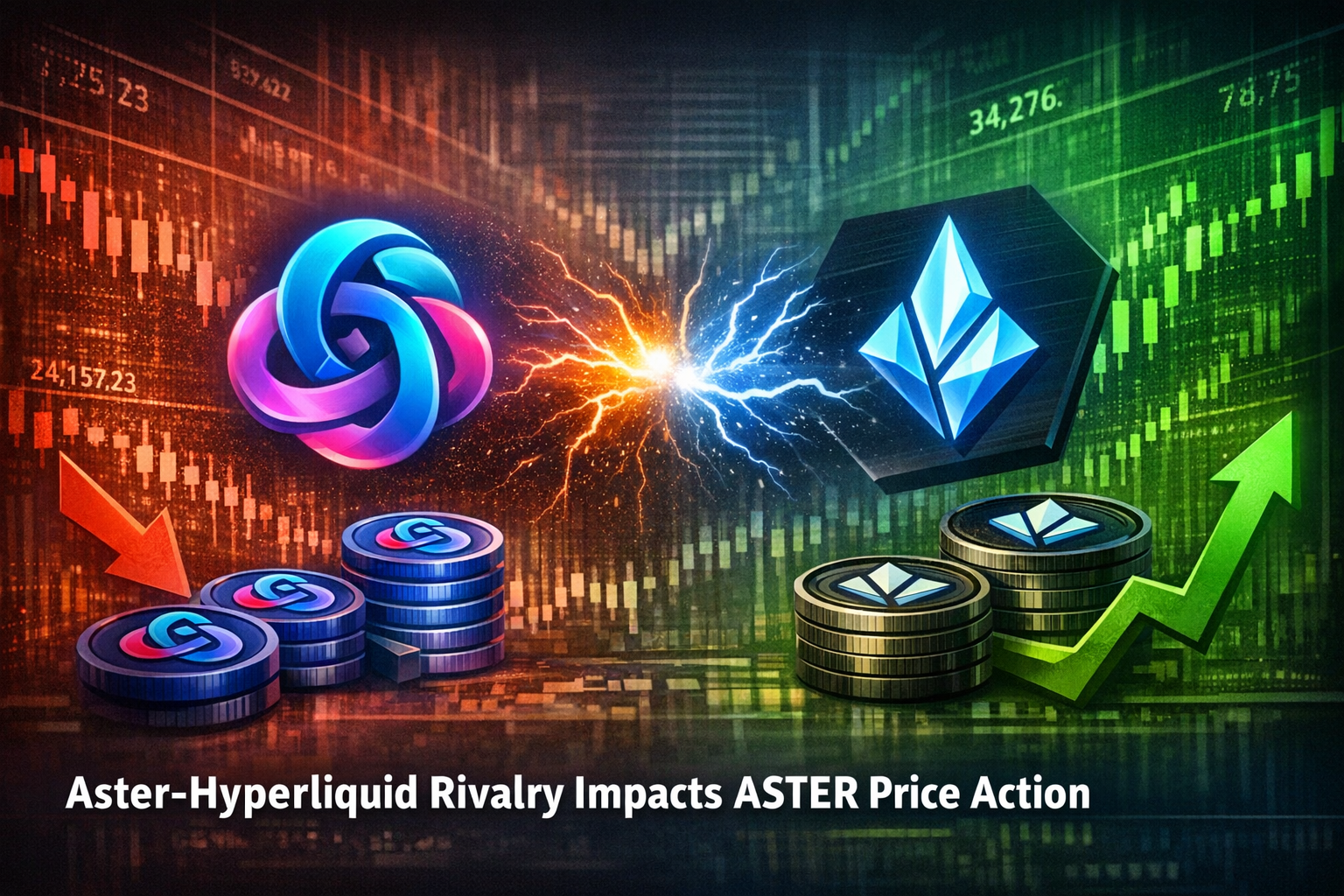
The decentralized finance (DeFi) landscape is once again reminding investors that price action rarely tells the whole story. While ASTER has recently turned bearish amid broader market weakness, the deeper narrative lies in Aster DEX’s accelerating development and its growing rivalry with Hyperliquid. Together, these forces are reshaping trader sentiment, liquidity flows, and the competitive dynamics of on-chain derivatives.
This is not just a short-term price fluctuation. It’s a structural contest for relevance in one of crypto’s most competitive verticals.
A Market Pullback Sets the Stage
Like much of the altcoin market, ASTER has faced selling pressure as macro uncertainty and declining risk appetite ripple through crypto. Bitcoin’s consolidation and reduced speculative leverage have pushed many smaller tokens into corrective phases, and ASTER has not been immune.
However, unlike purely speculative assets, ASTER’s price action is increasingly influenced by ecosystem fundamentals. Traders are watching not only charts but also protocol metrics: trading volume, active users, liquidity depth, and product releases.
In other words, ASTER’s recent weakness reflects more than market sentiment—it highlights how competition is redefining value capture in decentralized exchanges.
Aster DEX: Building Through the Downturn
Aster has positioned itself as a next-generation decentralized exchange focused on performance, usability, and capital efficiency. While prices soften, the team continues to ship infrastructure upgrades aimed at improving execution quality and onboarding more sophisticated traders.
Key areas of focus include:
-
Enhanced trading architecture, designed to reduce latency and slippage
-
Improved liquidity mechanisms, encouraging deeper order books
-
User experience upgrades, targeting both retail and professional participants
-
Ecosystem integrations, expanding Aster’s reach across DeFi
These developments matter because DeFi adoption is increasingly driven by practical performance rather than hype. Traders want fast execution, predictable fees, and reliable liquidity. Aster’s strategy appears centered on meeting these expectations head-on.
Yet progress alone is not enough in today’s market.
Hyperliquid’s Momentum Raises the Stakes
Hyperliquid has emerged as one of Aster’s most formidable competitors, gaining rapid traction thanks to its high-speed trading environment and strong early liquidity. Its growth has captured attention across crypto Twitter and trading communities, drawing volume that might otherwise have flowed into rival platforms.
This has created a clear competitive pressure point for Aster.
In DeFi derivatives, liquidity tends to be reflexive: where traders go, liquidity providers follow—and vice versa. Hyperliquid’s momentum has amplified this effect, forcing Aster to compete not just on features, but on network effects.
The result is a zero-sum dynamic in the short term. As Hyperliquid attracts activity, ASTER faces headwinds. But over the longer term, this rivalry may strengthen both platforms by accelerating innovation and raising standards across the sector.
How Competition Is Shaping ASTER Price Action
ASTER’s recent bearish movement reflects a combination of macro weakness and micro-level competition. Traders are reassessing where sustainable volume will concentrate, and that uncertainty is being priced into ASTER.
Several factors currently influence ASTER valuation:
-
Relative liquidity versus Hyperliquid
-
User growth trends on Aster DEX
-
Upcoming protocol upgrades and roadmap milestones
-
Broader market risk sentiment
Importantly, ASTER is transitioning from a narrative-driven token to a performance-driven one. Future upside will likely depend less on announcements and more on measurable outcomes such as daily active traders, total value locked, and consistent fee generation.
This marks a maturation phase for the project—and for DeFi markets as a whole.
Traders Watch Structure, Not Just Charts
Experienced participants increasingly view ASTER through a structural lens. Instead of focusing solely on short-term price levels, they are monitoring:
-
Market share among perpetual DEXs
-
Depth and resilience of liquidity pools
-
Retention of active traders
-
Integration with broader DeFi tooling
If Aster succeeds in differentiating itself through execution quality and ecosystem depth, ASTER could regain momentum even in a challenging macro environment. Conversely, failure to keep pace with Hyperliquid’s growth could extend the current consolidation phase.
Either way, the rivalry is becoming a defining feature of ASTER’s market behavior.
The Bigger Picture for DeFi
Beyond ASTER itself, this competition highlights a broader shift in DeFi. The sector is moving away from speculative experimentation toward infrastructure that must perform under real trading pressure.
Users now expect:
-
Centralized-exchange-like speed
-
Transparent on-chain settlement
-
Competitive fees
-
Robust risk management
Platforms that deliver on these expectations will capture the next wave of DeFi adoption. Those that fall behind may struggle, regardless of past hype.
In that sense, the Aster–Hyperliquid rivalry represents a healthy evolution of the ecosystem.
ASTER’s bearish price action may dominate headlines, but the underlying story is far more nuanced. Aster DEX continues to build, Hyperliquid continues to grow, and traders are actively reallocating capital based on real utility rather than promises.