
Anthropic is officially entering its ‘Thinking’ era. Today, the company announced Claude 4.6 Sonnet, a model designed to transform how devs and data scientists handle complex logic. Alongside this release comes Improved Web Search with Dynamic Filtering, a feature that uses internal code execution to verify facts in real-time.
Adaptive Thinking: A New Logic Engine
The core update in Claude 4.6 Sonnet is the Adaptive Thinking engine. Accessed via the extended thinking API, this allows the model to ‘pause’ and reason through a problem before generating a final response.
Instead of jumping straight to code, the model creates internal monologues to test logic paths. You can see this in the new Thought interface. For a dev debugging a complex race condition, this means the model identifies the root cause in its ‘thinking’ stage rather than guessing in the code output.
This improves data cleaning tasks. When processing a messy dataset, 4.6 Sonnet spends more compute time analyzing edge cases and schema inconsistencies. This process significantly reduces the ‘hallucinations’ common in faster, non-reasoning models.
The Benchmarks: Closing the Gap with Opus
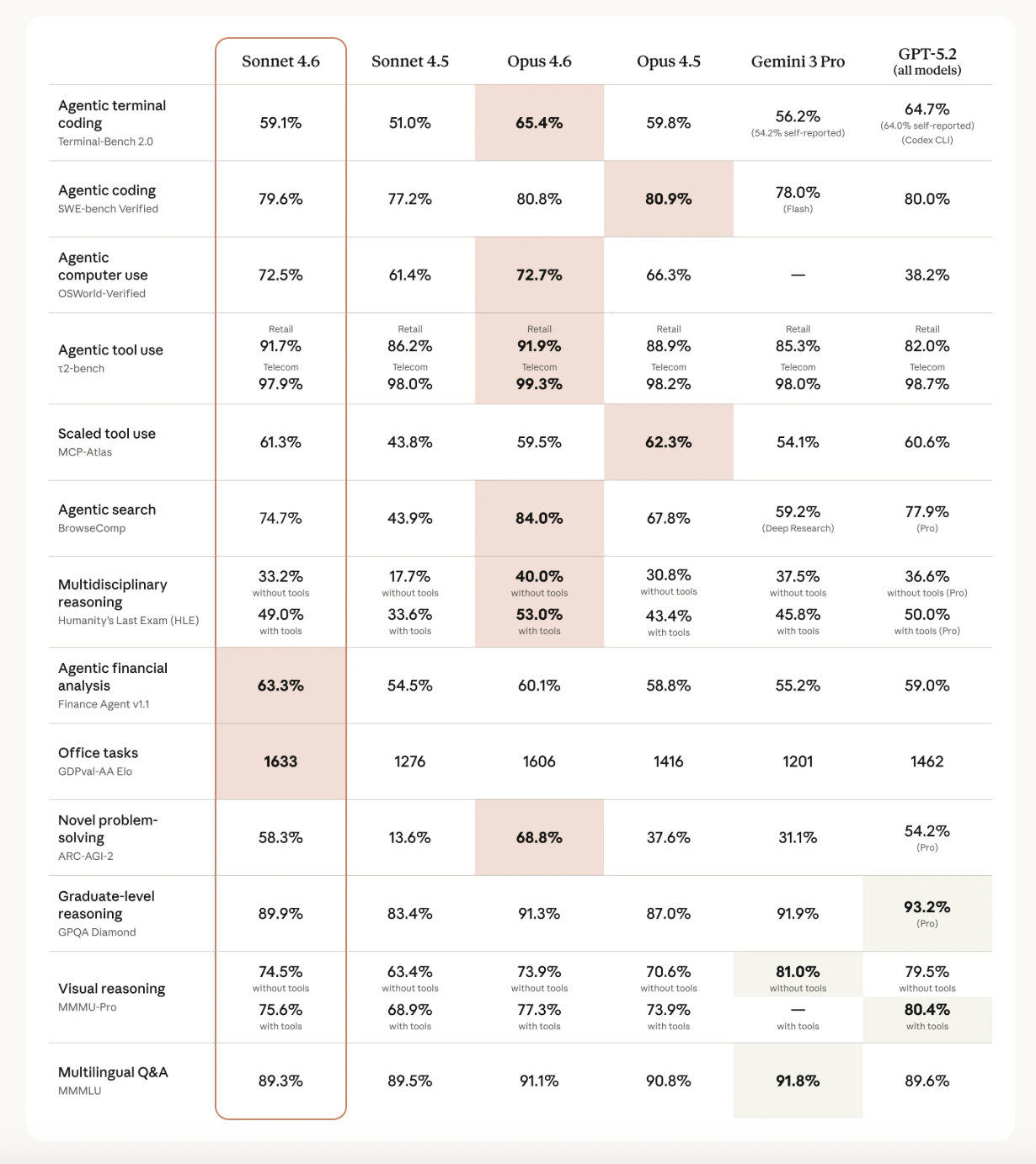
The performance data for 4.6 Sonnet shows it is now breathing down the neck of the flagship Opus model. In many categories, it is the most efficient ‘workhorse’ model currently available.
| Benchmark Category | Claude 3.5 Sonnet | Claude 4.6 Sonnet | Key Improvement |
| SWE-bench Verified | 49.0% | 79.6% | Optimized for complex bug fixing and multi-file editing. |
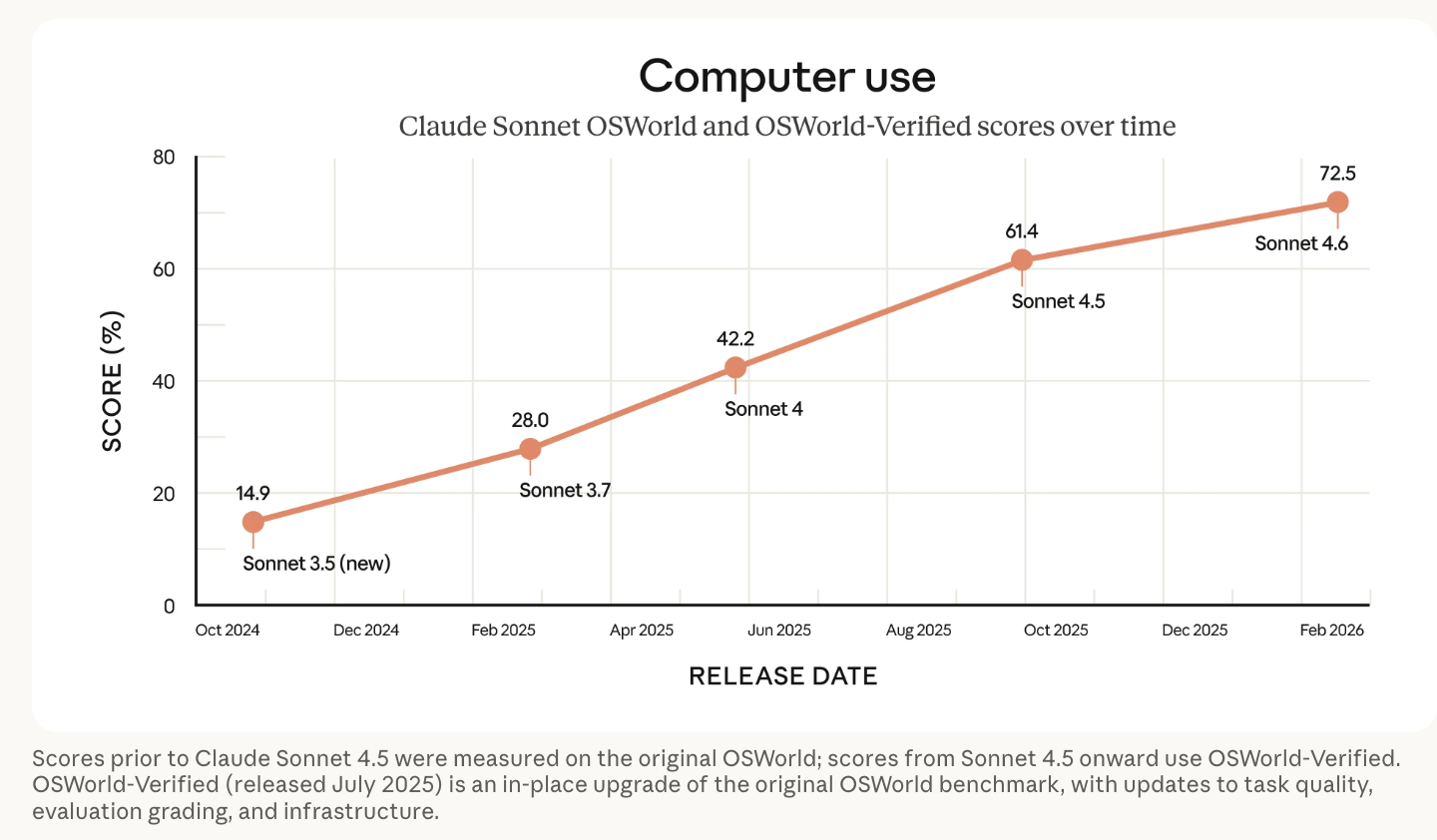
| OSWorld (Computer Use) | 14.9% | 72.5% | Massive gain in autonomous UI navigation and tool usage. |
| MATH | 71.1% | 88.0% | Enhanced reasoning for advanced algorithmic logic. |
| BrowseComp (Search) | 33.3% | 46.6% | Improved accuracy via native Python-based dynamic filtering. |
The 72.5% score on OSWorld is a major highlight. It suggests that Claude 4.6 Sonnet can now navigate spreadsheets, web browsers, and local files with near-human accuracy. This makes it a prime candidate for building autonomous ‘Computer Use’ agents.
Search Meets Python: Dynamic Filtering
Anthropic’s Improved Web Search with Dynamic Filtering changes how AI interacts with the live web. Most AI search tools simply scrape the first few results they find.
Claude 4.6 Sonnet takes a different path. It uses a Python code execution sandbox to post-process search results. If you search for a library update from 2025, the model writes and runs code to filter out any results that are older than your specified date. It also filters by Site Authority, prioritizing technical hubs like GitHub, Stack Overflow, and official documentation.
This means fewer outdated code snippets. The model performs a ‘Multi-Step Retrieval.’ It does an initial search, parses the HTML, and applies filters to ensure the ‘Noise-to-Signal’ ratio remains low. This increased search accuracy from 33.3% to 46.6% in internal testing.
Scaling and Pricing for Production
Anthropic is positioning 4.6 Sonnet as the primary model for production-grade applications. It now features a 1M token context window in beta. This allows developers to feed an entire repository or a massive technical library into the prompt without losing coherence.
Pricing and Availability:
- Input Cost: $3 per 1M tokens.
- Output Cost: $15 per 1M tokens.
- Platforms: Available on the Anthropic API, Amazon Bedrock, and Google Cloud’s Vertex AI.
The model also shows improved adherence to System Prompts. This is critical for devs building agents that require strict JSON formatting or specific ‘persona’ constraints.
Key Takeaways
- Adaptive Thinking Engine: Replacing the old binary ‘extended thinking’ mode, Claude 4.6 Sonnet introduces Adaptive Thinking. Using the new
effortparameter, the model can dynamically decide how much reasoning is required for a task, optimizing the balance between speed, cost, and intelligence. - Frontier Agentic Performance: The model sets new industry benchmarks for autonomous agents, scoring 79.6% on SWE-bench Verified for coding and 72.5% on OSWorld for computer use. These scores indicate it can now navigate complex software and UI environments with near-human accuracy.
- 1 Million Token Context Window: Now available in beta, the context window has expanded to 1M tokens. This allows AI devs to ingest entire multi-repo codebases or massive technical archives in a single prompt without the model losing focus or ‘forgetting’ instructions.
- Search via Native Code Execution: The new Improved Web Search with Dynamic Filtering allows Claude to write and run Python code to post-process search results. This ensures the model can programmatically filter for the most recent and authoritative sources (like GitHub or official docs) before generating a response.
- Production-Ready Efficiency: Claude 4.6 Sonnet maintains a competitive price of $3 per 1M input tokens and $15 per 1M output tokens. Combined with the new Context Compaction API, developers can now build long-running agents that maintain ‘infinite’ conversation history more cost-effectively.
Check out the Technical details here. Also, feel free to follow us on Twitter and don’t forget to join our 100k+ ML SubReddit and Subscribe to our Newsletter. Wait! are you on telegram? now you can join us on telegram as well.
The post Anthropic Releases Claude 4.6 Sonnet with 1 Million Token Context to Solve Complex Coding and Search for Developers appeared first on MarkTechPost.