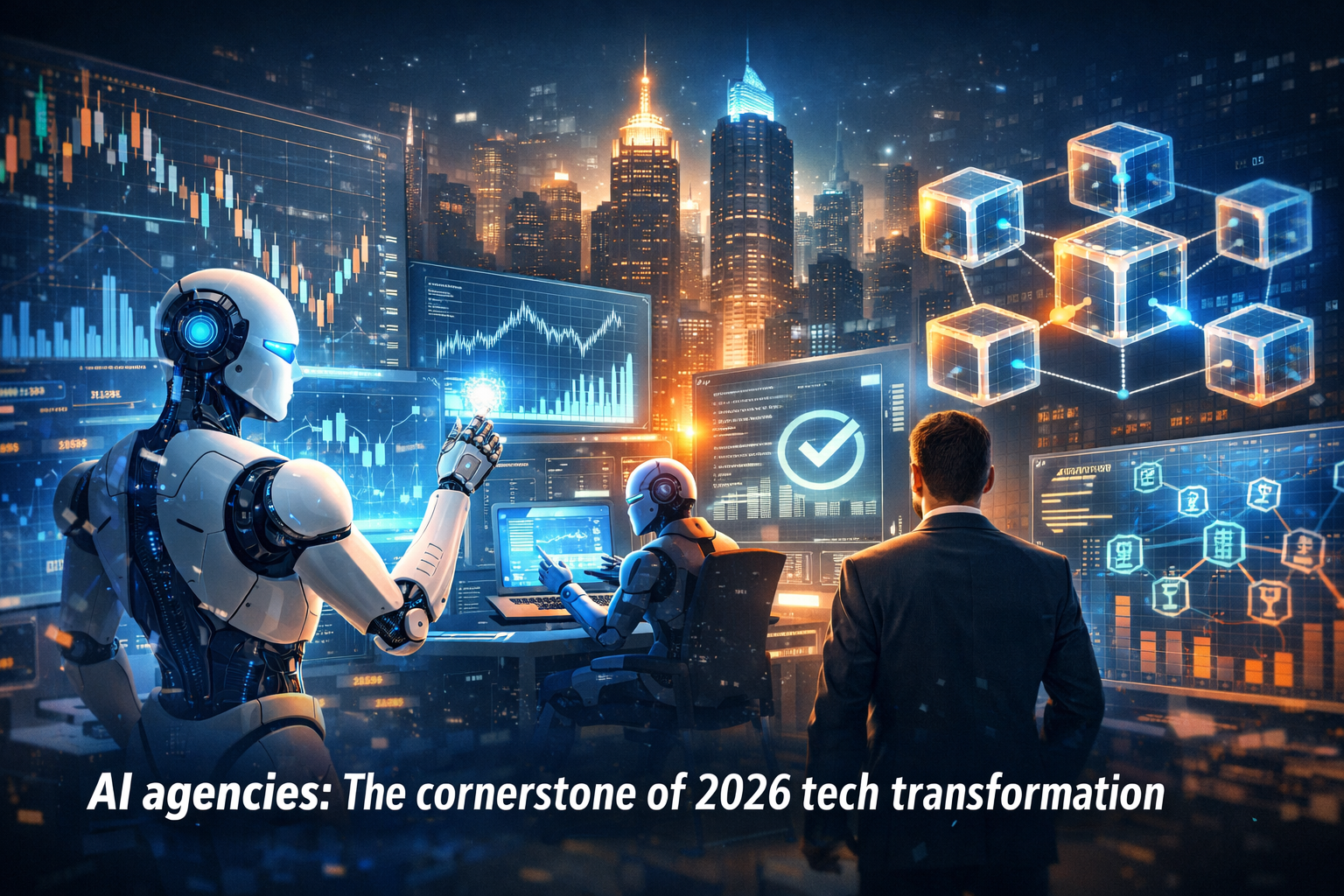
As we step deeper into 2026, a quiet but powerful shift is reshaping the digital landscape. Artificial intelligence is no longer just a tool that responds to prompts or automates isolated tasks. Instead, we’re witnessing the rise of AI agencies — autonomous, goal-driven systems capable of planning, executing, and optimizing complex workflows across industries.
These AI agent ecosystems are quickly becoming the backbone of modern productivity, redefining how businesses operate, how financial systems evolve, and how blockchain infrastructure scales. What began as experimental automation is now transforming into a new operational paradigm.
Welcome to the age of AI agencies.
From Assistants to Agencies
For years, AI existed primarily as an assistant: answering questions, generating content, or performing narrow tasks. Today’s AI agencies represent a fundamental leap forward.
An AI agency is not a single model. It’s a coordinated system of specialized agents that can:
-
Interpret objectives
-
Break them into actionable steps
-
Delegate tasks among sub-agents
-
Monitor progress in real time
-
Adapt strategies based on feedback
-
Deliver outcomes with minimal human intervention
In practical terms, this means businesses can now deploy digital workforces that operate continuously, learn from results, and improve performance autonomously.
Instead of asking AI to help with a task, organizations are increasingly asking AI to run the task entirely.
Productivity Enters a New Era
The most immediate impact of AI agencies is being felt in productivity.
Traditional automation required rigid rules and predefined workflows. AI agencies introduce dynamic intelligence. They understand context, adjust priorities, and respond to unexpected changes. This enables:
-
Automated market research and competitive analysis
-
End-to-end content pipelines, from ideation to publishing
-
Autonomous customer support operations
-
Continuous software testing and deployment
-
Intelligent supply chain optimization
Entire business processes that once required teams of analysts, operators, and managers can now be orchestrated by AI agencies working around the clock.
The result is not just efficiency — it’s a structural shift in how value is created.
Human teams are increasingly focused on strategy, creativity, and oversight, while AI handles execution at scale.
Financial Services Lead the Charge
Few sectors are embracing AI agencies as rapidly as finance.
Banks, hedge funds, and fintech platforms are deploying autonomous agents to manage portfolio rebalancing, risk assessment, fraud detection, and customer onboarding. These systems can analyze massive datasets in real time, respond instantly to market movements, and continuously refine their models.
Algorithmic trading has existed for years, but AI agencies take this further by coordinating multiple strategies simultaneously, dynamically reallocating capital, and learning from every transaction.
In compliance and operations, AI agencies are streamlining KYC processes, monitoring regulatory changes, and flagging anomalies long before they escalate into systemic risks.
Finance is becoming less reactive and more predictive — powered by autonomous intelligence.
Blockchain Verification and Trust at Scale
Blockchain ecosystems are another area where AI agencies are proving indispensable.
As decentralized networks grow, so does their complexity. Verifying transactions, auditing smart contracts, monitoring network health, and detecting malicious activity all demand constant attention.
AI agencies are stepping in to provide:
-
Automated smart contract audits
-
Real-time anomaly detection across blockchains
-
Continuous liquidity monitoring
-
Validation of cross-chain transactions
-
Optimization of gas fees and execution paths
In tokenized asset markets and decentralized finance, AI agencies act as tireless guardians, helping maintain integrity, transparency, and efficiency.
This fusion of AI and blockchain is laying the groundwork for truly autonomous financial infrastructure — systems that can self-monitor, self-correct, and self-optimize.
The Rise of Autonomous Enterprises
Perhaps the most transformative implication of AI agencies is the emergence of what many call autonomous enterprises.
These are organizations where large portions of operations are handled by interconnected AI systems. Marketing, sales, customer support, accounting, and even strategic planning can be partially automated and coordinated by intelligent agents.
Startups can launch with lean teams and enterprise-level capabilities. Established companies can scale globally without proportionally increasing headcount.
This doesn’t eliminate human roles — it redefines them.
Leadership becomes about vision and governance. Teams focus on innovation and relationship-building. AI agencies manage execution.
The company itself becomes a hybrid organism: part human, part machine.
Challenges on the Road Ahead
Despite their promise, AI agencies also introduce new challenges.
Governance is a major concern. Autonomous systems making real-world decisions require clear accountability frameworks. Businesses must define boundaries, escalation paths, and ethical guidelines.
Security is another critical issue. AI agencies interact with sensitive data and financial systems, making them high-value targets for cyberattacks. Robust safeguards, continuous monitoring, and transparent auditing are essential.
There’s also the question of interoperability. As different platforms deploy their own AI agencies, standardization becomes necessary to ensure seamless collaboration across ecosystems.
And finally, there’s trust. Users and regulators alike must gain confidence in systems that operate with increasing independence.
The success of AI agencies in 2026 will depend not only on technical capability, but on responsible deployment.
A Defining Technology of 2026
Every technological era has its defining innovation. For the early 2010s, it was mobile. For the late 2010s, cloud computing. For the early 2020s, generative AI.
In 2026, that defining force is shaping up to be AI agencies.
They represent the transition from intelligent tools to autonomous systems — from assistance to action.
Across finance, blockchain, enterprise operations, and beyond, AI agencies are becoming the invisible infrastructure powering the next wave of digital transformation.
Organizations that embrace this shift early will unlock unprecedented speed, scalability, and adaptability. Those that hesitate may find themselves struggling to compete in a world where intelligence no longer sleeps.