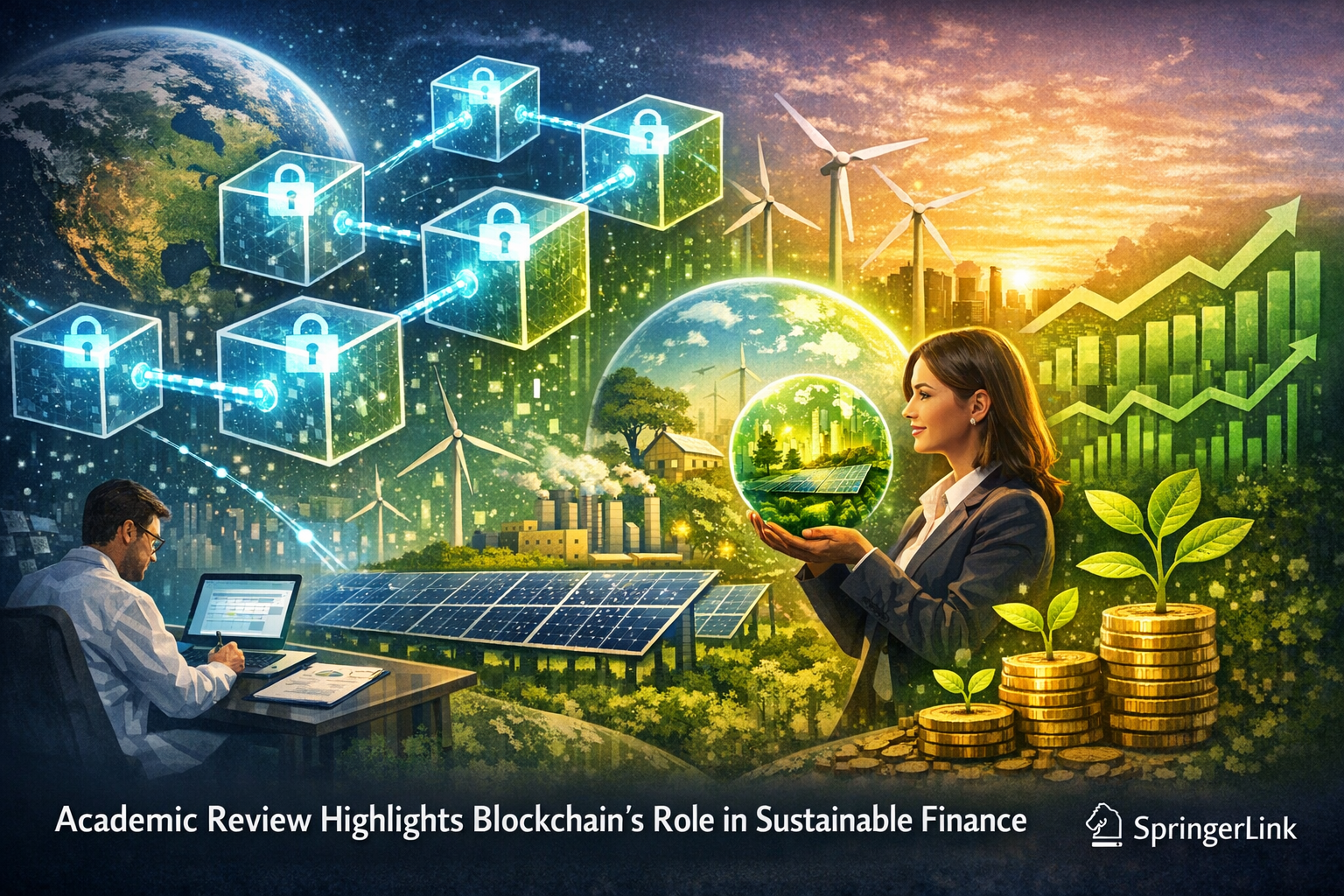
In recent years, sustainable finance has moved from a niche concept to a central pillar of global economic strategy. Governments, financial institutions, and corporations are increasingly aligning capital allocation with environmental, social, and governance (ESG) objectives. A comprehensive academic review published on SpringerLink now adds strong scholarly weight to this transformation, highlighting blockchain technology as a key enabler of regenerative finance—a model that goes beyond minimizing harm and actively restores social and environmental systems.
The study provides a systematic overview of how distributed ledger technologies are reshaping sustainable finance by improving transparency, accountability, and trust across complex financial ecosystems. Rather than framing blockchain as a speculative or purely technical innovation, the research positions it as an infrastructure layer capable of fundamentally improving how sustainability goals are financed, measured, and enforced.
From Sustainable Finance to Regenerative Finance
Traditional sustainable finance focuses on reducing negative externalities—lower emissions, ethical supply chains, and responsible governance. Regenerative finance (often referred to as ReFi), however, takes this one step further. Its goal is to actively regenerate natural and social capital, funding projects that restore ecosystems, empower communities, and create long-term resilience.
The academic review argues that blockchain is uniquely suited to support this shift. Regenerative finance requires precise tracking of impact, long-term accountability, and verifiable data across multiple stakeholders. These requirements have historically been difficult to meet using centralized systems. Blockchain’s decentralized, tamper-resistant architecture directly addresses these limitations.
Transparency as the Foundation of Trust
One of the study’s central findings is the role of blockchain in enhancing transparency. ESG claims often suffer from information asymmetry, inconsistent reporting standards, and greenwashing risks. Blockchain-based systems allow environmental and social data—such as carbon credits, renewable energy generation, or biodiversity metrics—to be recorded immutably and audited in real time.
This transparency does not only benefit regulators and investors. It also empowers end users, communities, and NGOs to independently verify claims and outcomes. By reducing reliance on opaque intermediaries, blockchain strengthens trust across the entire sustainable finance value chain.
Smart Contracts and Automated Accountability
The review highlights smart contracts as a major innovation driving regenerative finance forward. Smart contracts enable automated execution of financial agreements once predefined sustainability conditions are met. For example, funds can be released only when verified emissions reductions occur, or interest rates can dynamically adjust based on ESG performance.
This automation reduces administrative costs, minimizes human error, and—most importantly—aligns financial incentives directly with real-world impact. The academic analysis suggests that such mechanisms could significantly improve capital efficiency in sustainability-linked financing instruments.
Tokenization of Real-World Impact
Another key theme in the study is the tokenization of sustainable assets and outcomes. Tokenization allows real-world assets—such as renewable energy infrastructure, reforestation projects, or water conservation initiatives—to be represented digitally on a blockchain.
This approach increases liquidity, lowers barriers to entry for investors, and enables fractional ownership of impact-generating projects. According to the review, tokenization has the potential to democratize access to sustainable investments while simultaneously improving impact measurement and reporting accuracy.
Challenges and Responsible Implementation
While the academic review is largely optimistic, it also emphasizes the importance of responsible implementation. Issues such as regulatory uncertainty, interoperability between blockchains, data quality, and energy consumption must be carefully addressed. The study stresses that blockchain is not a standalone solution, but a complementary tool that must work alongside robust governance frameworks and standardized ESG methodologies.
Importantly, the researchers note that technological design choices—such as energy-efficient consensus mechanisms—play a crucial role in ensuring that blockchain-based systems genuinely support sustainability goals rather than undermine them.
A Converging Future for Finance and Technology
The overarching conclusion of the review is clear: blockchain is emerging as a foundational technology for the future of sustainable and regenerative finance. By merging financial incentives with transparent, verifiable impact data, distributed ledger technology enables a more accountable and outcome-driven financial system.
As climate risks intensify and social inequalities persist, the integration of blockchain into sustainable finance is no longer a theoretical concept—it is rapidly becoming a practical necessity. Academic research such as this provides a critical evidence base, helping policymakers, institutions, and innovators design systems that channel capital toward measurable, long-term positive change.
The convergence of blockchain and sustainable finance represents more than a technological evolution. It signals a deeper transformation in how value is defined, measured, and preserved in the global economy.